E-Paper



When Britain went to sleep on September 2 and woke up 11 days later
How did this happen? Did a whole country go into a deep slumber for 11 days?

 Prefer HTon Google


Nearly 300 years ago, on this day, Britain and its colonies experienced a bizarre loss of time when they skipped 11 days overnight. The country, along with its colonies, including India, went to sleep on September 2 and woke up on September 14 in the year 1752.
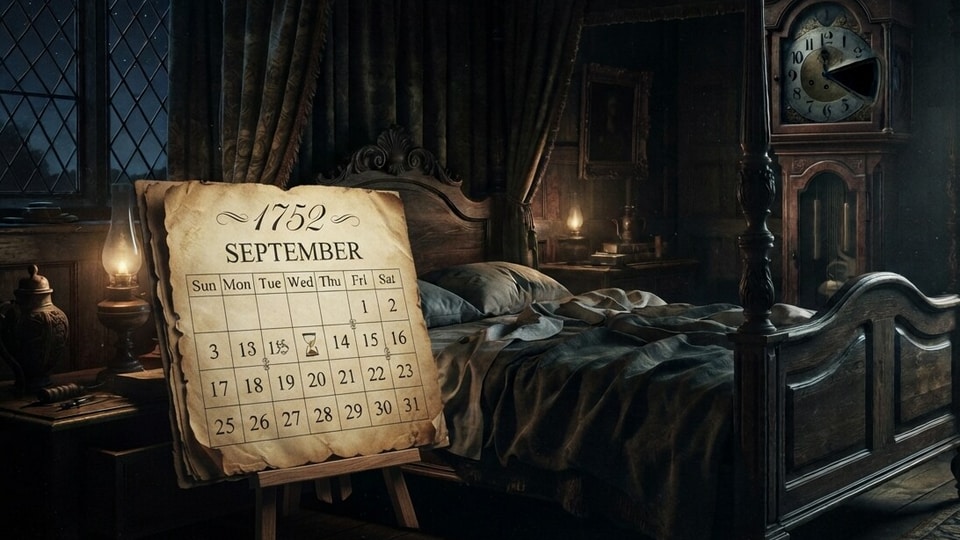
How did this happen? Did a whole bloc of nations go into a deep slumber for 11 days? Well, no, that would be very spooky.
As bizarre as it sounds, the reason behind the loss of 11 days was deceptively ordinary. Britain jumped 11 days ahead due to a change in the system of calculating days, weeks and months in a year.
ALSO READ: Did you know the term 'Artificial Intelligence' was coined 71 years ago?
In 1752, Britain decided to implement the Calendar (New Style) Act 1750 and switched from the Julian to the Gregorian calendar, which is followed globally till date, according to information widely available on the internet.
Due to this change in the calendar system, September 2 was followed by September 14, effectively removing 11 dates.
When did countries switch to Gregorian calendar
With this switch in calendar system, Britain and its colonies fell into line with Western Europe. France, Spain, Italy, Portugal and Poland were among the first nations to adopt the new calendar in 1582. Turkey became the last country to officially adopt the Gregorian calendar, much later on January 1, 1927.
Why countries adopted Gregorian calendar
The Gregorian calendar, first introduced in February 1582, was named after Pope Gregory XIII, according to Britannica. It was adopted to overcome a major calculation error in the Julian calendar which was being followed by the European countries and their colonies.
There was a miscalculation in the Julian calendar which led to an error of 1 day every 128 years. Under the Julian calendar, introduced by Julius Caesar in 46 BC, the solar year was miscalculated by 11 minutes. This led to the date of Easter moving further away from the traditionally observed date of March 21 with each passing year.
ALSO READ: NASA once sent chicken eggs to space with funding from KFC
To correct the growing discrepancy, the Gregorian calendar was introduced, a new system designed to bring the calendar back into closer alignment with the Earth’s journey around the Sun.
Unlike the calendar it replaced, the Gregorian calendar followed a solar year of 365 days, divided across 12 months. Of these, 11 months contain either 30 or 31 days, while February has only 28 days. Every four years, however, an additional day is added to February, creating a leap year with 366 days and helping keep the calendar in sync with the seasons.
What changed with adoption of Gregorian calendar
As Britain switched to Gregorian calendar system, the start of the legal year changed from March 25 to January 1. This resulted in the year 1751 becoming shorter, lasting just 282 days.
The Calendar (New Style) Act 1750, also known as Chesterfield's Act or the British Calendar Act of 1751, was adopted by the Parliament of Great Britain to bring about the change.
The calendar reform kept religious celebrations on their traditional dates. Christmas continued to be celebrate on December 25, while Easter continued to follow its established calculation. However, civil and commercial dates, including rent payments, salaries, contracts and market days, were moved forward by eleven days. This prevented financial losses or gains and kept markets aligned with the agricultural seasons.