
 E-Paper



 Trending News
Where in the world is Mark Carney? Five continents and 32 countries in 113 days
The Canadian prime minister has traveled far more than most world leaders, as he cements new alliances to break the country’s reliance on the U.S.


TORONTO—Few world leaders are racking up the air miles like Mark Carney.
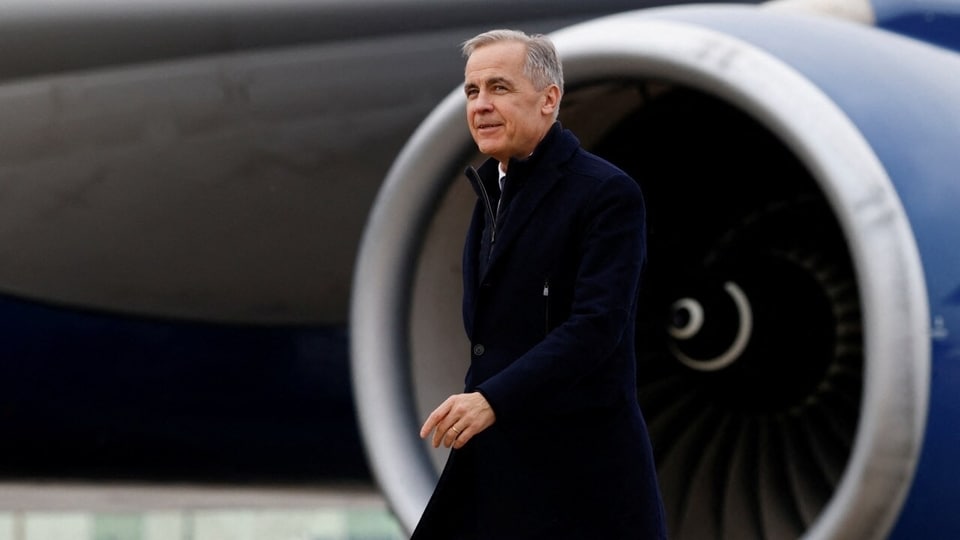
Since being sworn in as prime minister in March 2025, he has crisscrossed the globe to expand Canada’s security and trade partnerships and break its reliance on the U.S., as President Trump’s tariffs and annexation threats jeopardize North American free trade and traditionally close ties between neighbors.
Carney has visited 32 countries on all but two continents—several of them more than once. On Thursday, Carney wrapped up a whirlwind tour back and forth across the Atlantic and Pacific oceans to Ireland, Cambodia, the Philippines and China, where he announced the conclusion of negotiations on two free-trade pacts with Asian countries and expanded economic ties with China.
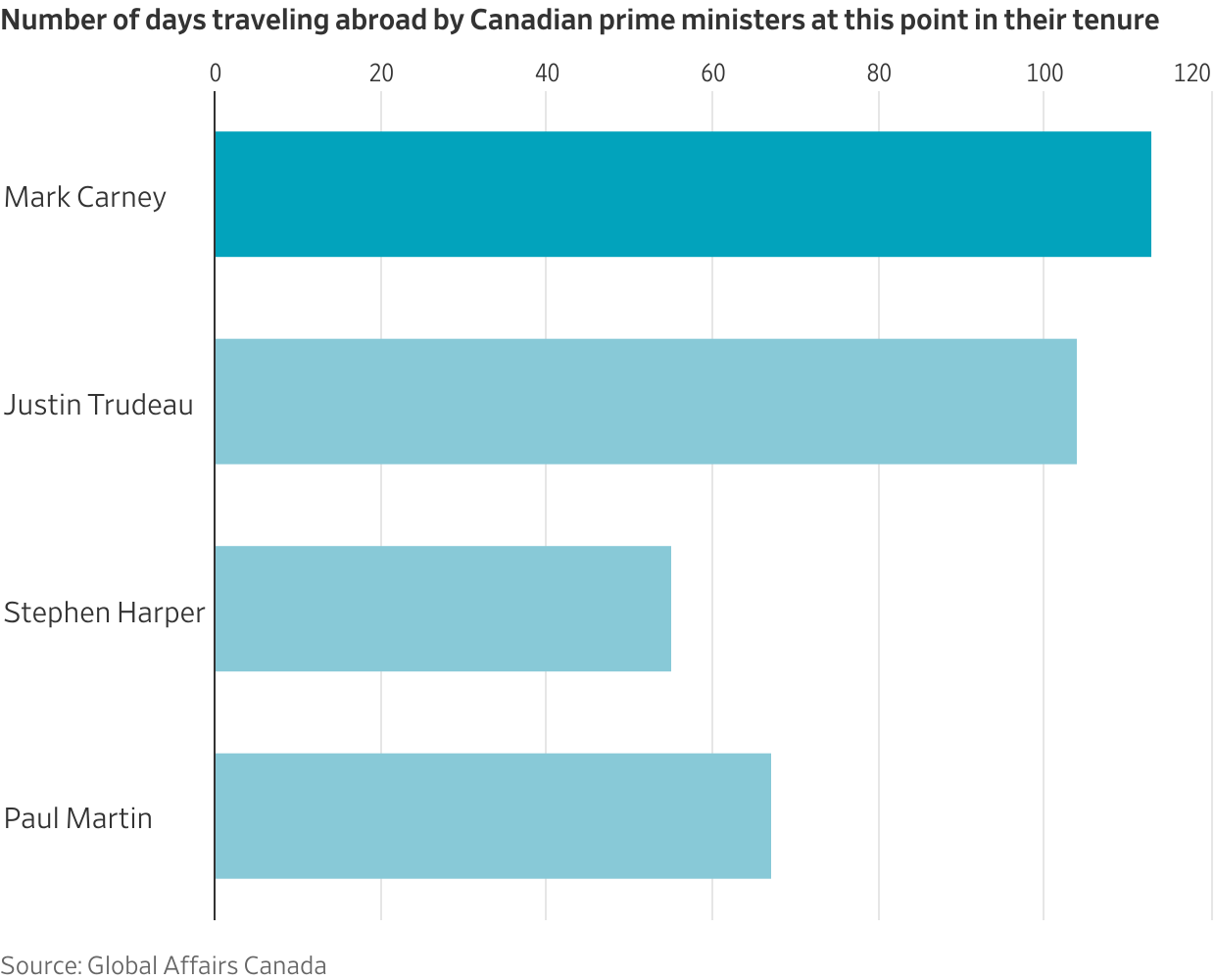
In total, the peripatetic prime minister has spent 113 days, or nearly 20% of his time in office, traveling abroad, according to data from Canada’s foreign ministry.
“It’s a part of our strategy to develop this dense web of connections to make us resilient, to make us more independent, to make us sovereign, so we can live our lives as we choose, so we’re not being told what to do by some hegemon or hyperscaler,” Carney said at a news conference in the Philippines this week.
Few world leaders have spent as much time abroad or visited as many countries over the same period, according to a Wall Street Journal analysis of government accounts, official itineraries and other records.
In his 20 months in office, Carney has spent more than twice as much time abroad than Trump during that same period and four times as much as Chinese President Xi Jinping. He has been on the move more than the leaders of India and Britain. French President Emmanuel Macron’s travel schedule rivals Carney’s, but not when short trips to nearby countries—often for European Union meetings—are excluded.
Carney is also outpacing several of his Canadian predecessors at this point in their tenure. Paul Martin spent 67 days traveling abroad. Stephen Harper logged 55. Justin Trudeau, who came to power in 2015 and pledged to re-engage with the world after what critics said was Canada’s retrenchment from the international stage under Harper, came close with 104 days.
“What’s different now is it’s less about ‘Hey, let’s go do this junket and feel good about ourselves,’ and more about the successful ability for the Carney government to have persuaded Canadians that this is imperative” because of fraying U.S. ties, said Shachi Kurl, president of the Angus Reid Institute, a pollster. “This isn’t a nice to-do. It’s a must-do.”
The question, she added, is “at what point does the accountability factor kick in? At what point do Canadians take a step back, cross their arms in front of their chest and say what have you got to show for this? That hasn’t really kicked in yet.”
Carney, who drew praise for his handling of the 2008 global financial crisis as Bank of Canada governor and for navigating Brexit as head of the Bank of England, came to office last year by pitching himself as the experienced crisis manager that Canada needed as the trade war with the U.S. sent one of the world’s closest bilateral relationships into a tailspin.
“I’m most useful in a crisis,” he said on the campaign trail. “I’m not that good at peacetime.”
Few countries are as reliant on the U.S. than Canada, which sends most of its exports to its southern neighbor. Carney, a former Goldman Sachs investment banker, has pledged to double non-U.S. exports by 2035 and has sought to leverage his extensive rolodex of contacts to get it done. In a keynote address in Davos, Switzerland, this year, he called on middle powers to unite against coercion from superpowers or “be on the menu.”
He departed on his first international trip three days after taking office. He has spent much of his time abroad in Europe, where Canada is seeking to become an “associate member” of the European Union—a status with neither precedent nor definition in the 27-member bloc—and in the Indo-Pacific region, home to several of the world’s fastest-growing economies.
The share of Canada’s exports to the U.S. is trending lower. In September 2026, it had fallen to 70% from about 76% in 2024. Exports to other countries, meanwhile, are up 50% from 2024, growth mostly fueled by an increase in gold exports and crude-oil shipments to Europe and Asia. In 2025, the non-U.S. share of Canadian exports hit its highest level in 40 years.
Canada’s federal Conservatives have criticized Carney’s international trips as “illusion tours” and costly “photo ops on the taxpayers’ dime” that have distracted the prime minister from pressing domestic concerns such as the cost of living and housing affordability or answering questions in Parliament.
“Mark Carney needs to get back home and deal with the real costs, the real struggles…here in Canada,” Conservative Party leader Pierre Poilievre said last week as Carney embarked on his latest voyage. “We don’t need any more costly global theater.”
The cost of Carney’s international travel from his swearing-in as prime minister to the end of the fiscal year on March 31, 2026, totaled more than $4 million, according to the government’s public accounts. He usually flies aboard a Royal Canadian Air Force aircraft—callsigned Canforce 1—that features a seat-back entertainment system that doesn’t always work.
Carney, who enjoys high approval ratings in public opinion surveys, has pushed back against criticism that his international trips come at the expense of addressing domestic issues.
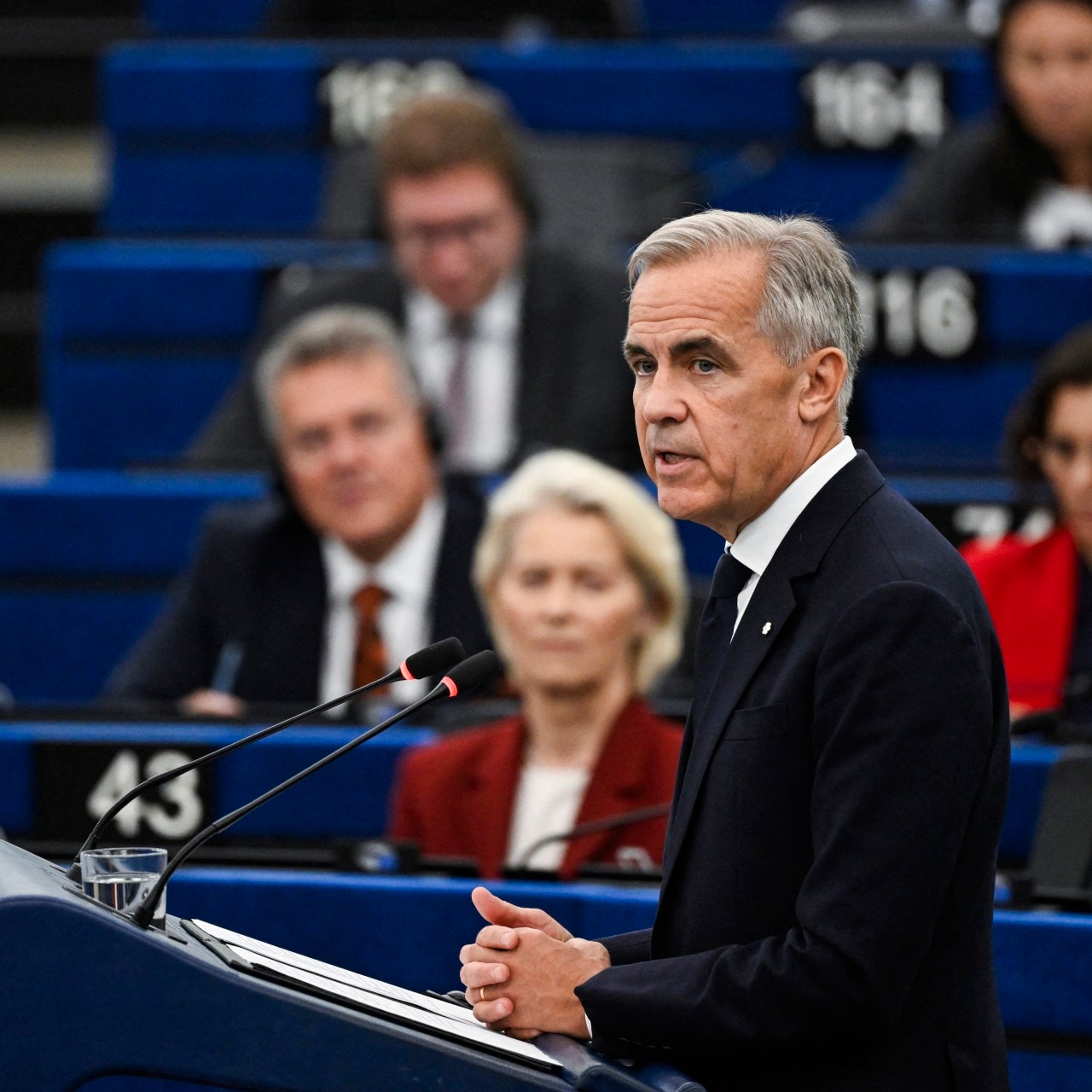
“You can do both,” he told reporters in September. “I have to do, and I am doing, both.”
An Angus Reid Institute poll this week found that around 62% of Canadians agree Carney has helped Canada’s trade relationships. But they are more divided on whether he has helped or hurt the economy, with 42% saying he has helped and 33% saying he has hurt. The rest said he has had no impact. The same survey found that the cost of living and inflation are the issues Canadians most care about.
“There is a gap,” Kurl said. “It’s one thing for Canadians to have a level of support or buy-in for the prime minister’s travel and attempts on this front versus their perception of his progress—or lack thereof—on major domestic issues.”
Write to Amanda Coletta at amanda.coletta@wsj.com


