
 E-Paper



Why China under Xi poses military threat to India
By deploying four additional combined armed brigades across India's eastern sector, China under President Xi seems to be telling Modi's India to take a step back from QUAD and the Indo-Pacific.

 Prefer HTon Google


On Wednesday, Han Chinese protests erupted in the world's biggest iPhone factory in Zhengzhou with workers clashing with Hazmat suits wearing riot police over zero Covid policy and alleged non-payment of salaries. Even though President Xi Jinping has been elected for the third term, he is the first leader facing lowest economic growth in the past four decades. The Chinese vaccines have been largely ineffective, forcing partial or total lockdown even in Beijing let alone Tibet and Muslim Xinjiang. That President Xi reached out to western leaders on the sidelines of the G-20 summit this month, clearly shows that China’s wolf warrior diplomacy has failed and its Belt Road Initiative is heading to become a nonproductive asset with countries like Nepal and Sri Lanka not interested in high interest loans from Chinese Exim Bank. However, China has increased its military budget and is baring teeth towards Taiwan and India for standing up to the authoritarian Chinese Communist regime.
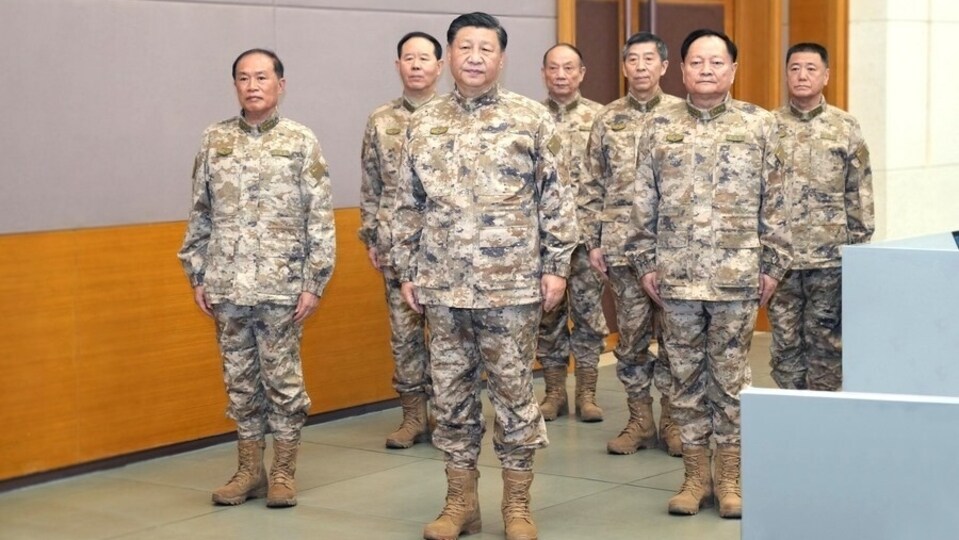
With economic growth in dire straits and internal strains erupting all over China, President Xi may do a Mao Zedong and strike a nationalist chord by forcing a military situation to digress angry domestic situations within the communist country with unemployment among youth reaching record levels. One must remember that Mao Zedong did a 1962 on India after the humongous failure of Great Leap Forward, which resulted in death of tens of millions of Chinese people due to hunger and famine. While Taiwan is under the protection of the US, it is the strategic autonomy of India that may be targeted by China in near future and that should be the cause of worry for Prime Minister Narendra Modi and his national security planners. What better way to teach QUAD a lesson than by militarily humiliating India anywhere along the 3488 km long Line of Actual Control (LAC) by intruding into Indian territory. This is not a strategic scenario but a distinct possibility if one considers the PLA, which reports directly to President Xi, moves along the LAC.
Although Chinese military spokesmen talk about stable LAC post May 2020 PLA transgressions in East Ladakh, the ground reality is very different with the PLA packed up in occupied Aksai Chin and Xinjiang region. The major worry is the deployment of additional four combined armed brigades of the PLA across the Eastern Sector as reserves a month before the 20th National Party Congress last month even as India and China are still to resolve the border issues arising out of May 2020 transgressions. The PLA combined armed brigades are essentially a battle group organized around 4500 troopers with artillery, rocket, and armor support for faster mobility during hostilities. The Indian answer to Chinese CAB are Integrated Battle Groups (IBGs), which are being rolled out first within the Mountain Corps.
According to reports, the PLA have inducted four CABs from Eastern and Southern Theatre Command and deployed them across India’s Eastern Army Sector. One brigade is deployed at Phari Dzong across the Siliguri Corridor or so-called chicken neck area, one at Tsona Dzong across Tawang sector, and two at Yanbaijan and Bayixincun near Nyingchi across the Walong sector in Arunachal Pradesh. Until such time these CABs do not move back to their original bases, the military threat to the Eastern Sector will remain high even though its ostensible purpose may be for internal duties as part of the Sinicization of Tibet.
While India has raised the issue of these battle groups with the Chinese in border meetings in the eastern sector, fact is that the CABs are still deployed in reserves with no sign of any movement back to bases. This deployment may also be a signal to India to take a step back from QUAD or take an active role in the Indo-Pacific. Given the state of economic chaos in the Indian neighborhood, China could also trigger unrest in Sri Lanka, Maldives, Nepal, Pakistan, Myanmar, Bhutan or even rattle Bangladesh.
While China under Xi is continuing to put military pressure directly and through client state Pakistan on India, it should question itself why the QUAD has gained salience in the past five years and the role played by Beijing in its resurrection. It should also remember that the more it pushes India on borders, the more India may exercise the option of leaning towards the United States as the Modi government unlike the previous UPA regime has no ideological hang-ups and works on India first principle. India , meanwhile, continues to deeply engage Russia so that it does not take the route to Beijing and starve India of crucial military supplies and platforms. However, India needs to build its military-industrial complex so that it is not dependent on any third country for crucial hardware supplies. And it here that the Indian private sector must live up to its expectations.
The Indian industry despite all the bureaucratic hurdles must manufacture within the country rather than add to an already humongous Indian trade deficit with China by importing from the adversary. The Indian bureaucracy must work with the national security planners by clearing border infra projects in a short time rather than taking through the meandering red tape route to avoid perceived post retirement complications with enforcement agencies. A classic case of this is that clearance for building a tunnel under Shinku La to pave way for an all-weather separate route to Ladakh via Himachal Pradesh is hanging fire now for over four years. The move to tweak regulation to allow private companies play a larger role in Indian defence manufacturing is also lost in files. While the bureaucracy may window dress these shortcomings as a penalty for being a democracy, the authoritarian Chinese regime is not waiting for India to catch up.


