E-Paper



Former Nepal PM Baburam Bhattarai launches new party
Nine months after he quit Nepal’s biggest Maoist party, former Prime Minister Baburam Bhattarai launched a new political outfit on Sunday.


Nine months after he quit Nepal’s biggest Maoist party, former Prime Minister Baburam Bhattarai launched a new political outfit on Sunday.
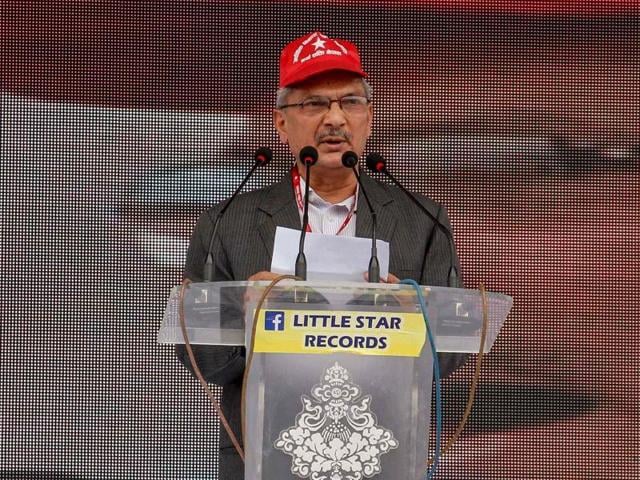
Naya Shakti Nepal was made official at a public gathering in Kathmandu’s Dasarath Stadium where Bhattarai administered oath to thousands of party members present.
“After promulgation of the constitution, the new challenge for Nepal is development and prosperity and Naya Shakti aims to lead that change,” Bhattarai stated.
The new party whose name means ‘New Power’ is urging Nepalis disenchanted with old ideologies to be part of “the movement for economic revolution” assuring “a prosperous nation is possible in our lifetime”.
The commitments made by it for a New Nepal are equitable prosperity, proportional, inclusive and participatory democracy, good governance and enhanced socialism while protecting national interests.
Bhattarai said the party has a plan to reduce poverty significantly within the next seven years, increase per capita annual income from the present $700 by 10 times within 15 years and make Nepal one of the richest countries in the world in 25 years.
“We shall strictly follow a system of ‘one person-one executive post’, and ‘one executive post—maximum two tenures’,” he said while adding the party would follow left-democratic ideals.
Bhattarai stated instead of getting squashed between its two big neighbours, India and China, Nepal can act as a “dynamic bridge” between the two and benefit from their economic development.
Once considered a Maoist ideologue, the Jawaharlal Nehru University alumnus had severed ties with Unified Communist Party of Nepal (Maoist) over ideological differences with chairman Pushpa Kamal Dahal Prachanda.
The 62-year-old had quit the party just nine days after promulgation of Nepal’s new constitution in September stating his old party wasn’t good enough for the country and a new ideology was needed.
A key architect of the constitution, he had felt that it was failure on part of the constituent assembly for not being able to address demands of Tharus and Madhesis by creating separate for them.
Bhattarai’s former party, which is part of the ruling coalition, had recently renamed itself as Communist Party of Nepal (Maoist Centre) after several other Maoist factions rejoined it.