
 E-Paper



China’s tactical play in Ladakh isn’t just about the boundary
China has amped up its presence along the Line of Actual Control around the same time that it is struggling with the Covid-19 induced surge in economic distress

 Prefer HTon Google


In the wake of the economic slowdown owing to the Covid-19 pandemic in China, paramount leader Xi Jinping and the Chinese Communist Party (CCP) are facing one of the biggest crises since the party came to power in 1949. The challenges before the party and the leader are being deliberated since May 22 at the National People’s Congress and a parallel Chinese People’s Consultative Conference, the most powerful political advisory body in the country. The move is already on to pre-emptively counter any dissatisfaction in handling the pandemic and the consequent surge in economic distress. While there is no political challenge to President Xi, who is also the Chairman of the Central Military Commission, it is the economic collapse that Beijing fears coupled with growing resentment against China, fuelling nationalism and the kindling of old Chinese fears against foreign threats.
While the NPC was called to deliberate on the next five-year development plan, the session will also provide a platform to President Xi to respond both domestically and internationally to the pandemic. The expected message will be conciliatory to the domestic audience, while the international assertion can be expected to be robust and defiant.
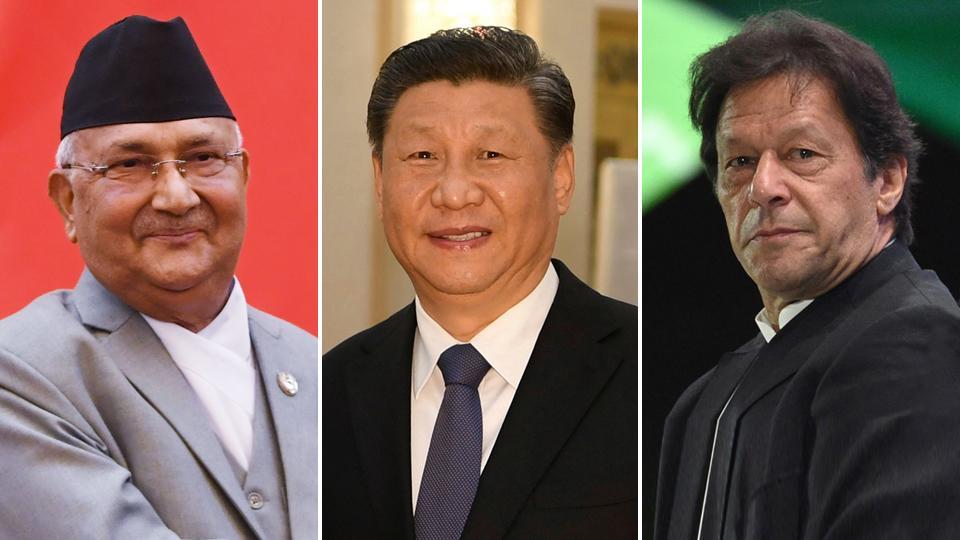
It is in this context that the current stand-off between India and China at multiple points along the 3,488 kilometre Line of Actual Control in eastern Ladakh and Sikkim should be seen. The Chinese move is multi-pronged as it not only diverts attention from the domestic economic crisis, Hong Kong and Taiwan, but is also engineered to paint India as a villain constantly at odds with Pakistan and more recently, Nepal. With China believing that India is catalyzing resentment against Beijing over poor handling of the pandemic that originated in Wuhan, the People’s Liberation Army’s tactical play along the LAC is also seen by its people as teaching a lesson to the “Gweilo Club” and its perceived proxies. The use of party tabloid Global Times to paint India as an aggressor in Sikkim and Ladakh also is designed to force India to reassess its strategy of perceived alignment with the US against China.
Even though the PLA is using a 1960 map released by then Premier Chou En Lai to present the cartographic expansion in Ladakh, there is little resemblance of the ground situation to either 1962 skirmishes or 1999 incursions in Kargil sector. The only coincidence is that President Xi may use the Ladakh military option to divert attention of his domestic audience, just as the then Chinese leader Mao Zedong used the 1962 skirmish to cover the massive Chinese famine due to failure of the Great Leap Forward revolution. Another Chinese leader Deng Xiaoping used the 1979 border war with Vietnam to divert internal dissatisfaction before embarking on economic recovery of the middle kingdom.
While Ladakh may tactically serve the political objectives of Beijing, India under Prime Minister Narendra Modi is no pushover. It is the third largest market after the US and ASEAN, and could even be the key to economic revival of China. Militarily, it serves neither the interest of China nor India to raise the red flag as there will be huge economic and political costs to such a move. Pakistan and Nepal don’t add up to cost-benefit analysis. And the Doklam stand-off message did not exactly work with Bhutan in 2017.
The fact is after the construction of strategic Darbuk-Shyok-DBO road in eastern Ladakh and rapid construction of strategic roads in both the middle and eastern sector, it is China that is concerned about India’s military objectives. At present, both sides are matching on the ground, whether it is Galwan valley or Pangong Tso lake and are constantly talking to each other through institutionalised diplomatic and military channels. With the LAC being undefined by nature at least in the western and eastern sector, the option of emphasizing its own cartographic interpretation is also available to the Indian Army.
Even though China is playing to its long-term plan to use the LAC to destabilise India, Delhi does need to get its act together when it comes to Beijing as any conciliatory move with the best of intentions will be viewed as a sign of weakness. Rather than leave it to its military or diplomatic commanders, the two leaders need to have a candid conversation on the lines of the Wuhan or Mahabalipuram dialogue to carry out course corrections and take the bilateral relationship beyond third party suspicions. This may sound simple but is terribly complex as another challenge is looming on the horizon with Tibetan leader in exile Dalai Lama, now 84 years old, and still without a designated reincarnation. The Dalai Lama’s nomination of Panchen Lama, the second most important priest after Dalai, is now 31 and still under the Chinese Communist Party’s tutelage since he went missing on May 17, 1995. Given the scale of problems involved and its impact on sovereignty of both the countries, the only option left is for PM Narendra Modi and President Xi Jinping to keep communication channels open 24 X 7. Because the NPC may get over on 28 May but China’s bilateral troubles with India won’t.


