E-Paper



After 3-0 defeat, BJP now gears up to regain its foothold in tribal areas
Some 5,000 elected representatives of the BJP will congregate in Odisha in February where the party’s agenda for tribals will be finalised.


Around 5,000 elected representatives of the Bharatiya Janata Party (BJP) from across the country will congregate in Odisha in February for a two-day conclave where the party’s agenda for the country’s tribespeople population will be finalised in time for 2019 general polls.
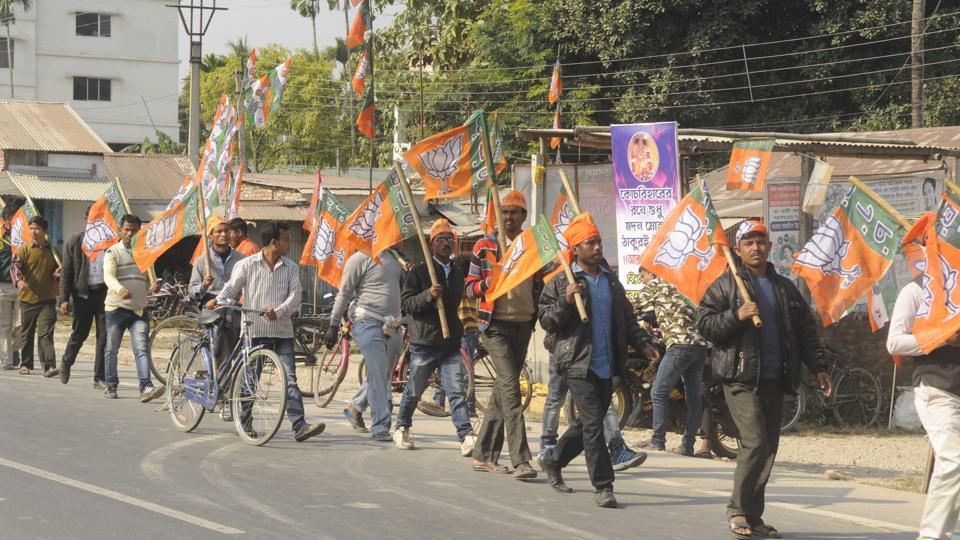
The conclave acquires importance in the face of the BJP’s performance in the tribespeople-dominated areas in the recently concluded state assembly polls in five states.
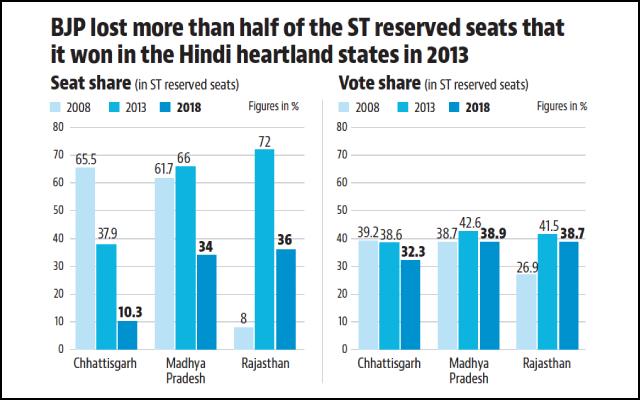
In seats reserved for the Scheduled Tribes, which have a higher share of the tribal population, the party lost both vote share and seat share in the three Hindi heartland states of Madhya Pradesh, Chhattisgarh and Rajasthan. Its performance in two of these states this time was worse than its performance there in two previous Assembly elections.
BJP won just three of the 29 seats reserved for tribespeople in Chhattisgarh, a state with about one-third of the country’s tribespeople population. In Madhya Pradesh and Rajasthan, the party won just half of the seats reserved for STs as compared to the previous election.
Sure, the party’s decline in the three states was secular across voter groups and across both urban and rural areas but the loss of the tribespeople vote is of special concern to the party and its ideological parent, the Rashtriya Swayamsevak Sangh (RSS), because the two have assiduously wooed tribes, which constitutes about 9% of the country’s population as per the 2011 Census.
The BJP’s performance in the Hindi heartland states, where it lost power, has compelled the party to rework its strategy to win the tribespeople vote.
“These votes are critical to winning in states such as Chhattisgarh, Gujarat, Rajasthan, Odisha and Jharkhand. There has been a dip in the vote share in Chhattisgarh, which the party will need to correct before we head into the 2019 elections,” said a senior party functionary who asked not to be named.
The fear is that tribespople, who were considered as the vote-bank of the Congress till the late 90s, and then gradually moved to the BJP, are now moving away from it. Another senior party leader who is also involved in framing strategy for the tribal areas said the party erred in not giving adequate representation to tribespeople.
“The Congress came up with an attractive manifesto, including the promise to waive off farm loans; but on the ground poor implementation of the centre’s policy for giving land rights to forest dwellers, ensuing minimum support price for forest produce are not being implemented; these had an impact. Also, there were also job expectations for the educated youth, which remained unmet,” the second leader said, asking not to be identified.
As per the Census 2011 over two-thirds of the country’s tribespeople population is heavily dependent on agriculture either as cultivators or as agricultural labourers, and in the absence of land rights, their dissatisfaction was accentuated.
Sanjay Kumar of the Centre for Studies of Developing Societies said the recent losses are not an indication of anger but disenchantment. “The BJP’s loss in the tribal belt in Chhattisgarh has been more as compared to Rajasthan or MP. The party has not been able to retain the momentum that it built in the tribal constituencies in 2014 and the reason for the voters to move away from the BJP is not because of any one policy; it is because of the general disenchantment that groups such as the youth and the farmers are showing towards the party that had made tall promises but has not been able to deliver much,” he said.
JC Patel, who teaches sociology at the Gujarat University, Ahmedabad, also said the shift in the tribal vote is not very significant. “Tribespeople are not moving away from the BJP in significant numbers; its a gradual shift in some areas,” he said.
A third party functionary who has worked extensively in tribal areas, however, said the party has to evolve state-specific plans, taking into account the peculiarity of the tribes and the nomadic communities to ensure that these communities do not drift away.
“Central policies have a limited impact on the lives of the tribes. For instance in Tripura which was a Left-bastion in the North-East till BJP won the election and bagged as many as 9 of 19 tribal seats, tribespeople have found representation in the government,” the third leader said.
“For the first time, there are tribespeople who have been given key ministries such as finance, power and rural development and there is a district council budget allotted too. In Chhattisgarh and MP lack of representation in critical positions had become a sore point with them,” the leader said on condition of anonymity.
The party has also received a crucial tip from the Sangh, which has a dedicated wing that works with tribal communities spread across states.
A senior Sangh functionary who asked not to be named, said in Madhya Pradesh and Chhattisgarh the leadership at the state level was not able to grasp the mood on the ground. Citing an example he said, “… When the SC (Scheduled Caste) and ST (Scheduled Tribe) communities were up in arms after the amendment to the SC/ST Prevention of Atrocities Act, the government did pass an ordinance in Parliament, but its boots on the ground could not reach out to the communities and explain why the party was not anti-reservation.”
The RSS has also flagged the absence of the ST leaders in positions of power within the party hierarchy. “In some villages in Chhattisgarh steps taken to weed out left wing extremism was based only on police action. Villagers became collateral damage and the government erred by not having a political solution to the problem,” said another functionary who is associated with a Sangh-backed think-tank.
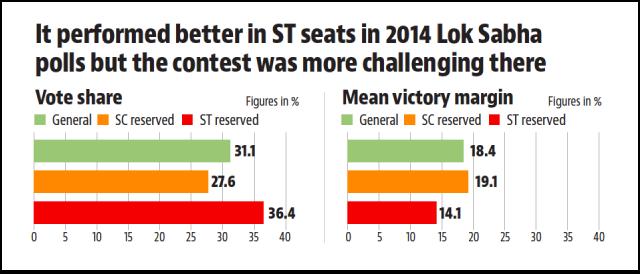
As a voter group, tribespeople are important for the BJP in the upcoming Lok Sabha elections. The party won 27 of the 41 tribal reserved seats it contested in 2014.Its vote share in these was 36.4%, which was 5.3 percentage points more than that in the unreserved seats and 8.8 percentage points more than that in the seats reserved for the SCs. However, it was more challenging for the party to win these seats as its mean victory margin there was less than that in other regions.