
 E-Paper



Elephant gets stuck in railway fencing while fleeing villagers in Karnataka, chokes to death
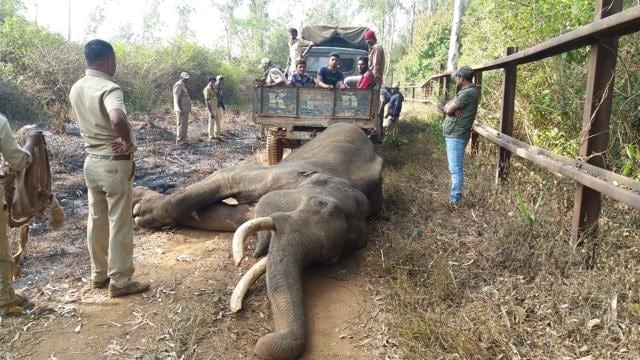
A wild elephant was killed near Karnataka’s Nagarhole National Park as it was trying to flee chasing villagers. The tusker was running back into the nearby Veeranahosahalli forest when it got trapped in the railway fencing and choked to death.

 Prefer HTon Google


A wild elephant was killed near Karnataka’s Nagarhole National Park on Saturday as it was trying to flee chasing villagers, adding to the spiralling count of deaths caused by human-animal conflicts.
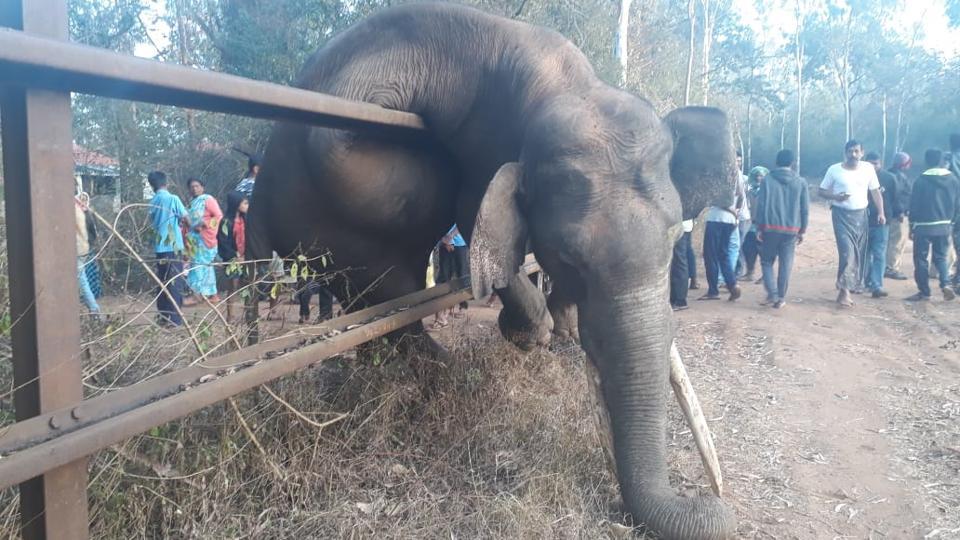
The tusker, which raided farms in Bharthawadi village in the early hours, was running back into the nearby Veeranahosahalli forest when it got trapped by the railway fencing erected by the Karnataka forest department.
As it tried to heave itself over the fence, it reportedly collapsed under its own weight and its diaphragm got crushed, after which it was unable to breathe and choked to death.
Since 2013, the Karnataka forest department has been setting up railway fencing in national parks in the state as a conflict-mitigation measure. In the first phase of the project, it erected 33 kms of fencing. A further 220 kms of fencing, to be completed with a budget of ₹220 crores, has been sanctioned.
“This is the first time we have witnessed the death of an elephant due to railway fencing. It is unfortunate and we’re going to make sure it does not happen again,” said KM Narayanaswamy, conservator of forests and field director, Nagarhole National Park.
“The fencing project, as far as I’m aware, is set to continue since it is a solution favoured by farmers in the area and, apart from today’s incident, has not affected elephants adversely,” he added.
Earlier, in November, the Supreme Court (SC) had ordered removing of spikes set up to impede elephant movement. The order came on a public interest litigation (PIL) filed by conservationist and author Prerna Bindra seeking the removal of any artificial barriers that prevent free movement of elephants.
According to guidelines issued by the Project Elephant programme, under the aegis of the ministry of environment, forests and climate change, large-scale fencing is not a solution to human-elephant conflicts. “Elephants move enormous distances and such artificial barriers do not solve any problems. In Udawalawe National Park in southern Sri Lanka, there were reports of elephants starving to death when fenced within the forest,” Bindra said.
“I think both short term and long term, multi-pronged solutions that take all stakeholders and expertise of researchers and conservationists into account is required. Not such short-sighted solutions like fencing. This is like applying a bandage to fix a deep wound,” she added.
Divya Vasudev, senior scientist at the Wildlife Conservation Society in Bengaluru, concurred. “A one-size-fits-all solution is likely not going to work. As soon as you talk about connectivity and corridors for wildlife, then you have to talk about other stakeholder engagement, working with them to allow animal movement through the land and secure connectivity while mitigating conflict,” she said.
The Nagarhole National Park is part of the largest contiguous Asiatic Elephant habitat that stretches across multiple national parks in Tamil Nadu, Kerala and Karnataka. With an estimated population of 5,500 elephants across the national parks, it is home to the largest number of elephants anywhere in Asia.
According to the forests ministry, 80 elephants have on average died every year across India in the last decade due to human-wildlife conflict. Most of these deaths are due to electrocution, train accidents, poaching and poisoning.


