E-Paper



Hingot war: 1 dead, over 36 hurt as villages attack each other with burning ‘missiles’
In Hingot war, group of villagers from two villages attack each other with burning hingots (a hollow fruit stuffed with explosive powder and hurled on the other side).

 Prefer HTon Google


One person died in Madhya Pradesh after getting injured in ‘Hingot war’, a tradition observed a day after Diwali, in Gautampura area, about 59km from Indore.
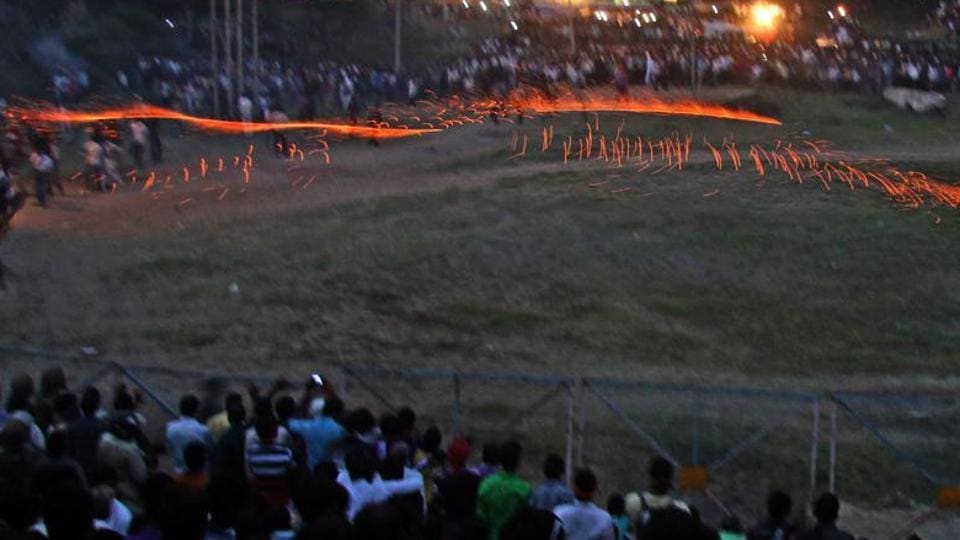
Over three dozen people were injured in the ‘Hingot war’ on Friday evening.
Three of those injured seriously were referred to Indore’s MY Hospital, where one of them died on Saturday. The deceased, who was a farm labourer, has been identified as 30-year-old Kishore Chouhan. He had come from Barwani district’s Dahta village to watch the spectacle.
In Hingot war, group of villagers from two villages — Turra group from Gautampura and Kalgi group from Rungi village — attack each other with burning hingots (a hollow fruit stuffed with explosive powder and hurled on the other side ).
Anil Kumar Verma, town inspector, Gautampura, told HT that one Kishore died and 36 others were injured in the Hingot war. He said after the post-mortem examination of Kishore’s body, it has been handed over to his family.
According to local sources, the ‘warriors’ fought the ‘Hingot war’ on Friday evening for nearly 90 minutes. Thousands of people had gathered in the village to watch the spectacle of ‘Hingot missiles’ dazzling the night sky. Every year people get injured while participating or watching this dangerous tradition. Some people have died in the past also due to injuries in Hingot war, said local sources.
Most of the three dozen injured were taken for treatment to local health facilities, while three seriously injured were rushed to the MY Hospital Indore. Kishore who died on Saturday had gone to see the spectacle when he was hit by one of the ‘Hingot missiles’. He received injuries on his head and face. After taking him to local hospital, he was referred to Indore for treatment, where he died
(with inputs from Hema Tiwari from Indore )