Sign in

Over 68,000 trees illegally axed in MP, finds CAG report

A Comptroller and Auditor General of India report has revealed that in Madhya Pradesh over 68,000 trees below the prescribed girth were felled from 2010-11 to 2014-15, taking sheen off the International Day of Forests celebrated by the forest department on Monday.

Updated on: Mar 22, 2016, 17:04:51 IST
Hindustan Times | By , Bhopal
Share
Share via
  • facebook
  • twitter
  • linkedin
  • whatsapp
Copy link
  • copy link

A Comptroller and Auditor General of India (CAG) report has revealed that in Madhya Pradesh over 68,000 trees below the prescribed girth were felled from 2010-11 to 2014-15, taking sheen off the International Day of Forests celebrated by the forest department on Monday.

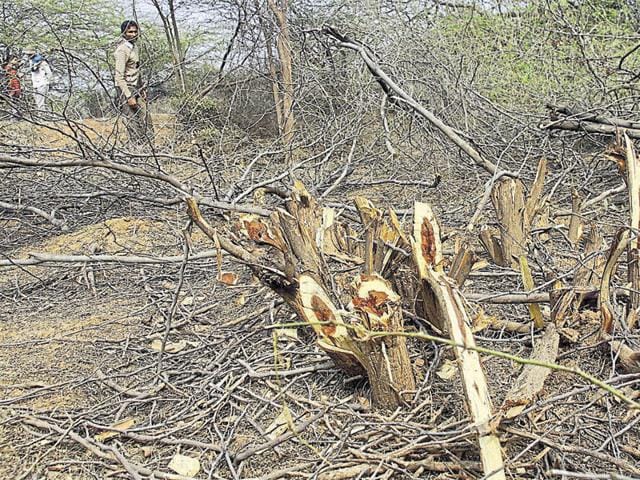
The CAG report said that in 10 of the 12 forest divisions in the state, over 1.04 lakh trees had been felled between 2010-11 and 2014-15. (Sakib Ali / File photo)

Forest working plans allow felling of mature and ill-formed trees of fixed girth to obtain optimum volume of timber. The prescribed girth is fixed by factoring the climatic region, the species among other factors. Felling trees below the selected girth is prohibited, except in cases they were dead, dying or diseased.

The CAG report, tabled in the state assembly recently, said that in 10 of the 12 forest divisions in the state, over 1.04 lakh saal, teak and other species were felled from 2010-11 to 2014-15. Of these, 68,940 trees, nearly 65% of the felled trees, were below the selected girth. The record books also did not mention if the trees were dead, dying or diseased.

The report also stated that trees were being felled in excess in the state, which gave the forest department Rs 22.8 crore revenue, but did not take care of the environmental impact.

The report says that while executing the forest working plans, the district forest officers did not account for the illicit felling and felling mandated under Forest Conservation Act, which resulted in excess felling.

CAG FINDINGS

Forest produce seized for illicit felling between 2010 and 2015 were found short on transportation to the depots, resulting in loss of Rs 64.8 lakh

E-auctioning not implemented even after nine years after its contemplation that incurred an expenditure of Rs 19.9 lakh

Forest produce lying in depots due to court cases was up to 33 year old, which was leading to a loss of nearly Rs 7 crore.

The forest department also did not record the data regarding the quantity of minerals extracted and transported through forest area from the mining department. This resulted in short recovery of transit fee for transportation of minerals by Rs 12.2 crore.

  • Neeraj Santoshi
    ABOUT THE AUTHOR
    Neeraj Santoshi

    Neeraj Santoshi is the Chief of Bureau for Hindustan Times in Uttarakhand, where he leads the state reporting team while covering government, politics, environment, wildlife, Uttarakhand High Court, and issues shaping the Himalayan region. With more than two decades in journalism across conflict zones, he has covered politically sensitive regions and environmentally fragile landscapes, and focused on stories that combine public interest with in-depth storytelling. An alumnus of Pune University with a Master’s in Communication Studies, he has reported extensively from Jammu & Kashmir (2003-2010), Madhya Pradesh (2010 to 2018 ) and Uttarakhand (Since 2018), covering subjects ranging from insurgency, elections and governance to wildlife conservation, mining, climate change, agriculture, human rights and social justice. He has covered politics and legislative assemblies of both Jammu & Kashmir and Madhya Pradesh over more than a decade. Before taking over as Chief of Bureau in Uttarakhand, he served as Special Correspondent with Hindustan Times in Madhya Pradesh and earlier reported for both Hindustan Times and The Indian Express in Jammu & Kashmir, where he covered state politics, environment and insurgency-related developments. Over the years, his stories have focused on environmental degradation, wildlife, illegal mining, governance and the changing social fabric of Himalayan states and Central India. He is particularly interested in long-form explanatory journalism, and stories that explore the intersection of ecology, conservation, governance and society. Outside the newsroom, Neeraj enjoys reading widely on neuroscience, consciousness studies, Artificial Intelligence and quantum physics, with a special interest in Kashmiri Tantric Shaivist traditions. He is also passionate about wildlife, mountaineering and the Himalayas, interests that continue to inform his reporting and deepen his understanding of the region he covers.Read More