
 E-Paper



Bihar Election 2020: NDA’s return to power gives BJP an upper hand in alliance
The BJP has never won elections in Bihar on its own. Senior party leaders explained that though over the years the party has increased its vote share in Bihar, where caste faultlines run deep, there is still lots of ground to cover


The National Democratic Alliance (NDA)’s return to power in Bihar is likely to change the nature of alliance in the state and end the Bharatiya Janata Party’s (BJP) wait to emerge as the senior partner in the equation with a vote share of 19.46% and 74 out of 124 seats.
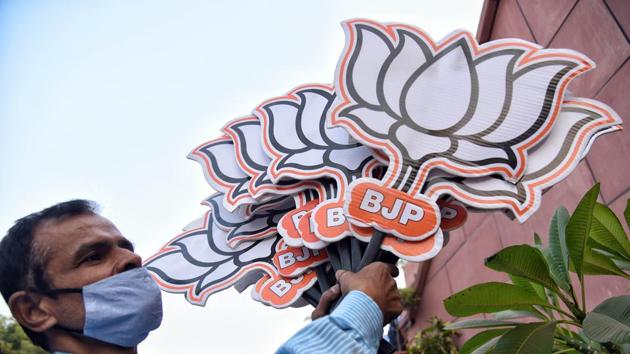
The BJP’s victory in the 2014 national elections was seen as a sign of a likely end to coalition politics and the coming together of a bunch of political outfits not necessarily tied by ideology. The unprecedented majority the party won in the 2019 elections further cemented the perception that the party did not need allies and that the compulsion to stick to coalitions was over.
But while the BJP rode to power at the Centre twice on its own, it needed alliances in a clutch of states like Bihar.
Given the caste dynamics of Bihar that it could not overcome with the goodwill it garners at the Centre and the development it promises, the BJP was compelled to partner with the Janata Dal (United), or JD(U), despite the anti-incumbency against chief minister Nitish Kumar and the demand from its own cadre to go solo.
The fraying of the equation that was rocky from the beginning was clear when the BJP cadre pushed the leadership to contest as equal partners, ally Lok Janshakti Party (LJP) rebelled and launched a tirade against Kumar. There was also a lukewarm response to the idea of a joint campaign. Yet, the BJP chose to stick to the alliance with JD(U) even though the chances of an electoral upset were far greater.
Also Read: Full coverage of Bihar assembly election 2020
The coalition is a compulsion
Senior party leaders explained that though over the years the party has increased its vote share in Bihar, where caste faultlines run deep, there is still lots of ground to cover. “It is like needing the extra 5% grace marks to pass an examination,” said a BJP leader.
The BJP commands the support of the upper castes that make up for 15% of the electorate and has been wooing the Other Backward Castes (OBCs), including the dominant Yadavs considered the Rashtriya Janata Dal (RJD)’s main support base. It needed the JD(U) to bring votes from the Extremely Backward Castes, or EBCs, (30%), the Mahadalits that together with the Dalits account for 18% of the voters, and the Kurmis (12-14%).
“Taken together the support groups of the BJP, the JD(U), the Mahadalits that support the HAM [Hindustani Awam Morcha] and the EBCs, who are drawn by the VIP [Vikassheel Insaan Party], is a formidable coalition,” said the BJP leader cited above.
Leadership lacuna
Absence of strong leadership in the state was a second reason why the BJP preferred to resurrect “sushasan babu”, a sobriquet for Nitish Kumar, and press ahead with the “double engine model”, wherein Nitish Kumar was the face of the election in the state and Prime Minister Narendra Modi its other anchor.
“While the BJP’s support base has increased even among the SCs [Scheduled Castes] and the OBCs because of central policies and welfare schemes, it still needs to address the leadership lacuna in the state. It has not cultivated a leadership that can allow it go solo,” said Patna-based political commentator Ajay Kumar Jha.
Another reason why the BJP stuck to the alliance is the acknowledgment of the regional aspirations. This acquires more significance as the party heads into polls in states such as Tamil Nadu and Kerala, where it depends heavily on alliances.
“In Bihar, for instance, the social equations are such that it necessitates the need for a triangular polity. Parties at various times have had to rely on partners to make for the absence of support from a particular social group and this also gives room to smaller parties. The BJP is not the only one; even the RJD had to join hands with JD(U) in the last election. The coalition is a compulsion in Bihar,” said a second BJP leader.
Senior partner
The BJP has never won elections in Bihar on its own. It is now expected to emerge from the shadows of the JD(U) and pitch itself as an alternative. There is a feeling in both the BJP and JD(U) that with Modi leading the charge, Kumar’s stature has diminished. And there is a growing clamour in the party to have a BJP chief minister.
But the BJP leadership has opted for a measured stance.
BJP leaders say the alliance will continue with Kumar at the helm. The party is acutely aware of the shrinking NDA, which has lost two of its oldest allies, the Shiv Sena and the Shiromani Akali Dal (SAD). The two left accusing the BJP of not taking the allies on board before pushing ahead with major decisions.
Between 2014 and 2019, several parties including the Telugu Desam Party broke ties with the NDA.
Jha said getting the bigger role will not be easy for the BJP since it wants to stay in power in the state and has the compulsion of sticking with the JD(U). “The BJP will want a larger role, but Nitish Kumar will not bow down. He has been explicitly clear that he will be chief minister even if he gets fewer seats. And there is precedence when Chandrashekhar became Prime Minister, he did not have the most seats in that alliance but his clout was more. Even in 2015 when Nitish Kumar had fewer seats, he was still the chief minister,” Jha said.
Are alliances here to stay
BJP’s Bihar unit chief Sanjay Jaiswal rubbished the speculation that the BJP wanted to emerge as the bigger partner in the alliance and therefore offered tacit support to the LJP’s attacks against JDU. He said the discourse questioning the BJP-JD(U) ties or speculating about strain in equations existed only in the media. “From the very beginning, our leaders announced that no matter what the political outcome, Nitish Kumar will be the chief minister.”
Jaiswal said they are equal partners and have fought the election on an equal number of seats both in the Lok Sabha as well as the assembly elections.
Vinay Shahsrabuddhe, BJP’s Rajya Sabha member, said alliances are here to stay and are not contingent on election results. “Alliances have their own place in the polity. And the BJP is an expert in not just making but also continuing alliances,” he said.
On the reason why the party has not been able to hold on to the allies, he said the blame for leaving the NDA umbrella rests on those who quit. “We cannot be held responsible for that. They deserted the NDA. We have been sticking to our agenda and policies. For instance, the SAD walked out on the issue of farm laws, but that was part of the manifesto. We did not do anything clandestinely and they were on board.”


