
 E-Paper



Report: A culturally enriching Marga Utsav
The one-day festival, which presented two plays, combined classical dance, stagecraft, scholarship and a deep understanding of ancient Indian performing arts

 Prefer HTon Google


On their 10th anniversary on 16th March, the Chidakash Kalalay Center of Art and Divinity, Kolkata, in collaboration with the Sangeet Natak Akademi, presented Marg Utsav, a one-day festival at Ravindra Bhavan in New Delhi. The celebration, a part of the Ministry of Culture’s Azadi Ka Amrit Mahotsav, comprised two plays, Padmaank Gatha: the Lotus Consent and Bhim Hanuman Samvad, performed back to back. While the first was directed by Piyal Bhattacharya, the second was a Nada Sutra production by Akash Mallick and Rudra Prasad Roy in Kathakali and contemporary dance inspired by Marga Natya.

Incidentally, Marga Natya is a manner of presenting theatrical performance according to Bharata’s Natyashastra (a Sanskrit treatise that dates to between 200BCE and 200CE). Building on that text, Matanga Muni later distinguished classical music as Marga as opposed to Desi, the category influenced by regional cultural nuances. Piyal Bhattacharya, who has been working on the Natyashastra for more than two decades, has reconstructed Bharata’s codification of the Marga tradition. Trained in Kathakali Vesham (acting) at the Kerala Kalamandalam, and in the Rasa, Bhava, Chitravinaya, and Samanya-abhinaya of the Natyashastra, he also plays the Rudra veena and the saung gauk (Burmese arched harp). The scholar-musician recognized by the Sangeet Natak Akademi for “Safeguarding the Intangible Cultural Heritage of India” is well versed in the pungchoba, the Saraswati veena and martial arts like Kalaripayettu and Thang Ta, and also knows Sanskrit, English, Hindi, Bengali, and Malayalam. Not surprisingly, he has infused the Marga Natya with much energy and the audience at the Marg Utsav felt like they were being transported on an upward journey.
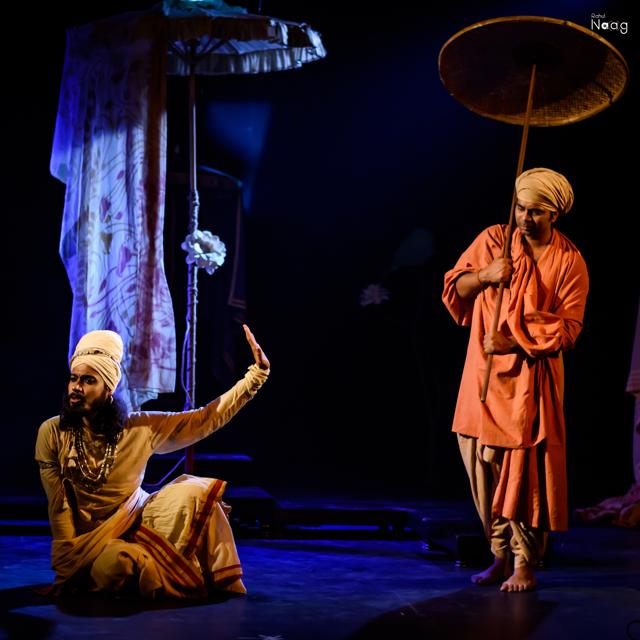
The festival’s opener Padmaank Gatha: the Lotus Consent, included a live orchestra. According to Bharatmuni, there are 10 kinds of performative modes. This one was Bhana, which deals with lighter, mundane, laukik themes. Just like a natak has a sutradhar or narrator, the bhaan has a vit or a narrator who belongs to the middle stratum of society and exposes human follies and hypocrisies in a jovial way. Dialogues form the core and the performance evokes mostly the rasas of shringar (amorous love) and veer (valour). Sayak Mitra who played Samvatsar vit, the monologist in Padmaank-Gatha, stood out for his eloquent dialogue delivery, seasoned acting, veena playing, dancing, and singing. His sahachar (companion), Madan Mohan Kumar, acting as the vidushaka, left the audience in splits. The Natya Kutap or live orchestra that played ancient instruments like the vattakokila veena created a soundscape that enhanced varied dramatic situations. The attention paid to the minutest details of stage decor, music, and the tonal quality of instruments, including the bamboo rudra veena with two large tumbas or resonators, was impressive. Even the selection of ragas like the Adi-Vasant to recreate amorous springtime and Megh to change the mood after an intense scene where an elderly character on the verge of dying asserts, “Naatyopaasana hi mama dharmah; I have adhered to my duties as an actor all along and would do so till I die”, was exemplary.

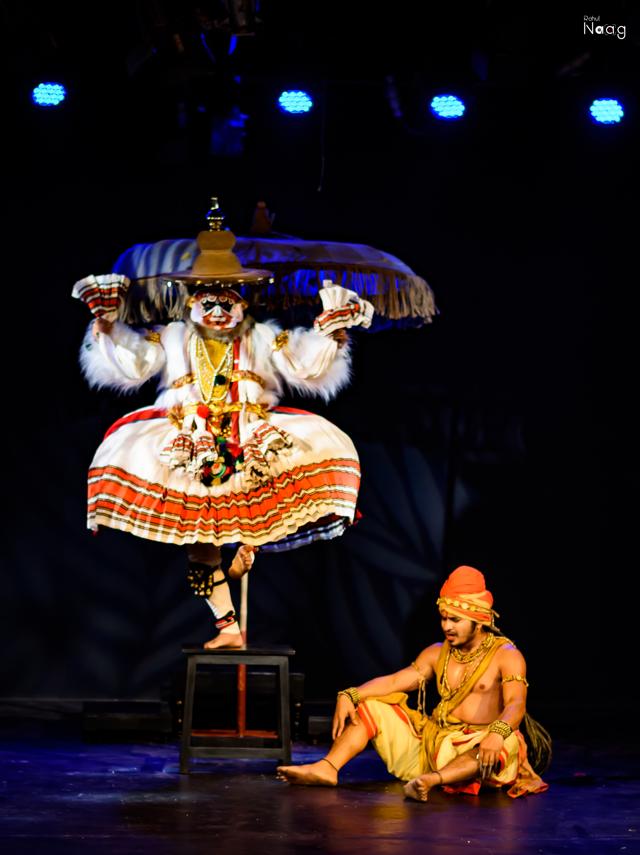
The other presentation, Bhim Hanuman Samvad combined the adaptation of Kottayathu Thampuran’s traditional Kathakali play Kalyan-Saugandhikam with Saugandhika Haranam a 14th century Sanskrit play by Kaviraj Vishwanath. Here, two distinct dance forms merge as Akash Mallick, playing Hanuman, performed in Kathakali and Rudra Prasad Roy, playing Bhima, executed contemporary dance movements. While the Kathakali aspect had musical support by Kalamandalam Abhishek Kunhiraman on chenda, Kalamandalam Vishnu Dathan on maddalam and Kalamandalam Shyam Kishore on vocals, the music for Bhima included Abhijit Roy on kachchhapi veena, Jay Dalal on pakhawaj, Kalamandalam Vivek on mizhavu and Sayak Mitra on vocals. Here, Sunil Sunkara’s eloquent anchoring also deserves a special mention.
The Chaidakasha Samman ceremony that honoured the cultural contributions of classical dancer Sonal Mansingh, musicologist Bharat Gupta, performer Bipin Kumar and this critic too, was held between the two performances.
All in all, the Marga Utsav, was thought provoking, culturally enriching and deeply engaging.
Manjari Sinha is a senior music critic
The views expressed are personal


