
 E-Paper



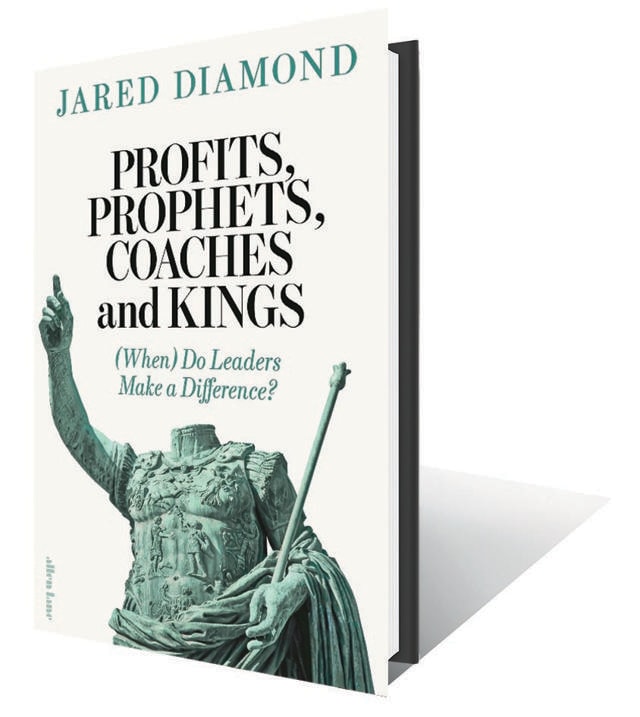
Review: Profits, Prophets, Coaches and Kings by Jared Diamon
The Pulitzer Prize-winning author’s new book looks at success and failure and ponders about the particular circumstances that allow a leader to make an impact

 Prefer HTon Google


Would Genghis Khan have founded the Mongol empire if he were born just a few decades earlier? Would there have been an environmental revolution without Rachel Carson? And can a sports team change its winning rate just by hiring a great coach? These are some of the questions Pulitzer prize-winning author and scientist Jared Diamond attempts to answer in his latest book Profits, Prophets, Coaches and Kings.

While the answers are not the most satisfying, what unfolds is a very interesting account of leaders and changemakers, amusing social experiments, and even a brief history of the pomegranate juice industry – an interesting tale of a couple who created a super-premium juice category in American supermarkets. One may not care much about pomegranate juice, and it may not be why one reads this book, but the section does contribute to making it a fun read.
The primary question Jared Diamond attempts to unravel in this book – “(When) Do leaders make a difference?” is not an easy one to conclusively answer. Unlike controlled lab and test-tube experiments, there is no way to control the umpteen variables that influence success, failure and impact in real life.
Unfortunately, the very meme-able thought experiment of travelling back in time and doing away with Baby Hitler, is just that – a meme; and a social scientist sadly, cannot create multiple simulations of a world with and without Hitler and observe the results.
Given these constraints, the methodology that Diamond uses to analyse the book’s key question is fascinating. Approaching the question with all the academic rigour of the scientist that he is, he uses two methods. The first he calls the Hamlet Test. It asks whether anyone other than Shakespeare could plausibly have written Hamlet; or whether, at that particular time, Shakespeare was the only person who was uniquely qualified to do so. He presents two interesting biographies of individuals who pass the Hamlet test – Seretse Khama the first President of Botswana, and Rachel Carson, author of Silent Spring (1962), which kick-started an environmental revolution.
Not to discount Khama’s leadership ability and other personal qualities, but the fact is he was perhaps the only person in erstwhile Bechuanaland who could have transformed one of the poorest African countries into a thriving, fast-growing economy within decades. Luck smiled at Botswana with the discovery of diamonds. Had they been discovered a few years earlier, while the country was still part of the British Empire, the story would have been very different. As chief of Botswana’s largest tribe, Khama could convince other tribes to give up subsoil mineral rights to the government. He did this by giving up his own tribe’s rights. Naturally, other chieftains were compelled to follow his lead. The country’s small population, strong education policy and the lack of a colonial presence all helped. Without diamonds, would Khama have been able to achieve similar results? And conversely, would anyone else have been able to do what he did, had they not inherited the position of tribal chieftain? Perhaps not. This unique blend of circumstances, along with Khama’s undeniable political acumen, paved the way to a prosperous Botswana.
The other method is that of natural experiments, where naturally occurring events are studied across a large dataset. For instance, a study that examined the effect of the death of a CEO’s close family member on company profits. Or another that questioned whether the IQ of a ruler impacts the prosperity of a country. Such experiments, across sufficiently large datasets, can be treated as evidence that CEOs and kings are instrumental in the growth of a company or a country respectively. Diamond does caution against deriving conclusions from such experiments and walks the reader through possible objections too. However, many of the surmises made seem a bit fuzzy. This was not the case with Diamond’s Pulitzer prize-winning book, Guns, Germs and Steel, which presents a fascinating explanation to the question of why a few specific countries colonized others and not the other way round. While Guns, Germs and Steel also was criticised by anthropologists for giving simplistic answers and being too deterministic, it nevertheless managed to provide an intriguing, yet believable viewpoint.

Diamond’s latest book seems to rely heavily on timing and luck. For instance, the CEO of a perfume company can make more impact than the CEO of a furnace manufacturing company, owing purely to the nature of the product. Genghis Khan’s military prowess would have been of much less use had he been born just a decade earlier. He was born in a fertile wet season which allowed for plenty of food and fodder, which, in turn, allowed him to build a strong cavalry. It would seem that while a leader may have the skill, intelligence and charisma, their impact still depends heavily on timing.
There is no binary answer, which, perhaps, is why Diamond puts the parentheses in the title. The more pertinent question therefore is – When, or under what specific circumstances do leaders make a difference? The book does not conclusively answer the question. However, Diamond does take the reader on a meandering, albeit interesting, journey through politics, sports, religion, and business that’s stuffed with information and provides a fun perspective on leadership.
Here is a scientist who is very hard to dismiss, even when the reader is not entirely convinced about the conclusions he presents.
Yashodhara Sirur is a part-time writer and full-time IT professional based in Mumbai.


