
 E-Paper



Bengaluru BJP MP claims Indus Water treaty halt is drying up Pakistan's Chenab river, shares images
In the aftermath of Pahalgam terror attack, the Indian government decided to put the Indus Waters Treaty of 1960 in abeyance.

 Prefer HTon Google


Bengaluru Central MP PC Mohan on Tuesday claimed that India’s suspension of the Indus Water Treaty (IWT) is beginning to impact Pakistan, with a visible drying up of the Chenab River near Sialkot.
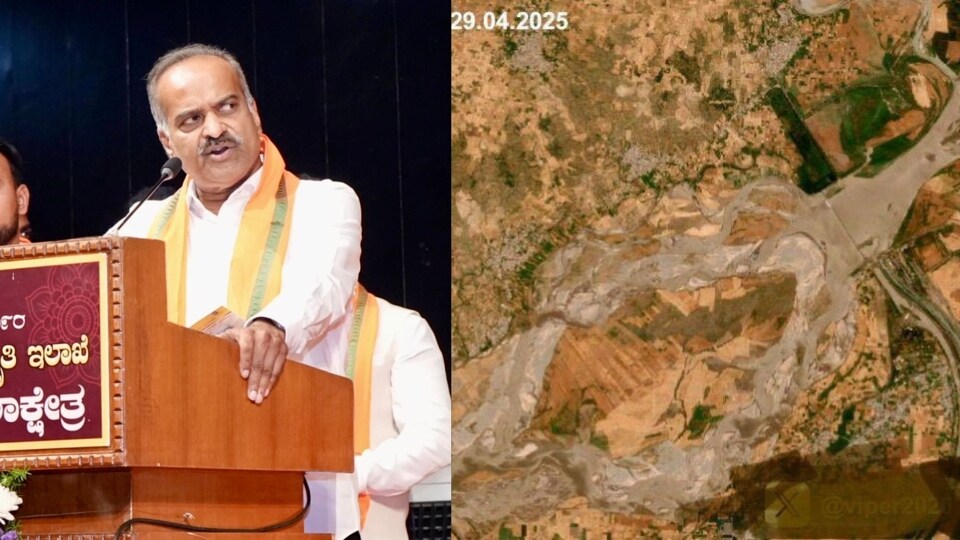
Taking to social media platform X (formerly Twitter), Mohan posted satellite images comparing the river’s water levels, suggesting a drastic drop. “India’s suspension of the Indus Water Treaty is drying up the Chenab River near Sialkot in Pakistan. Pani chahiye, pani (Do you water)?” he wrote, in a pointed remark aimed at Pakistan.
(Also Read: 'Congress acting as Pakistan’s PR firm': BJP’s Tejasvi Surya hits back over ‘gayab’ jibe at PM Modi)
Read his post here:
In a significant move, the Indian government has decided to put the Indus Waters Treaty (IWT) of 1960 in abeyance, citing Pakistan's continued support for cross-border terrorism. The decision was taken during a Cabinet Committee on Security (CCS) meeting chaired by Prime Minister Narendra Modi, and attended by senior leaders including Home Minister Amit Shah.
The suspension of the treaty will remain in effect until Pakistan credibly and irreversibly renounces its backing of cross-border terrorism and shuts down the integrated Attari Check Post, a key trade and travel route between the two nations.
The Indus Waters Treaty, brokered by the World Bank, governs the distribution of water from the Indus river system between India and Pakistan. While India controls the eastern rivers, Pakistan has rights over the western rivers like the Indus, Chenab, and Jhelum. Any alteration to the treaty is likely to have far-reaching geopolitical and ecological implications.
Meanwhile, Jammu and Kashmir’s former Chief Minister Omar Abdullah reiterated his long-standing criticism of the treaty, calling it "the most unfair document" for the people of the Union Territory.
Speaking to the media, Abdullah said that Jammu and Kashmir has consistently opposed the treaty, which he believes has deprived the region of its rightful share in water resources. “As far as J&K is concerned, we have never been in favour of the Indus Water Treaty,” he said, adding that the steps taken by the Centre were welcome but long overdue from the perspective of Jammu and Kashmir.
(Also Read: Bengaluru woman rowdy-sheeter trained adopted children to burgle homes, arrested: Report)


