
 E-Paper



Decree on anti-sacrilege law: Mann govt gives 26-page reply, Takht calls it ‘unsatisfactory’
Akal Takht media adviser Jaskaran Singh confirmed that while the letter had been received, it failed to impress. “The government’s official response was submitted only after the expiry of the deadline,” said Jaskaran

 Prefer HTon Google


The Punjab government on Wednesday submitted its official response to the Akal Takht decree on the newly enacted anti-sacrilege law. The development came a day after a one-month ultimatum given by the highest temporal seat of Sikhs to amend the “controversial clauses” in the Jaagat Jot Sri Guru Granth Sahib Satkar (Amendment) Act-2026 expired.
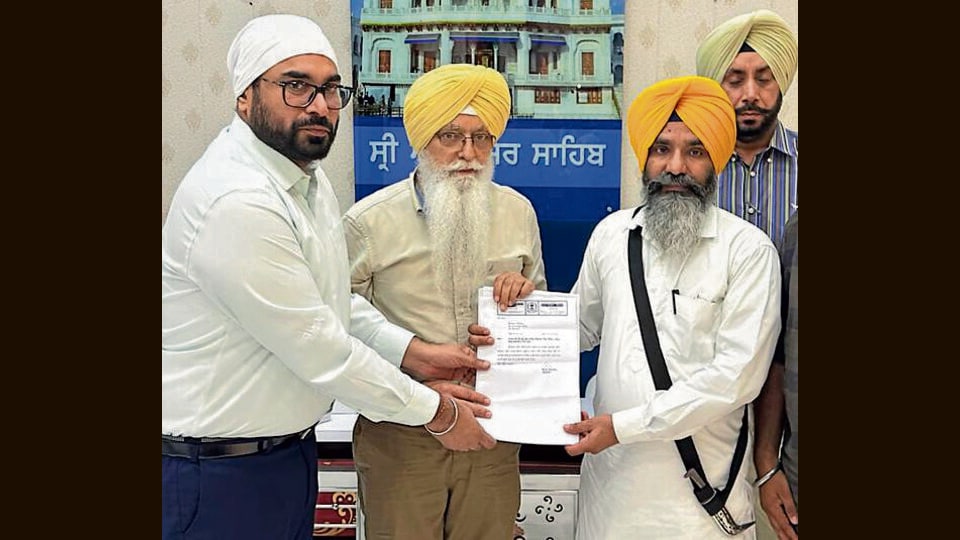
A government delegation, including Aam Aadmi Party MLA and Chief Khalsa Diwan (CKD) president Dr Inderbir Singh Nijjar, Amritsar deputy commissioner Dalwinderjit Singh, and SDM Gurmandar Singh, visited the Akal Takht secretariat to submit a comprehensive 26-page official response. The late submission, however, drew immediate flak from the Takht.
Speaking to the media, Akal Takht media adviser Jaskaran Singh confirmed that while the letter had been received, it failed to impress. “The government’s official response was submitted only after the expiry of the deadline,” said Jaskaran. “It reflects a lack of seriousness on the part of the government regarding legislation related to the serious issue of sacrilege. Also, the AAP government stance in the written response is not satisfactory,” he said.
Akal Takht acting jathedar Giani Kuldeep Singh Gargaj asserted that nothing short of the July 4 recommendations (when revised set of objections by clergy were forwarded to the government) would be acceptable. “I have read the government’s communique. Some of the controversial clauses, it seems, have not been removed,” said the jathedar at a Miri Piri Khalsa march in Moga.
On Tuesday, the jathedar had accused those in power of “arrogance” and a complete “lack of seriousness toward Sikh sentiments” for failing to establish meaningful communication during the one-month window.
The Bhagwant Mann-led AAP government, on its part, has convened its monsoon assembly session from August 3 to August 10, where it intends to table amendments to the Act.
The legislation at the heart of the crisis was passed by the state assembly on April 13, 2026. Aimed at curbing desecrations, the law introduces stringent punishments, including life imprisonment and fines up to ₹20 lakh for acts of sacrilege involving Guru Granth Sahib. Despite its intent, the law triggered sharp backlash from the clergy and various Panthic bodies over several “objectionable clauses drafted without consultations”.
On June 29, the five Sikh high priests summoned Sikh legislators across all political parties to the Takht, culminating in a one-month ultimatum to amend the Act. A revised list of specific objections was officially sent to the government on July 4.
On July 4, Akal Takht sent a revised set of objections and additional recommendations to the Punjab government regarding the law.
In the fresh representation, the acting jathedar Giani Gargaj had flagged objections to certain provisions of the Act relating to the Shiromani Gurdwara Parbandhak Committee (SGPC), Sikh Rehat Maryada, terminology, and custodial definitions. He also sought an amendment to the Act to include a specific provision for legal protection of sewadars and devotees in cases of self-defence during incidents of sacrilege. Setting up of fast-track courts to ensure speedy investigation and prosecution in cases related to sacrilege of religious scriptures were also part of the recommendations.
Mann had previously stated that Akal Takht’s suggestions had been sent to the Punjab advocate general for legal review. “If the AG recommends, we will make the changes,” the CM had said.
However, the Takht has warned the government against taking any unilateral legislative shortcuts. “The government should not hastily proceed with further legislative amendments in the assembly,” Jaskaran Singh said. The secretariat has demanded that a joint coordination committee, comprising representatives from the Akal Takht, the Shiromani Gurdwara Parbandhak Committee (SGPC), Sikh intellectuals, and the state government, must first review and clear any draft before it is introduced on the assembly floor.
MLA Nijjar declined to reveal the contents of the letter, stating he was only there to deliver the document. However, people privy to the matter said the government is adamant to keep terms ‘custodian’ intact in the law and has apprised the Takht of it. In the letter to Akal Takht, the government has stated that it will frame rules under this law to specify the term. In response to the Takht’s apprehension, it said that sewadar of Guru Granth Sahib will not come under this term and he or she will not be punished if sacrilege takes place under his watch.
The jathedar said the government was asked to remove both the clauses of custodian. “Any deviation will not be accepted at any cost”, he added. The clause in the Act defines a “custodian” as any individual, institution, or gurdwara committee given a saroop of the holy scripture. The current Act holds the custodian responsible for the safe care, protection, and reporting of any damage to a saroop. The Takht’s main opposition to this clause is based on the argument that no human can be a “custodian” of the living Guru and that religious discipline should not be regulated by the new law.
The latest development indicates that a consensus between the state government and the Panthic bodies/ institutions on the issue remains highly unlikely. “The Takht will thoroughly examine the letter submitted by the government and then decide on next course of action,” added Jaskaran.


