E-Paper



Experts worried as Kashmir’s harshest winter period ends with scant snowfall
The experts warn that if Kashmir doesn’t receive a few major spells of snowfall or rains in the coming weeks, its effects will be witnessed well into spring

 Prefer HTon Google


As the 40-day harshest winter period of Chilai Kalan in Kashmir ended on Monday with scant snowfall or rain, the agricultural and horticulture experts warn of its adverse effects in coming months if there is no major snowfall in early February.
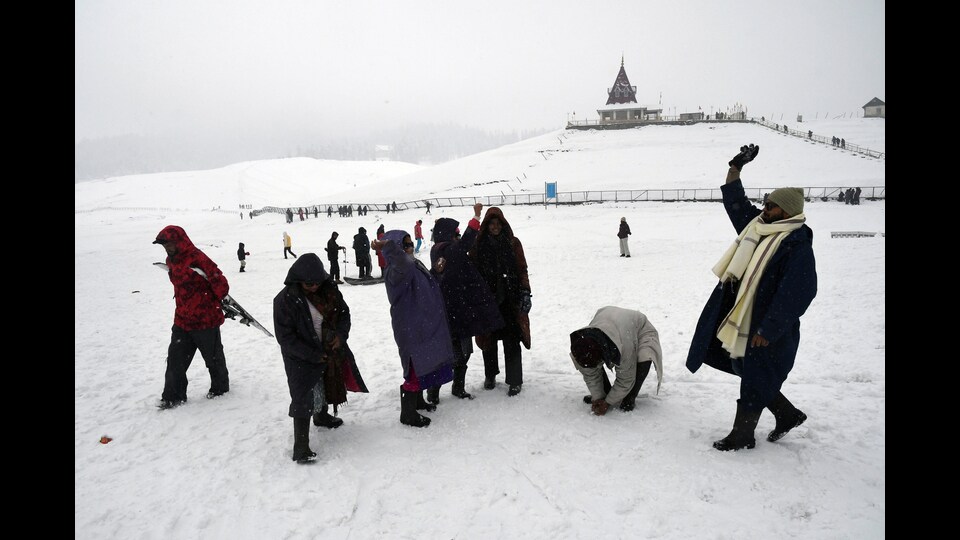
The Himalayan valley, known for its glaciers, snow covered mountain slopes, blue lakes and gushing rivers, witnessed a prolonged dry spell since the beginning of December this winter leading to dry and parched landscape and riverbeds with little water.
As there was some light snowfall and rains for the past two days, the experts warn that if the Valley doesn’t receive a few major spells of snowfall or rains in the coming weeks, its effects will be witnessed well into spring and summer months on agriculture, horticulture and on water supply.
Director, agriculture, Chowdhary Mohammad Iqbal said that the light snowfall and rains in the past one day should be followed by major spells of snowfall till February 10.
“Our next seven to 10 days are important as far as agriculture production is concerned. If the dry spell continues, the standing crops will be seriously affected,” he said.
Iqbal said that the farmers are waiting for the rain and snowfall with bated breath. “The growth of standing crops like oil seed, wheat, oats, seeds and vegetables will be stunted if there is no major precipitation,” he said.
He said that the upcoming crops will also be majorly impacted if the dry spell continues. “The coming kharif crops will be impacted. If there is no snowfall by February 10, the impact will be direct as the snowfall after that will melt immediately owing to high temperatures,” he said.
Owing to global climatic phenomena like El Nino, the subsequent weather changes and less western disturbances this winter, Jammu and Kashmir experienced a prolonged dry spell amid harsh winter, with barely any precipitation since the beginning of December. The J&K meteorological centre has said that the union territory received 13 mm precipitation in December last year, much less than the average 60 mm – a deficit of 79%. January was also dry.
Kashmir gets 70% of its precipitation through western disturbances – moisture-laden winds from the Mediterranean – with normally December, January and February as snow months and March and April (receiving above 100mm each) as the wettest rain months.
Horticulture expert Mohammad Amin said that the scant precipitation was going to impact fruit production, now and in coming months. “Every crop, whether related to agriculture or horticulture, is going to get affected. If the situation continues and temperatures remain high, the flower bloom and bud burst will happen early, preponing all the horticultural operations like spraying in February. And if there is a fluctuation in temperature after bloom, it will affect the fruit formation,” said Amin, who is a technical officer at the horticulture department.
He said that in spring and summer months, the fruit quality of apples, grapes, pears and others will be affected owing to dry conditions. “No moisture means deterioration in quality of fruit,” he said.
The department has already advised the fruit growers to take precautions and conserve moisture in their orchards. “This is the reality now and we have to take precautions and conserve moisture. We have advised farmers to cover canopy region of fruit plants with paddy husk or black polythene film as mulch. This will conserve moisture and prevent weeds which again would have evaporated water content from soil,” he said.
“Similarly, the farmers should only go for light pruning to avoid sun stroke of plants in case the dry weather and high temperatures continue in February,” he said.
Chilai Kalan, Kashmir’s harshest 40-day winter period which starts December 21 and usually remains cold and wet, was unexpectedly warm and dry this winter. The harsh winter period is followed by 20 more days which are less intense (called Chillai Khurd) and then lastly 10 days of mild cold (Chille Bache).
More snow in offing in Kashmir: MeT
As light snowfall continued in a few upper reaches of Kashmir, two back-to-back weather systems are approaching the Himalayan valley expected to bring moderate to heavy snowfall from Tuesday, the meteorological centre of J&K said on Monday.
The MeT director, Mukhtar Ahmad said that a strong Western Disturbance –moisture laden winds from Mediterranean – will hit the region on Tuesday.
“The western disturbance will start from Tuesday afternoon during which there are chances of light to moderate snowfall (in plains) while mountainous areas will witness heavy snowfall particularly in Bandipora, Kupwara, Ganderbal and Baramulla districts and in south Kashmir’s upper reaches of Shopian, Kulgam and Anantnag,” he said stressing that Tuesday and Wednesday will witness a good wet spell as compared to yesterday’s spell.
After about two months of dry weather conditions, light snowfall was witnessed in mountainous areas of Kashmir including the ski resort of Gulmarg from Sunday morning.
Ahmad said a significant accumulation of snow has happened in the Sonamarg-Zojila axis of around 1 foot. “Similarly, Gulmarg has witnessed around 6 inches snowfall. The upper reaches of Bandipora and Kupwara have also recorded 4 to 6 inch snowfall. Plains saw rain for an hour and a half,” he said.
“The light snowfall is still going on in Sonamarg and Gulmarg and in some upper reaches,” he said.
He said that another western disturbance is arriving on February 3 and 4. “There are again chances of light to moderate snowfall in upper reaches while plains will witness light rains. In Jammu as well, there is a possibility of light rains in plains and light snow in mountains,” he said.
The snowfall has prompted closure of prominent roads. “Srinagar-Leh national highway has been closed. The roads of higher reaches like Mughal road, Sinthan Top and Sadhna Pass are closed due to fresh snowfall,” he said.
An official of the traffic control room confirmed the development informing that Srinagar-Leh highway was closed after Sunday’s snowfall.
The Bandipora-Gurez road was also closed owing to the snowfall, officials of the district said.
The MeT has issued an advisory informing that the weather system may lead to temporary closure of roads of higher reaches and important passes like Sinthan pass, Mughal Road, Sadhna & Razdan pass, Zojila etc during January 30-31.
“Travellers are advised to plan accordingly while farmers are advised to withhold irrigation and fertilizer application & drain out excess water from orchards and fields during the above mentioned period,” it said.