
 E-Paper



Himachal’s weather-hit harvest pushes Kashmir apple prices up 35%
Premium boxes fetch up to ₹2,500 amid pre-festive demand; rail, highway freight push 2,000 daily truckloads to national markets

 Prefer HTon Google


Himachal’s loss has become Kashmir’s gain this apple harvest season. Crop loss in Himachal Pradesh—brought on by spring droughts, flowering-stage heatwaves, and late-season heavy rain—has triggered a surge in demand for Kashmiri apples, driving wholesale prices up by as much as 35% across national markets.
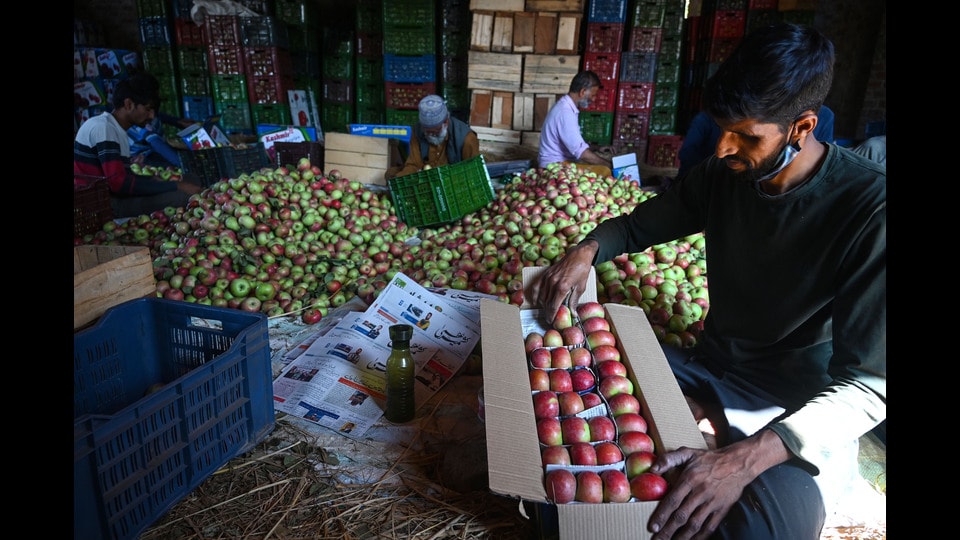
Good-quality Kashmiri apple boxes are currently fetching between ₹1,500 and ₹2,500 in Valley mandis (wholesale markets). The deficit across the border has prompted fruit growers, regional distributors, and bulk traders from Himachal Pradesh, Delhi, Maharashtra, Punjab, and Madhya Pradesh to travel directly to Kashmir to buy produce at source.
However, apple production in Himachal Pradesh has been much lower this year than the last year. Jagat Singh Negi, revenue, horticulture, and tribal development minister of Himachal, on Friday said, “As of today, only around 1.30 crore boxes have reached the market, compared to more than 2.25 crore boxes by this time last year.”
Negi said that the decline in apple production has affected Himachal’s horticulture-based economy, which generates business worth around ₹5,000 crore annually when factoring in the value of apples, packaging material, labour, and transportation.
The minister said that the reduced availability of apples has also hit processing operations at crushing units, particularly at Parala. Furthermore, the Himachal Pradesh Horticultural Produce Marketing and Processing Corporation (HPMC) could not undertake crushing operations at its Parwanoo unit this season due to the severe shortage of produce.
Negi said that 13,202 metric tonnes of apples had been procured so far this season in Himachal Pradesh under the Market Intervention Scheme (MIS) by the Himachal Pradesh Horticultural Produce Marketing and Processing Corporation (HPMC) and HIMFED, compared to 79,000 metric tonnes procured the previous year.
Kashmiri apple boxes fetching nearly ₹2,500 in Valley mandis
However, the picture is quite different in Jammu and Kashmir, with good-quality Kashmiri apple boxes currently fetching nearly ₹2,500 in Valley mandis (wholesale markets).
The strong pricing comes as a critical buffer for local growers. Kashmir’s own yield is down roughly 20-30% this season due to localised hailstorms and erratic rainfall during the fruit-setting phase. However, overall farm revenues remain robust.
At Sopore, Asia’s second-largest fruit market, between 300 and 400 trucks leave daily. “Market sentiment across the country is exceptionally strong,” said Fayaz Ahmad Malik, the president of the Sopore Fruit Mandi. “Because harvests are down across the entire northern belt, growers are securing good dividends. Rates at our mandi range from ₹1,200 to ₹2,200 a box, and we expect further upward momentum as Durga Puja and Diwali draw closer.”
Smooth supply
To keep supply chains flowing for an industry that contributes 8-10% to Jammu and Kashmir’s gross domestic product (GDP), regional logistics are operating at peak capacity. Between 1,500 and 2,000 apple-laden trucks are departing rural orchards and assembly points daily.
Logistical efficiency got a major push this season with the integration of specialised rail freight services. In addition to smoother traffic flow along the Jammu-Srinagar National Highway (NH-44), Indian Railways has deployed dedicated parcel freight trains, including the specialised Namo Bharat Rapid Rail and temperature-controlled cargo rakes, from Kashmir. This dual-rail-and-road transport corridor moves thousands of tonnes of fresh produce daily directly to major consumption hubs in western, central, and southern India, reducing transit times by up to 48 hours and cutting post-harvest spoilage.
Bashir Ahmad Bashir, president of the Srinagar Parimpora Fruit Mandi, said while the total volume is lower, market realisation for A-grade apple varieties, including Delicious, Kullu Delicious, and Maharaji, remains buoyant at ₹1,300 to ₹1,500 a box.
“In Himachal, the crop was light and the fruit size remained small due to the dry spell earlier in the season,” said Satish Kumar, a Himachal-based trader currently procuring in Shopian. “I moved operations to Kashmir to meet my seasonal commitments. While Kashmir also experienced weather disruptions, its sheer production scale guarantees steady supply ahead of Diwali.”
Growers confirm that high unit rates are balancing out production losses. Adil Ahmad, owner of Sarhad Fruit, reported selling over 10,000 boxes so far at prices ranging between ₹1,300 and ₹1,600 a box, confirming that overall turnover remains healthy.
Bottlenecks unblocked
Horticulture is the backbone of Kashmir’s rural economy. The region produces roughly 20 lakh metric tonnes of apples annually, generating ₹8,000 to ₹10,000 crore and accounting for nearly 75% of India’s total domestic apple production.
Over 7 lakh farming families, comprising roughly 35 lakh individuals, or over a quarter of the UT’s population, depend directly or indirectly on the apple supply chain.
Earlier, the apple harvest would suffer losses due to landslides on the Ramban-Banihal stretch of NH-44, which trapped scores of trucks for days. The combination of widened highway corridors and newly introduced rail parcel services has effectively unblocked this bottleneck, protecting fruit quality and price realisation.


