
 E-Paper



Last day of Punjab Monsoon Session: House passes 9 bills, caps pvt school fee hike at 5%
Students and their families will receive robust protection and safeguards against arbitrary fee hikes, alongside complete transparency in the operation of these institutions, says chief minister Bhagwant Mann; Bill to bring 28k outsourced employees under direct govt contractual engagement also passed unanimously

 Prefer HTon Google


The Punjab assembly on Monday passed nine key bills, including a legislations paving the way for a 5% annual cap on fee hikes by private schools and bringing 28,000 outsourced employees under direct contractual engagement with the government, on the last day of the monsoon session.
Education minister Harjot Singh Bains tabled the Punjab Regulation of Fee of Unaided Educational Institutions (Amendment) Bill, 2026 in the House, while finance minister Harpal Singh Cheema tabled the Punjab State Outsourced Personnel (Transition to Contractual Engagement) Bill, 2026.
While both these bills were passed unanimously, chaos was witnessed during the passage of three legislations pertaining to digital universities, with the Opposition accusing the government of “selling education to private players.”
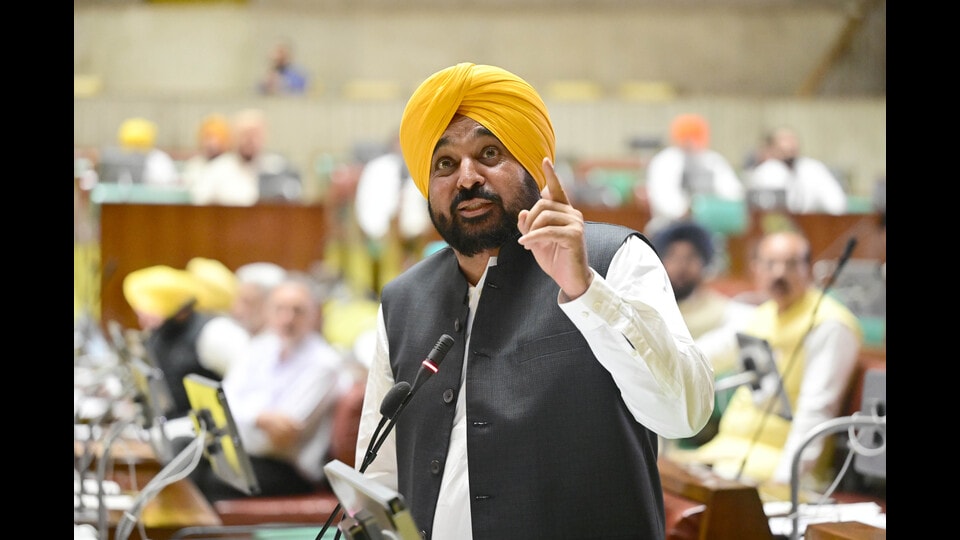
Winding up the discussion on the bill regulating fee hike in unaided schools, chief minister Bhagwant Mann said it will cover around 7,800 private schools in the state, directly benefiting around 32 lakh students.
Mann said the ceiling will cover not only the tuition fees but also mandatory charges and funds collected by schools. According to the bill, fees include all amounts charged, which include tuition fee, development fee, annual charges, activity charges, smart class or technology charges, transportation charges (where not separately contracted), laboratory and library charges, examination charges, and any other funds.
“The bill will pave the way for stronger protection of students and parents against excessive and opaque fee collection. The government will also conduct forensic audits of private schools to identify excess collections and ensure that the additional amount is refunded to parents,” Mann said.
Under the new law, violations will attract fines of ₹50,000 for the first offence, ₹1 lakh for the second and cancellation of affiliation for a third offence.
Mann said that during Covid, when schools were shut and vehicles were not operating, parents were still forced to pay transport fees, showing that such exploitation would no longer be allowed in Punjab. The chief minister said his government will neither allow education to become a business nor let education mafias flourish in the state.
“More than 32 lakh students are currently enrolled in nearly 7,800 private schools across Punjab, and the bill is aimed at protecting their interests. Students and their families will receive robust protection and safeguards against arbitrary fee increases, alongside complete transparency in the operation of these institutions. Punjab has surpassed Kerala in the field of education due to the concerted efforts of the state government,” said Mann.
During the debate on the bill, Congress members Pargat Singh questioned the delay in bringing the bill. “Why were you silent on a sensitive issue for more than 4.5 years?” he asked. Legislator Avtar Henry Junior also targeted the government for not making it clear what will happen to students in case a school’s affiliation was cancelled.
Curtain on contractual outsourcing: CM
Participating in the discussion on the Punjab State Outsourced Personnel (Transition to Contractual Engagement) Bill, 2026, Mann said it would apply to eligible outsourced employees in Group-C and Group-D categories, who are engaged in essential public services and fulfil the prescribed eligibility conditions.
“The bill has ended the decades-old system of contractual outsourcing and exploitation of employees. The landmark legislation will eliminate the role of private contractors, bring 28,000 outsourced employees into direct contractual engagement with the government in the first phase, and extend PF (provident fund), gratuity, ESI (employees’ state insurance), maternity leave and casual leave benefits to eligible workers, while ensuring that the 15% to 22% commission charged by outsourcing agencies is no longer deducted from their earnings,” the chief minister said.
Ruckus over digital varsities
The assembly witnessed an uproar over the setting up of digital universities, with the opposition led by Congress storming the well of the House after deputy speaker Jai Krishan Rodi, who was in the chair, did not allow the opposition members to speak and continued reading the draft of the bills.
Congress members entered the well of the House and started raising slogans against the state government and the deputy speaker.
The opposition accused the deputy speaker of being biased and accused the state government of selling education to private players.
Amid chaos, three bills — the Cloud University Hoshiarpur Bill, the MS Digital University Patiala Bill and the PhysicsWallah Digital University Patiala Bill — were passed.
The other bills passed included the Punjab Goods and Services Tax (Amendment) Bill, the Punjab Panchayati Raj (Amendment) Bill and the Punjab Protection Trees Bill.
Congress legislator Pargat Singh accused the government of giving preference to private institutes.
“It’s high time that we ponder over what we have done to the state-run universities and other educational institutions. Giving so much preference to private institutes should be discouraged,” Pargat said. Congress member Henry Junior said the government should clarify how these universities will run courses requiring mandatory laboratory facilities.
Defending the Punjab Goods and Services Tax (PGST) Amendment Bill, 2026, finance minister Cheema said it was aimed at promoting voluntary compliance, minimising litigation, and streamlining GST-related procedures across the state.
Cheema said the amendments to the PGST provisions are designed to support the trade and industry sectors by removing procedural bottlenecks, improving liquidity, and easing the overall compliance burden on taxpayers.
Minister Tarunpreet Singh Sond said the Punjab Panchayati Raj (Amendment) Bill has created the post of “Panchayat Development Secretary” after merging the cadres of panchayat secretary and gram sewaks.


