
 E-Paper



Containment zones reduced to 6 in Ggm, more police deployment on district borders
The new strategy can help prevent the transmission of the coronavirus disease to the other parts of the city, said police commissioner Muhammad Akil.

 Prefer HTon Google


A day after the Prime Minister Narendra Modi’s announcement to extend the lockdown till May 3, the Gurugram police on Wednesday increased the deployment of security personnel on borders with Nuh and Faridabad, as well as outside the six containment zones in the district to keep a check on the non-essential movement of people from areas with Covid-19 cases.
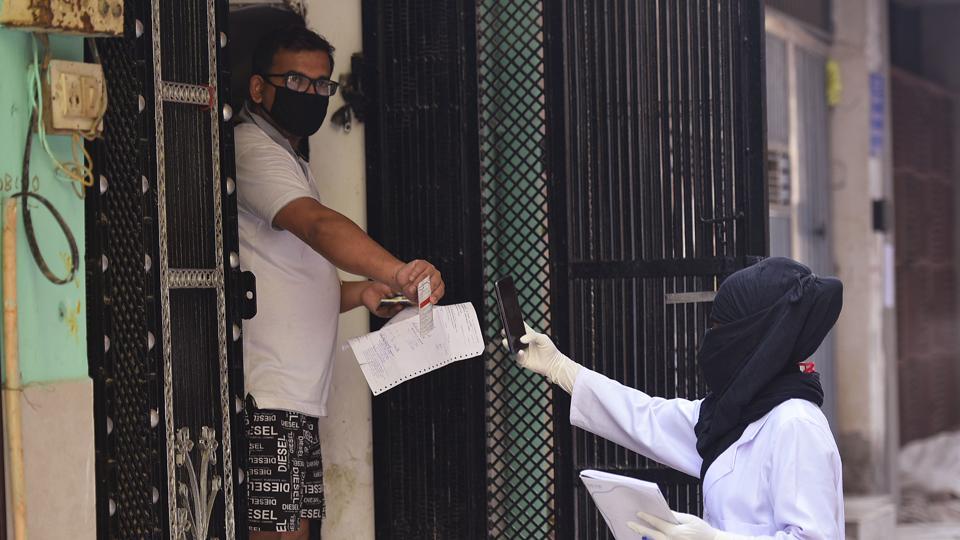
On Wednesday, the number of containment zones in the Gurugram district was reduced from nine to six.
The new strategy can help prevent the transmission of the coronavirus disease to the other parts of the city, said police commissioner Muhammad Akil.
Areas that will now be under containment zones are Devi Lal Colony, Sun City (Sector 54), Sector 39, Fazilpur Jharsa village, Pataudi ward number 11, and Raipur village in Sohna, said an order issued by the deputy commissioner on Wednesday.
Areas such as Nirvana Country, Sector 9, Palam Vihar, Emar Palm Gardens (Sector 83) and Laburnum Society have been rid of the containment tag, the order said, adding that the decision was taken “upon the recommendation” of the District Disaster Management Authority (DDMA) Committee.
The deputy commissioner, in his order, also said that the Containment Review Committee has been constituted for “combating the situation”.
According to the previous order (issued on April 10) on containment zones, much wider areas were made Covid-19 hot spots, such as Sector 54 instead of Sun City, and Sector 9 in lieu of Devi Lal Colony. However, the Wednesday’s order has narrowed down these areas.
The police said borders connecting to Nuh are most sensitive zones due to 45 positive cases reported from that district only. Besides, the security has been increased along intra-city borders with Pataudi and Sohna from where 15 Covid-19 cases have been reported, the police said.
Gurugram has reported 32 positive cases so far and 16 of them have recovered.
Around 400 more home guards and special police officers (SPOs) have been deployed in nine containment zones, the police said. Earlier, about 4,800 police personnel were deployed across the city, including 11 borders connecting to Delhi.
An area spread over five kilometres is cordoned off in the identified containment zone and an additional area of three kilometres is earmarked as a buffer zone as a precautionary measure, said the police.
Akil said strict action will be taken against people misusing passes and crossing police pickets without any valid reason.
He said that the police have set up 15 more police pickets, adding to 64 which were set up outside containment zones where a total of 1,742 personnel are deployed. “We have increased deployment in residential areas also as many people are stepping out without wearing masks and are making excuses of buying essential items from nearby markets,” he said.
The police said they have advised all the residents’ welfare associations (RWAs) to ask residents not to step out of their apartment or houses without masks and to maintain social distancing. “All morning and evening walks are prohibited as people had started moving out in groups,” Akil said.
After the extension of lockdown, the police changed the locations of the police post and pickets across the city.
“I had called a meeting of all 41 station house officers to discuss the new plan of action and to ensure no one enters the city from these areas unless for any medical emergency,” said Akil.
The Gurugram police have a total of 6,500 police personnel and around 2,500 home guards and SPOs.


