
 E-Paper



Around 1,000 personnel involved in Uttarkashi tunnel rescue ops: Officials
Heavy machinery was mobilised from across the country for the rescue operation, with rescuers going ahead with a multi prolonged approach, including vertical drilling from hilltop at two spots, and perpendicular drilling

 Prefer HTon Google


Around 1,000 personnel were involved in the rescue operation to save 41 construction workers who were trapped in the Silkyara-Barkot tunnel in Uttarkashi, a senior official said. However, people familiar with the matter said that the number of personnel and officials involved in the rescue could be much more and data in this regard is being compiled.
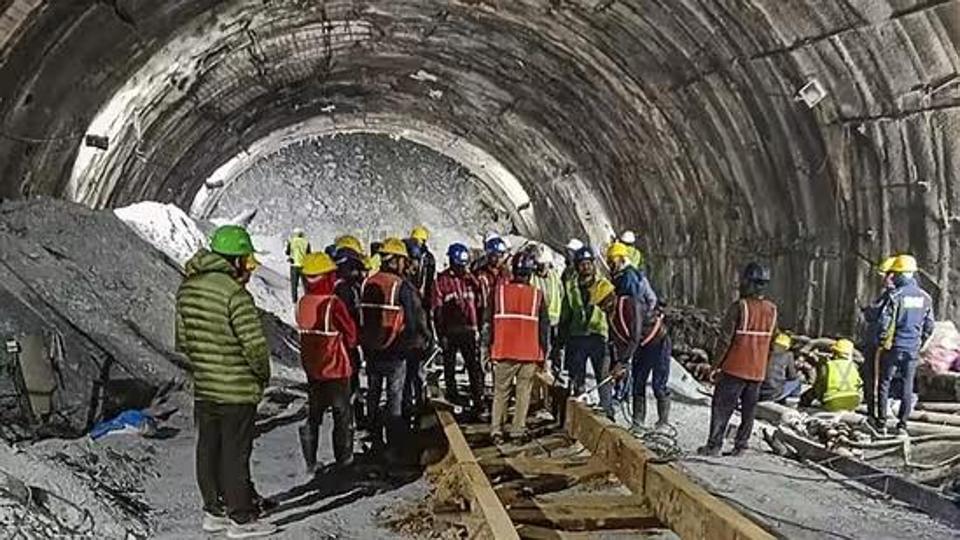
Neeraj Khairwal, a secretary in the Uttarakhand government and nodal officer for the rescue operation, said, “According to our estimate, around 1000 personnel and officials were involved in the rescue operation.”
Anshu Manish Khalkho, director (administration and finance), National Highways & Infrastructure Development Corporation Limited (NHIDCL), said, “We can’t tell now what was the magnitude of the rescue operation in terms of personnel and officials involved. We are making a report in this regard. It is expected to be prepared by Sunday.”
A manpower of 652 people was deployed in the rescue operation that lasted for 17 days. It included 189 from the police department, 106 from the health department, 77 from ITBP, 62 from NDRF, 39 from SDRF, 46 from Jal Sansthan Uttarkashi, 32 from the electricity department, 38 from BRO, the government earlier stated in an official report.
Navayuga Engineering Company Limited (NECL), the Hyderabad-based contractor constructing the tunnel, said they can’t reveal how many men from their side were involved in the rescue operation. Bhaskara Murty, vice president, NECL, said, “We have shared our record with NHIDCL. I can’t share the report with the media.”
Heavy machinery was also mobilised from across the country for the rescue operation, with rescuers going ahead with a multi prolonged approach, including vertical drilling from hilltop at two spots, and perpendicular drilling.
For RVNL perpendicular drilling by RVNL, the equipment for micro tunnelling to rescue labourers had arrived at site from Nashik and Delhi. For vertical drilling by ONGC, the air drilling rig had arrived from Indore. Some machines were brought using Indian Air Force aircrafts, while some reached the site by road.
With the rescue operation over on November 28 and rescued men reaching their native places, it has now become a challenge for the authorities to take back the heavy machinery from the site to where they were brought from.
The rescue operation began on November 12, when authorities put into use excavator machines to scoop out the debris. Within a day, the machines had carved through 21 of the 57m of debris. But that plan met its first hurdle within a day when a fresh cave-in wiped out a third of those gains and added seven metres more rubble to the wall. Amid fears that the continued use of excavators could potentially cause more damage during an already precarious situation, authorities began hunting for a fresh strategy on November 14.
They turned to auger machines – corkscrew-like devices with rotary blades at the front — to drill through the stubborn wall of rock and concrete.
As the machine cut through the rock, authorities kept inserting 800-900mm-wide steel pipes that would serve as exits for the trapped workers. But this machine hit its first hurdle just two metres in, snapping against the hard stone.
Then, officials turned to a more powerful US-made auger machine that was flown in from Delhi on November 15. It reached Uttarkashi the next day and by November 17, it had cleared out 22m of debris. But this machine snagged as well, with its blades dented by the hard wall. Still, authorities persisted with the auger machine, even as they planned contingencies: Drilling vertically in two spots to enter the tunnel from above, through a hill; drilling horizontally from the side of the hill; and digging in from the other end of the tunnel.


