E-Paper



49.2°C: A meltdown at Delhi’s Mungeshpur
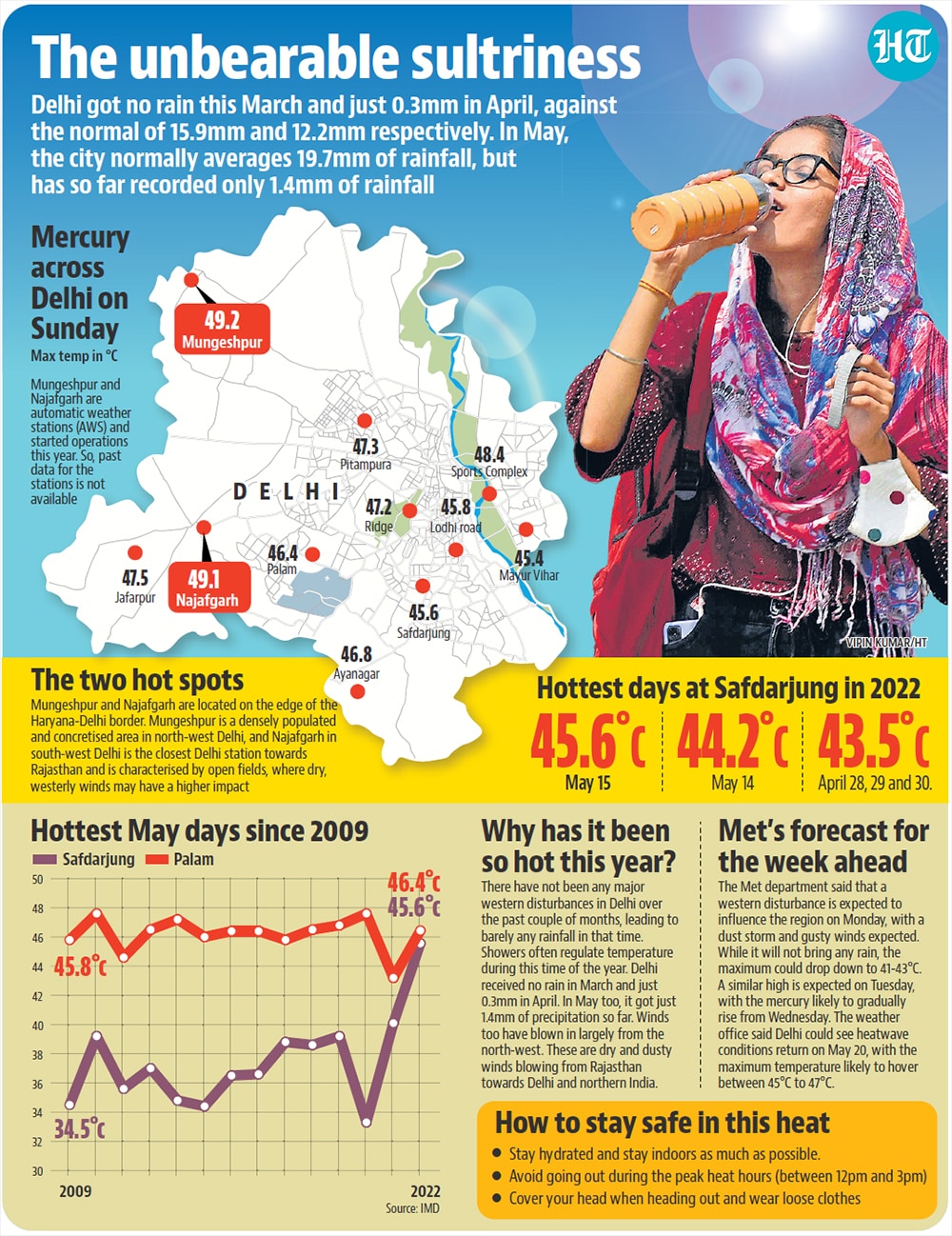
Mungeshpur, along the Capital’s border with Haryana, was the hottest place in India on Sunday, with the maximum temperature in the north-west Delhi neighbourhood a crackling 49.

 Prefer HTon Google


Mungeshpur, along the Capital’s border with Haryana, was the hottest place in India on Sunday, with the maximum temperature in the north-west Delhi neighbourhood a crackling 49.2 degrees Celsius (°C), according to countrywide data from the national weather office, with residents saying that surviving the record mercury felt akin to “a battle”.

Barely anyone in the village left their homes after noon, said residents.
“It seemed like there was a lockdown in place. Hardly anyone was outside, except daily wage labourers,” said Devinder Singh, a 67-year-old who has lived in Mungeshpur for most of his life.
On Sunday, all 11 weather stations across Delhi recorded maximum temperatures above 45°C, but Mungeshpur and Najafgarh (in south-east Delhi) recorded readings above 49°C, numbers that the national capital has never clocked.
To be sure, the automatic weather stations in the two neighbourhoods only started operations this year, so no past data is available. Safdarjung, the base weather station for Delhi, recorded a maximum of 45.6°C, five degrees above normal. The all-time record for Safdarjung is 47.2°C, recorded on May 29, 1944.
Umesh Singh, a resident of Mungeshpur, said the heat has impacted the area’s crop, which consists mostly of jawar.
“Most farmers find it tough to head out to the fields in this heat,” he said.
A semi-urban area characterised by a combination of concretised spaces and open farm fields, Mungeshpur also overlooks a number of industries in Haryana, a factor that residents said could be feeding the ongoing heat spell.
“Earlier, we had a lot of trees in the area. But slowly, development work, such as the Bawana industrial area, which is not too far away, or on the Haryana side, where a number of factories have sprung up, are all adding to emissions and the heat. The village has also evolved and with construction work, the number of trees has reduced,” Singh said, adding that the low-cost ACs installed in most homes wilted in the face of the record heat.
Over towards Najafgarh, Kartar Singh (74), voiced similar views.
“If one looks at the Najafgarh area towards the city, there are hardly any trees left and traffic congestion is a major problem. Even in the farming area and fields, there aren’t as many trees as there used to be,” said Singh.
A senior official from the India Meteorological Department (IMD) said westerly winds from Rajasthan are likely impacting the Mungeshpur and Najafgarh stations more than others in the city.
“These hot and dusty westerly winds hit Delhi’s western side first, and all stations in this part of Delhi are bound to have a higher maximum temperature,” said the official, adding that local factors such as the lack of green cover and presence of concrete structures exacerbate the problem.
Paras Tyagi, an environmental activist, who runs CYCLE India, an NGO, said open spaces are harder to find in Najafgarh now, with green cover along the roadsides also reducing due to construction work.
“Land values have appreciated over time and Najafgarh has turned into a concrete jungle over the last couple of decades. Our research clearly shows due to lack of implementation of the Delhi Master Plan and due to poor local planning, this historic town has been irreparably damaged in terms of congestion and concretisation,” he says.