
 E-Paper



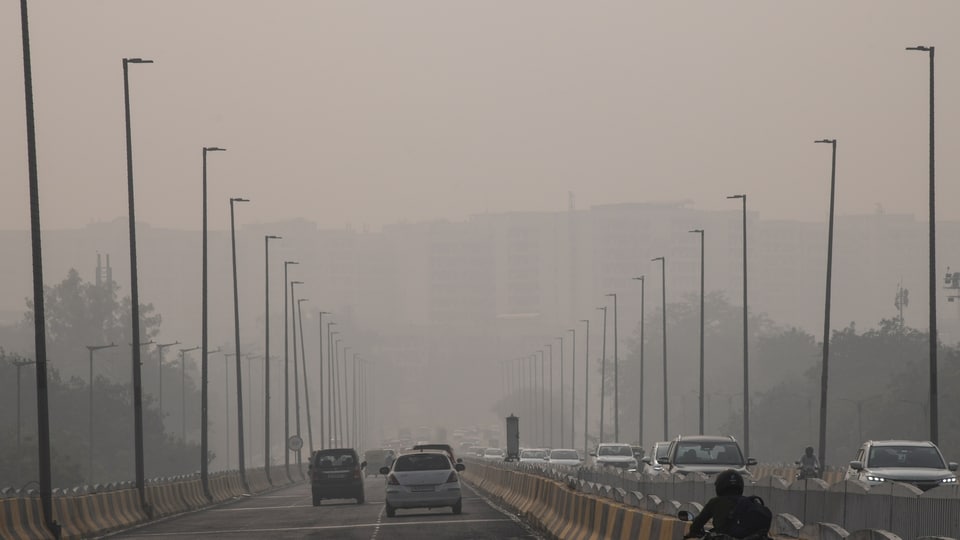
AQI surges amid wind shift, Capital enveloped in haze
PM2.5 more than doubled to 244 micrograms per cubic metre by Thursday evening, while Delhi’s AQI rose to 387.

 Prefer HTon Google


Delhi’s air turned sharply more toxic on Thursday, with the concentration of PM2.5 across the city more than doubling in 24 hours to 244 micrograms per cubic metre by 6pm, four times the national standard, as a thick, smoky haze that usually thins by afternoon stayed trapped over the Capital in warm, damp and almost motionless air.
Two things closed in on the city at once, an HT analysis of official pollution and weather data showed. The dome of air in which Delhi’s pollution mixes and thins shrank to about 400 metres high on Thursday afternoon, from 1,400 metres two days earlier; and the north-westerly that carries smoke from the farm fires of Punjab and Haryana, slack since Diwali, was blowing above the city again at 34 km/h.
Delhi's AQI climbs to 387 as 21 monitoring stations record severe pollution
The Central Pollution Control Board’s (CPCB) air quality index (AQI) for Delhi, a rolling average of the previous 24 hours, climbed from 313 at 2am to 366 by 6pm, gaining seven to eight points an hour through the afternoon. At 10pm, it reached 387 -- 74 points higher than the 24 hours before it. In all, 21 of the 58 stations reporting were in the “severe” zone, above 400, by then, against one on Wednesday evening and none on Tuesday.
The index for the day stood at 350, or “very poor”, in CPCB’s 4pm bulletin, up from 313 on Wednesday and 299 on Tuesday.
The weather meant that the afternoon – which typically brings some relief from high pollution every day – did not see a cleaning that’s routine.
HT records this conditions on its realtime air quality dashboard at hindustantimes.com/breathe.
Also read: Delhi AQI worsens to 323, IIT-Delhi records severe air quality as farm fires persist
Afternoon pollution levels rise instead of falling as haze remains trapped
For instance, at 4pm on Wednesday, PM2.5, the fine particles that lodge deep in the lungs, had fallen to 92. It then crossed 200 by 1am --- pollutants typically gather at night --- and stayed near 220 through the morning. In the hours it usually drops, it instead rose further: to 224 at 2pm, 232 at 3pm and 239 at 4pm.
The deterioration was citywide. On Wednesday evening, 44 of 58 stations had recorded PM2.5 below 120 and only one 200 or more; but by Thursday evening, 43 of 56 stations were at 200 or more and three were below 120.
At the Safdarjung airfield, which reported smoke in the air at 2.30pm, visibility fell to 800 metres by 3.30pm, with the temperature at 29°C. At 2.30pm on Wednesday it had been 2,500 metres.
Also read: Firecrackers were responsible for 71% of air pollution on Diwali night in Delhi: Study
Low wind speeds and absence of rain offer little immediate relief
The India Meteorological Department’s forecast suggests offers little relief in the days ahead, with no rain through forecast and surface winds expected to be in 5-10 km/h in the mornings and evenings over the next three days. The first stronger afternoon wind, of 15-20 km/h, is not expected until the weekend.
Delhi’s pollution builds through the night and falls by mid-afternoon, as the sun warms the ground and the air near it rises and mixes with cleaner air above. How high it rises sets the depth of the mixing layer, the dome of air into which everything the city emits is diluted.
The India Meteorological Department’s (IMD) weather balloon, launched from Safdarjung at 4.30pm, measured that layer at about 400 metres on Thursday. It had been about 700 metres high on Wednesday and 1,400 metres on Tuesday, so the dome lost more than two-thirds of its height in two days.
In HT’s record of the balloon’s readings over six winters, the layer is usually about 1,300 metres deep in early November and about 600 metres in the first half of January, its shallowest fortnight. No November afternoon in 2022 or 2024 had a layer as shallow as Thursday’s.
Also read: Delhi pollution: Transport emissions on top, stubble burning share dips; firecracker impact fades
Ventilation levels fall 84% in two days as winds weaken
The wind inside the dome weakened too, to an average of 8 km/h against a usual 13 km/h. Together, the layer’s depth and the wind through it decide how much air is available to dilute pollution. By that measure, called ventilation, Thursday was 84% below Tuesday, at about a fifth of the usual for early November and less than half of the usual for early January. (See Chart 2)
The air was also far more humid. The dew point, the temperature at which moisture in the air condenses, was 23°C at 2.30pm, against 19°C on Wednesday and 15°C on Tuesday.
North-westerly winds carry farm-fire smoke towards Delhi
Above the dome, the wind changed direction. Smoke from the fields travels to Delhi on a north-westerly 1 km to 3 km above the ground, and the balloon launched at 4.30am on Thursday measured that wind at 34 km/h between 1 km and 2 km up, blowing from the north-west at every level up to 3 km.
It had dropped to 5 km/h on November 9 and 10, the two days after Diwali, and blew from the north at 21 km/h on Wednesday.
Also read: AQI of 387 in India would be nearly 1,500 in US and 10 in UK. Why the range is so wide
Sunil Dahiya, founder and lead analyst at think-tank Envirocatalysts, said: “Today Delhi had two problems at once. Overnight, smoke from crop-residue fires in Punjab and Haryana drifted in from the north-west. Monitors in Panipat and Bahadurgarh spiked first, and Delhi rose a few hours later. Then the weather failed to clear it.”
“Tomorrow should bring less new smoke but will stay very poor. Real relief needs stronger winds, which models expect only by Saturday,” he added.


Stay updated with all top Cities including, Bengaluru, Delhi, Mumbai and more across India. Stay informed on the latest happenings in World News along with Delhi Election 2025 and Delhi Election Result 2025 Live, New Delhi Election Result Live, Kalkaji Election Result Live at Hindustan Times.


