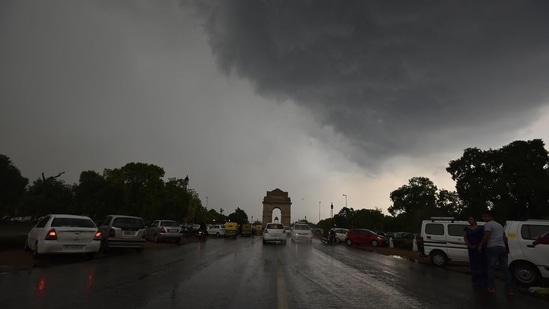
As rain leaves Delhi thirsty again, experts focus on ‘heat island effect’
This was largely owing to the trough of the monsoon not moving sufficiently over Delhi and low-pressure areas persisting around Orissa, and not northwest India, Met officials said.
Although it rained in Punjab, Haryana and parts of Uttar Pradesh, showers largely gave Delhi a miss over the weekend, despite a yellow alert by the India Meteorological Department (IMD), which predicted light to moderate rainfall over the Capital.
Representative image. (Raj K Raj/HT PHOTO)
This was largely owing to the trough of the monsoon not moving sufficiently over Delhi and low-pressure areas persisting around Orissa, and not northwest India, Met officials said. Independent experts, meanwhile, said the ‘urban heat island’ effect, which occurs when cities replace natural land cover with dense concretisation that absorb and retain heat, could be a factor at fault for the dry spell.
There was no rain in the Capital on Saturday night and in the early hours of Sunday. Only the Ridge weather station recorded trace rainfall. On Sunday, rainfall eluded most parts of Delhi, with only regions in the city’s southwest receiving some drizzles. Jafarpur recorded just 4mm of rainfall, trace rainfall was recorded at Palam and Ayanagar between 8.30am and 5.30pm, and no rainfall at all at any of the other weather stations.
The situation might not see any drastic change till July 16. Forecast for Monday shows there are chances of drizzles in some parts of Delhi, with temperatures hovering between 35°C and 27°C.
“We had forecast light to moderate rainfall, but it did not pan out that way as the monsoon trough did not shift suitably towards Delhi, and due to that, there were parts in northwest India without any rain,” said RK Jenamani, scientist at the national weather forecasting centre of the Met department.
“At present, there is a low-pressure area over Orissa and so sufficient moisture is not able to reach Delhi,” he added.
Delhi recorded a maximum of 34.9°C on Sunday, one degree below normal, with overcast conditions.
The minimum temperature was 27.5°C. Relative humidity remained high, oscillating between 66% and 89%.
Factors such as the urban heat island effect, aerosol formation and the changes in land-use patterns could be impacting rainfall in the region, experts said.
Despite moisture arriving into northwest India from the Arabian Sea and the Bay of Bengal, Delhi has not been lucky, with urban heat island possibly playing a role, according to Mahesh Palawat, vice president of meteorology and climate change at Skymet Weather Services, a private forecaster.
“We have seen substantial rain in Punjab, Haryana and even Uttar Pradesh, but it missed Delhi. When there is increasing concretisation, the heat being generated from these urban heat islands can sometimes cause rain clouds to evaporate faster, and therefore, they are not able to reach the heart of the city,” Palwat said. “This is what could be happening with Delhi.”
Predicting localised rainfall is generally accurate two to three days in advance, with the forecasting accuracy reducing after that, said M Rajeevan, former secretary at the earth sciences ministry.
“It is unsure why the IMD has been unable to forecast rainfall correctly, but it can be challenging sometimes as Delhi is fairly small in size and rain clouds can sometimes end up giving rain in neighbouring Haryana and Uttar Pradesh, but not Delhi,” he said
Forecasts now need to incorporate external factors such as the urban heat island effect, aerosol effect and changes in land use to get a better picture, Rajeevan said.

 E-Paper