E-Paper



Big weather conditions help Delhi's air
Stubble burning is nearly nil. Vehicular emissions remain a problem. But when wind speeds pick up, Delhi begins to breathe again. Monday was a case in point

 Prefer HTon Google


The peak stubble-burning season has come and gone. The fire count from Punjab reached a peak of 3,230 incidents on November 5 and as of November 27, had come down to zero. Yet Delhi continues to choke. The reason? Only a definitive meteorological event can resuscitate the national Capital that has been gasping for good air.
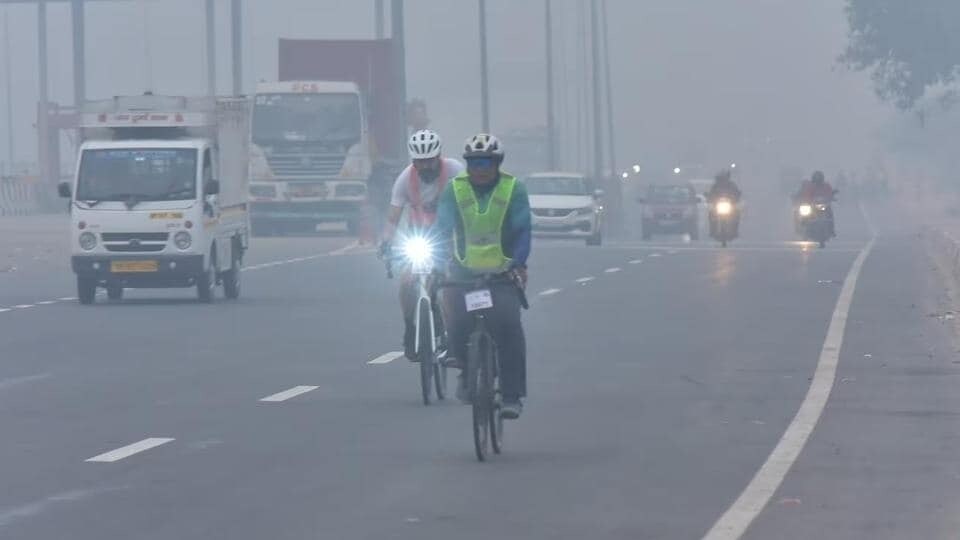
In the past two months, biomass burning was the major pollutant in days with ‘severe’ AQI. Vehicular emissions are also to blame. The restrictive measures under the Graded Response Action Plan (GRAP) banning vehicles of various fuel categories did not help improve the air quality in a significant way. What did help were high-speed winds, storms, and heavy rains.
For instance, the 24-hour average AQI of Delhi was 437 in the ‘severe’ category on November 9. After a good rain spell overnight the AQI on November 10 was 158 notches down to 279 in the ‘poor’ category. The maximum wind speed recorded on that day was 30kmph, according to IMD.
“Long-range transported dust, stubble burning smoke from Punjab along with local emissions hold the pollutants within the city. This usually does not improve unless the wind speed gets better during this season. The hope now only is if the current western disturbance leads to rainfall over the Indo-Gangetic plains that also brings rainfall over Delhi by the end of the week. We will have to wait and see how that turns out,” said D Saha, former head of CPCB’s air lab.
At 7 am on Monday, the hourly average AQI was 402. The 24-hour average AQI of Delhi was recorded at 395 in the 'very poor' category, as per readings recorded till 4 pm. However, high-speed winds started by early afternoon and reached around 20 kilometres per hour. At 8 pm, the hourly AQI of Delhi was 360 and the 24-hour average at the same time was 394. The city saw light rain over some parts, with gusty winds and thunderstorms — as well as hailstorms in some isolated parts of south and east Delhi — towards late evening. By 8:30 pm, 7.2mm rainfall was recorded at Safdarjung and 2.3mm at Palam, according to IMD. Officials said that the increased wind speed on Monday is likely to impact the 24-hour average AQI recordings for Tuesday.
“As the western disturbance hit the city, we saw winds of around 20 kmph at Palam and 12 kmph at Safdarjung in the afternoon. This increased to around 50 kmph by evening in some parts. Such gusty winds are usually seen during the monsoon season when it rains. During the last western disturbance on November 9-10, the wind speed went up to 30 kmph,” said Kuldeep Srivastava, a scientist at India Meteorological Department (IMD).
In other words, as wind speeds picked up and the pollution metrics improved.
A similar pattern was observed in October.
“The predominant surface wind was from northwest directions of Delhi with a wind speed of around 10-16 kmph and mainly clear sky on October 21. This will change to west/southwest with a speed of 08-20 kmph and mainly clear sky October 22,” the forecast predicted.
The season’s first ‘very poor’ AQI was recorded on October 22 at 313, which improved to the ‘poor’ category by the following day. After staying poor for five consecutive days, the AQI started increasing again on October 28 and touched the ‘very poor’ category at 304. This condition persisted till November 2 — the wind speed on these days was low, around 4 kmph. On November 3, the AQI was in the ‘severe’ category.
The season’s longest spell of ‘severe’ air quality continued for seven days from November 3 to 9 with a brief respite on November 7 when the 24-hour average AQI was 395, barely five points from the ‘severe’ cut-off mark. The big respite came only on November 10 when western disturbance induced rains across Delhi NCR, settling the pollutants and bringing down AQI considerably. This also helped keep pollution levels in check during Diwali despite gross violations of GRAP norms and crackers being burst across cities in Delhi and NCR.
The AQI reached ‘severe’ again on November 16 and has not seen much improvement since then. The AQI has been switching between ‘very poor’ and ‘severe’ categories since November 16 depending on the meteorological conditions like predominant wind speed as well as the contribution of local pollutants.
Experts say that November is usually characterised by calm winds particularly at night as it is a transitional month towards winter, following the withdrawal of monsoon around October.
“Usually, as the monsoon withdraws, wind direction over Delhi NCR changes from easterly to north-westerly. Earlier, it wasn’t a big problem as the stubble would end by September. However, around 2011 onwards, the annual trend has been that stubble burning continues till November bringing polluted air to Delhi NCR. This, coupled with local pollutants, and easterlies merge over Delhi NCR and trap the pollutants. Breezy weather due to conditions like the western disturbance is the only way that pollutants can disperse. As the western disturbance leaves Delhi, it is expected that the wind speed will increase leading to some respite,” said Mahesh Palawat, vice president, of climate and meteorology at Skymet Weather.
Low wind speed traps pollutants close to the surface and subsequently causes inversion — a phenomenon when pollutants create almost a lid over the city and lead to poor visibility throughout the day.
Experts say that locally, the traffic, industrial emissions, local dust, lack of greening efforts in dust-prone areas and overall move towards making a ‘concrete jungle’ megapolis in the national Capital have added to the pollution levels in the city that remain high during the winter months.
“We have seen that the episodic rain preceding Diwali resulted in one of the cleanest pre-Diwali ambient air quality but the air quality quickly turned hazardous soon after the rains stopped and high emissions accumulated in the air, this shows that mercy of favourable meteorological factors that have been helping Delhi breath so far will never be able to provide sustained clean air and the meteorological factors can’t be controlled but emission load can be reduced with strong political will and decisive actions,” said Sunil Dahiya, analyst, Centre for Research on Energy and Clean Air (CREA).
Experts add that the authorities in Delhi now need to divert focus from short-term ‘emergency’ steps taken during winter months under GRAP to long-term systemic changes for pollution control.
“While sporadic relief comes in the form of rain or increased wind speed, these occurrences are beyond human control. To ensure a sustainable solution and deliver clean, breathable air, it is imperative for our authorities and regulators to adopt and implement proactive and systematic measures for emission load reduction throughout the air-shed,” said Dahiya.
Correction: An earlier version of this report erroneously mentioned that the stubble burning figure on November 27 was 12. This figure has been corrected to reflect the accurate figure of stubble burnings recorded on November 27, which is 'zero'.