
 E-Paper



Bill to unify 3 MCDs tabled in Parliament
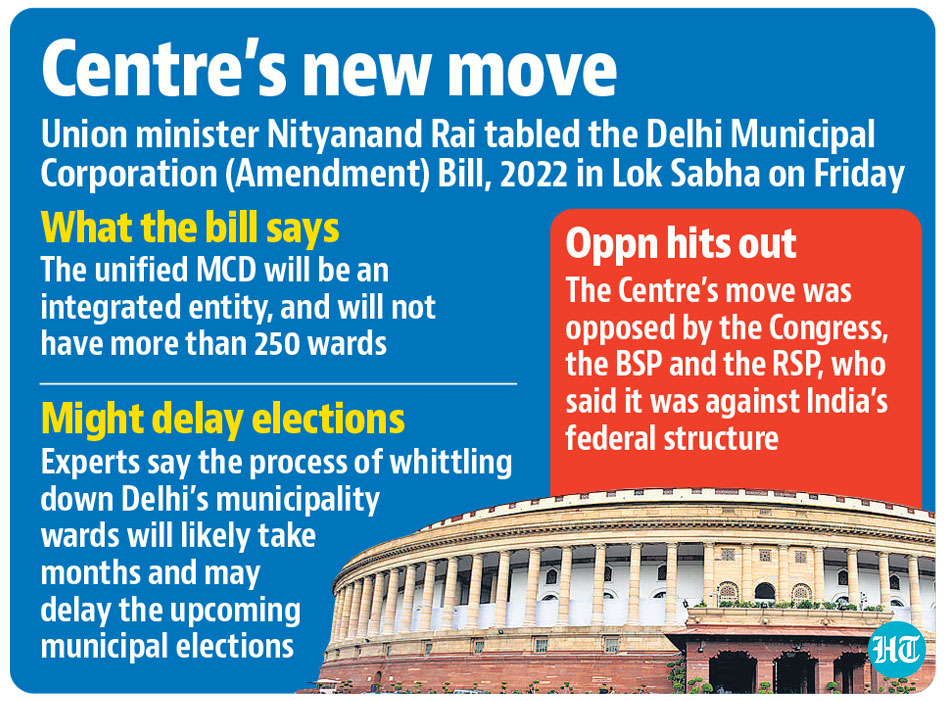
The bill also seeks to whittle down the total number of municipality wards in the city from 272 at present to no more than 250, a process that experts said will likely take months.


The Delhi Municipal Corporation (Amendment) Bill, 2022, which seeks to reunify the Capital’s three municipal corporations, was on Friday introduced in the Lok Sabha, a move that is likely to significantly delay the city’s civic elections and deepen the political row between the Aam Aadmi Party (AAP) in power in Delhi and the Bharatiya Janata Party (BJP) at the Centre.
The bill also seeks to whittle down the total number of municipality wards in the city from 272 at present to no more than 250, a process that experts said will likely take months. Delhi’s municipal ward boundaries were last redrawn between 2016 and 2017 and the process took around 16 months.
Tabling the bill, minister of state for home affairs Nityanand Rai said it will create a unified Municipal Corporation of Delhi (MCD) as “a single, integrated and well-equipped entity”. The move was later slammed by Delhi’s deputy chief minister and senior AAP leader Manish Sisodia, who said it amounted to “murdering democracy”.
“The BJP is so terrified of the Arvind Kejriwal government that instead of running the country, the Prime Minister is taking an interest in running MCD. It must be the first time in India that the ruling party has brought a Bill to stop a municipal election fearing defeat from a small party like AAP. In the guise of the Bill, the BJP is killing democracy by stopping MCD elections. But, the people of Delhi have decided that only AAP will come to MCD, whether elections are held now or after 6 months, or after a year,” Sisodia said in the Delhi assembly on Friday.
The bill appears to give a greater authority to the central government by specifying that the word “government” will be replaced with “central government” in at least 11 sections of the current legislation, the Delhi Municipal Corporation Act (DMC), 1957. These pertain to naming or resizing any zone or ward, listing out the obligatory functions of the MCD, rules on declaration of assets of councillors, the appointment and pay scale of the commissioner, approvals for loans and action against any councillor or MCD official.
It was not clear if the proposed changes would impact the funding of the corporation, or the prerogative of the committees of the elected representatives of the civic body.
The change in wording may, however, weaken the link between the state government and the civic body by further limiting the role of the state’s urban development department, which used to be the gateway for all major files and documentation.
The bill defines the broad contours of the unified MCD, indicating that it will have one official as the chief of the unified MCD, which in the interim or transition period will be a “special officer” and later, after the elections, the commissioner appointed by the Centre.
The bill also states that the commissioner shall exercise their powers and discharge functions on “building regulations” under the general superintendence and direction of the central government.
To be sure, the commissioner simply green-lights policies approved by MCD’s elected councillors.
The bill proposes that while the size of the lower rank staff will not change much, the number of higher rank officials will be reduced to a third of what it is at present. It also gives transitionary powers to the Centre to make amendments to remove any anomalies for a period of two years.
The bill does not mention the details of how exactly the transition will be carried out in terms of administrative changes.These specifics, according to people aware of the matter, are likely to be laid out in the rules, regulations and bye-laws of the Act, once the law comes into effect.
The Centre will issue gazette notifications for all major exercises during the transition phase, from naming the special officer to the delimitation process, the bill proposes.
The state election commission (SEC), which had sought legal opinion on the matter, did not comment on the introduction of the Bill on Friday.
Reports of the potential reunification of the municipal corporations (which was split by the then Sheila Dikshit-led state government in 2012) triggered a war of words between the AAP — which was the front-runner for the civic polls this year — and the BJP, which has governed the civic bodies for 15 years now.
On March 9, the Delhi state election commission postponed the announcement of the schedule for the civic polls at the last minute, citing communication from the Centre that alluded to a possible reunification of the corporations.
Since then, Delhi chief minister Arvind Kejriwal has accused the BJP of “running away” from the elections for fear of losing them. In a scathing attack at the BJP in the state assembly on Thursday, Kejriwal said the party’s aim was not to unify the corporations, but to defer the elections.
“This would not have happened anywhere in the world that a PM is getting an election deferred by directly calling and sending a letter to the election commission,” Kejriwal said. “The nation won’t tolerate the drama they’re doing. They say they are the largest party in the world. We are the smallest. Still, they got scared! The largest party in the world got scared of the smallest party. Contest polls if you have the courage,” he added.
The BJP, however, has maintained that unification was essential for reform in the city’s civic bodies, which have for a decade been dogged by protests over delayed salaries, inefficiency, corruption, and a bloated hierarchy. All three MCDs are currently run by the BJP.
Delhi BJP chief Adesh Gupta said, “The Delhi government has made the corporations financially unviable. The bill will strengthen the corporations so that the people of Delhi can benefit. Today, we are unable to pay salaries and don’t have funds to carry out essential development work. All these issues have to be sorted first.”
The Centre’s move to introduce the Bill in Parliament was opposed by the Congress, the Bahujan Samaj Party and the Revolutionary Socialist Party, who said it was against India’s federal structure, and added that the powers to amend laws concerning the civic bodies in Delhi lay with the elected state government.
Manish Tewari, the Congress MP from Punjab’s Anandpur Sahib, said the Lok Sabha does not have the legislative competence to enact this Bill. “The statement of objects and reasons of this Bill mentions that in 2011 this Act was amended by the legislative assembly of the national capital territory of Delhi vide the DMC (Amendment) Act, 2011 leading to the trifurcation of the corporation. After part 9(A) was inserted into the Constitution of India with effect from June 1, 1993, the power to constitute municipalities lies with state governments in terms of Article 243 (P&R) of the Constitution of India,” he said.
“…If any House has the legislative competence to unify these three municipalities, it is the Delhi Assembly and not this House. This House cannot substitute itself for the Delhi Assembly and pass this legislation in an illegal manner. This is a very serious Constitutional issue,” he added.
Responding to objections raised by the opposition, Rai said the Bill does not violate the spirit of the Constitution.
“According to Article 239AA of the Constitution of India, Parliament has the power to amend or form laws on any matter formulated by the Delhi assembly. At the time when the MCD was trifurcated, the expectation was that it would lead to Delhi’s progress. It was thought that the services provided by the MCDs will improve and there will be welfare of its workers. But, none of these happened in the last 10 years. The Bill has been introduced for greater transparency, improved governance and more efficient delivery of civic service for the people of Delhi, and to ease the financial crisis faced by MCDs at present,” Rai said.


Stay updated with all top Cities including, Bengaluru, Delhi, Mumbai and more across India. Stay informed on the latest happenings in World News along with Delhi Election 2025 and Delhi Election Result 2025 Live, New Delhi Election Result Live, Kalkaji Election Result Live at Hindustan Times.


