
 E-Paper



Decades on, Delhi still under siege by monkeys as relocation efforts falter
For millions of residents, monkeys remain an everyday hazard, shaping daily routines around avoidance of monkey encounters.


A 33-year-old government officer was critically injured on Monday after falling from the seventh floor of Shastri Bhawan while trying to escape a monkey attack. The man, who was on a phone call near a balcony when the animal startled him, lost balance and plunged down – the incident a reminder of the 2007 case when Delhi’s deputy mayor SS Bajwa died after being attacked by monkeys at his home in Vivek Vihar.
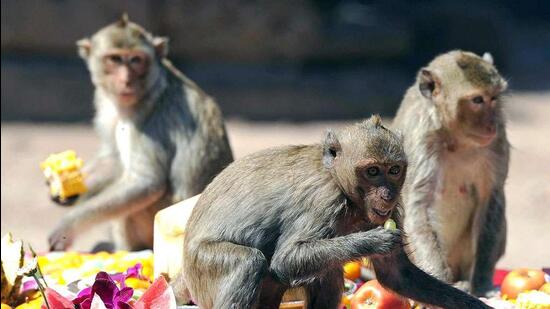
The Bajwa case had pushed the Delhi High Court to direct relocation of monkeys to the Asola Bhatti Wildlife Sanctuary. But nearly two decades later, and despite claims that more than 25,000 rhesus macaques have been shifted there, the Capital continues to live under a simian siege. For millions of residents, monkeys remain an everyday hazard, shaping daily routines around avoidance of monkey encounters.
The years-old relocation programme has moved at a crawl, experts and officials said, hampered by a shortage of trained catchers, legal disputes over who controls the issue, and the absence of barriers at Asola, which has no natural food sources and no fencing, allowing monkeys to return easily to residential neighbourhoods.
The result, officials explained, has led to patchwork of improvised measures by agencies --Langur cutouts at intersections, hired workers to chase monkeys away from VVIP areas -- exposing the administrative failure in tackling the issue.
According to an MCD official, only 10 private monkey catchers are currently on the civic body’s rolls. “These hired contractors catch monkeys on a complaint basis and hand them over to the sanctuary. They are paid ₹1,800 per capture, but very few people are willing to work because of the legal challenges they face,” the official, who asked not to be identified, said.
Data shows the scale of the problem. MCD relocated 1,654 monkeys in 2022-23, 1,788 in 2023-24, 1,483 in 2024-25, and 359 till July this year.
The New Delhi Municipal Council (NDMC), covering Lutyens’ Delhi, has focused more on “repelling” monkeys. One contractor hired last September captured 402 monkeys in 2025. It has deployed 30 field workers across VVIP zones and placed Langur cutouts at 41 sensitive sites -- from embassies to the Delhi High Court and Safdarjung Airport.
Policy confusion
For years, agencies have sparred over whether monkeys were wild animals under the forest department or strays that fall under municipal control. The 2022 amendments to the Wildlife Protection Act removed Rhesus macaques from the schedule of protected species, technically making them a civic issue. The forest department, consequently, shelved plans for a census and sterilisation drive.
The absence of a coordinated strategy has left entire neighbourhoods exposed. Residents across central Delhi, those in CR Park, Sukhdev Vihar, Kamla Nehru Ridge, Delhi University, Model Town, ITO, Bhajanpura, Uttam Nagar, and parts of Delhi Cantonment report regular harassment. Monkeys invade homes, steal food, ransack offices, and sometimes even turn violent.
Atul Goel, who heads the United RWAs Joint Action – a collective body of RWAs – said: “A few years ago, we had no monkey-related complaints from areas like Karol Bagh, Patel Nagar, Rajinder Nagar, Shalimar Bagh, but that has changed now. Catching a few monkeys are transferring them to forest with no food is no solution. They simply move to adjoining areas. Delhi will have to work on a comprehensive plan to create proper habitats for them with natural food sources in the forest areas. Fruit bearing trees need to be added in ridge and forest areas along with comprehensive relocation.”
Former director of veterinary services Ravindra Sharma said the solution must be multi-pronged: “We need to raise fencing at Asola, add natural food sources, undertake sterilisation drives and build awareness around food waste. The issue demands a holistic approach.”
This means that the sight of monkeys prowling outside government offices, clambering over apartment balconies, and raiding fruit carts is as common today as it was two decades ago.
Other solutions: Vermin?
Some officials have floated the idea of declaring monkeys “vermin,” enabling culling. But biologists argue this is neither practical nor ethical.
Ecologist Sohail Madan, director of the Wild Tales Foundation, warned against repeating Himachal Pradesh’s failed experiment. “Culling is not a solution. The real issues are food security and waste dumping. Feeding monkeys and our disposal of waste have fundamentally changed the way they interact with us. Sterilisation works only if an entire troop is targeted at once.”
Madan, who earlier managed the Asola sanctuary with the Bombay Natural History Society, said even artificially feeding monkeys there has failed: “We had to change the landscape to accommodate them, but it hasn’t worked. They keep coming back.”
Wildlife researcher Faiyaz Khudsar argued that the vermin debate is outdated. “They are no longer under the Wildlife Protection Act. This is now a civic issue. Civic bodies must act—limit artificial feeding, capture and release where densities are high, and restore forest cover with native species to provide natural food.”

Stay updated with all top Cities including, Bengaluru, Delhi, Mumbai and more across India. Stay informed on the latest happenings in World News along with Delhi Election 2025 and Delhi Election Result 2025 Live, New Delhi Election Result Live, Kalkaji Election Result Live at Hindustan Times.


