
 E-Paper



Delhi air stays ‘severe’ for second day, relief not likely till tomorrow
Analysis by the Union ministry for earth sciences’ System of Air Quality and Weather Forecasting and Research (Safar) suggested that the high pollution recordings on Saturday were mostly caused by local sources

 Prefer HTon Google


Delhi’s air pollution levels remained in the ‘severe’ zone on Saturday for the second straight day, as the city logged an air quality index (AQI) of 402, according to the 4pm bulletin released by the Central Pollution Control Board.
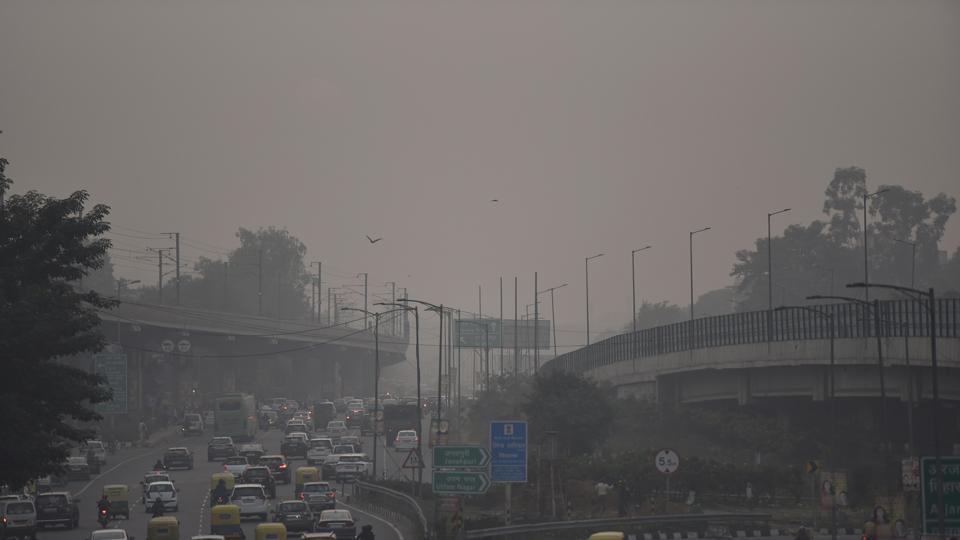
India Meteorological Department (IMD) officials warned that an improvement in pollution levels are unlikely at least till Monday, owing to slow winds.
“Calm winds are not allowing pollution particles to disperse properly. Similar conditions are likely to continue till November 29. On Sunday, the AQI levels are likely to be in the upper end of very poor zone,” said VK Soni, head of IMD’s environment and research centre.
Delhi logged an AQI of 406 (severe) on Friday, and 400 (a notch short of severe) a day before that.
The polluted air also affected visibility levels in the city.
Senior IMD scientist RK Jenamani said, “Till 10am, the visibility here was around 400-800 metres which improved to 800-1,200 metres later in the day. Delhi largely recorded calm winds throughout Saturday. At the Safdarjung airport, winds picked up for a short duration and reached around 5-7kmph, but that was not enough to help the dispersion of pollution.”
He said that at the Palam airport, which saw a maximum wind speed of 10-15kmph, the visibility levels improved from 1,200-1,800 metres in the morning to 2,200 metres by afternoon.
Analysis by the Union ministry for earth sciences’ System of Air Quality and Weather Forecasting and Research (Safar) suggested that the high pollution recordings on Saturday were mostly caused by local sources.
The share of stubble fires in Delhi’s PM 2.5 (particulate matter with diameter less than 2.5 micrometres) was 6%.
Safar also analysed Delhi’s pollution in two scenarios — when stubble fires peaked, and when it was lower.
Between October 30 and November 3, when the share of stubble fire in Delhi’s pollution was low, the share of stubble smoke from Punjab and Haryana was only 8% even as local sources contributed to nearly 69% to the Capital’s air pollution.
External sources had a 23% share in the pollution levels.
In the second scenario, when farm fires increased between November 9 and 13, its share spiked to 30% while the contribution of local sources remained around 52%.


