
 E-Paper



Delhi Cabinet clears private university Bill with 25% quota for Delhi students
The proposed law will allow private and foreign universities in Delhi, promote vertical campuses and reserve 25% of seats for Delhi students.

 Prefer HTon Google


The Delhi cabinet on Friday approved a draft law to create a legal framework for setting up private universities in the Capital, proposing provisions that will allow “vertical campuses” suited to a land-constrained city, reserve 25% of seats for Delhi students and permit foreign higher education institutions to establish campuses in Delhi, among others.

Bill to be introduced next week
The Bill will be introduced in the Delhi Legislative Assembly for consideration next week during the ongoing session.
The move assumes significance as Delhi currently does not have legislation governing the establishment of private universities, despite being a major higher education destination.
Also read: Delhi govt set to bring private universities bill next week
Announcing the cabinet decision, education minister Ashish Sood said the legislation was aimed at reversing the long-standing trend of Delhi students leaving the city for higher education.
“For decades, Delhi witnessed a strange paradox. The Capital of India became the destination for students preparing for higher education, but not for pursuing higher education itself. While neighbouring states established world-class private universities, Delhi’s students were compelled to leave their own city in search of quality institutions. Today, we have corrected that historic anomaly. This legislation is not merely about establishing private universities, it is about ensuring that Delhi’s youth receive world-class educational opportunities within their own city,” Sood said.
Vertical campuses for land-scarce Delhi
Recognising Delhi’s limited availability of land, the proposed framework does not prescribe any minimum land or built-up area requirement, explained a senior official, who asked not to be identified.
“Instead of insisting upon large horizontal campuses, the legislation promotes a modern regulatory framework focused on academic quality, infrastructure adequacy, research capability, student facilities and governance standards. This enables the development of high-quality, vertical and urban campuses suited to a land-constrained city like Delhi,” the official said.
To be sure, the draft Bill requires sponsoring bodies to demonstrate lawful possession of land for at least 30 years and provide adequate academic infrastructure, including laboratories, libraries, digital resources and student facilities. Shared infrastructure arrangements with other institutions and public authorities will also be permitted.
Also read: Delhi to be developed into education hub: CM Gupta
Foreign universities, off-campus centres allowed
The proposed law also seeks to encourage multidisciplinary private universities, permit off-campus centres of universities from elsewhere in India and allow reputed foreign higher education institutions to establish campuses in Delhi, subject to University Grants Commission (UGC) norms. It also seeks to align the Capital’s higher education ecosystem with the National Education Policy (NEP) 2020.
Private universities may be established as greenfield or brownfield multidisciplinary institutions. Existing higher educational institutions from elsewhere in India may also be permitted to open off-campus centres in Delhi. The universities will function as unitary institutions and will not be allowed to affiliate colleges, although they may establish constituent colleges, regional centres and additional campuses within Delhi, subject to UGC regulations.
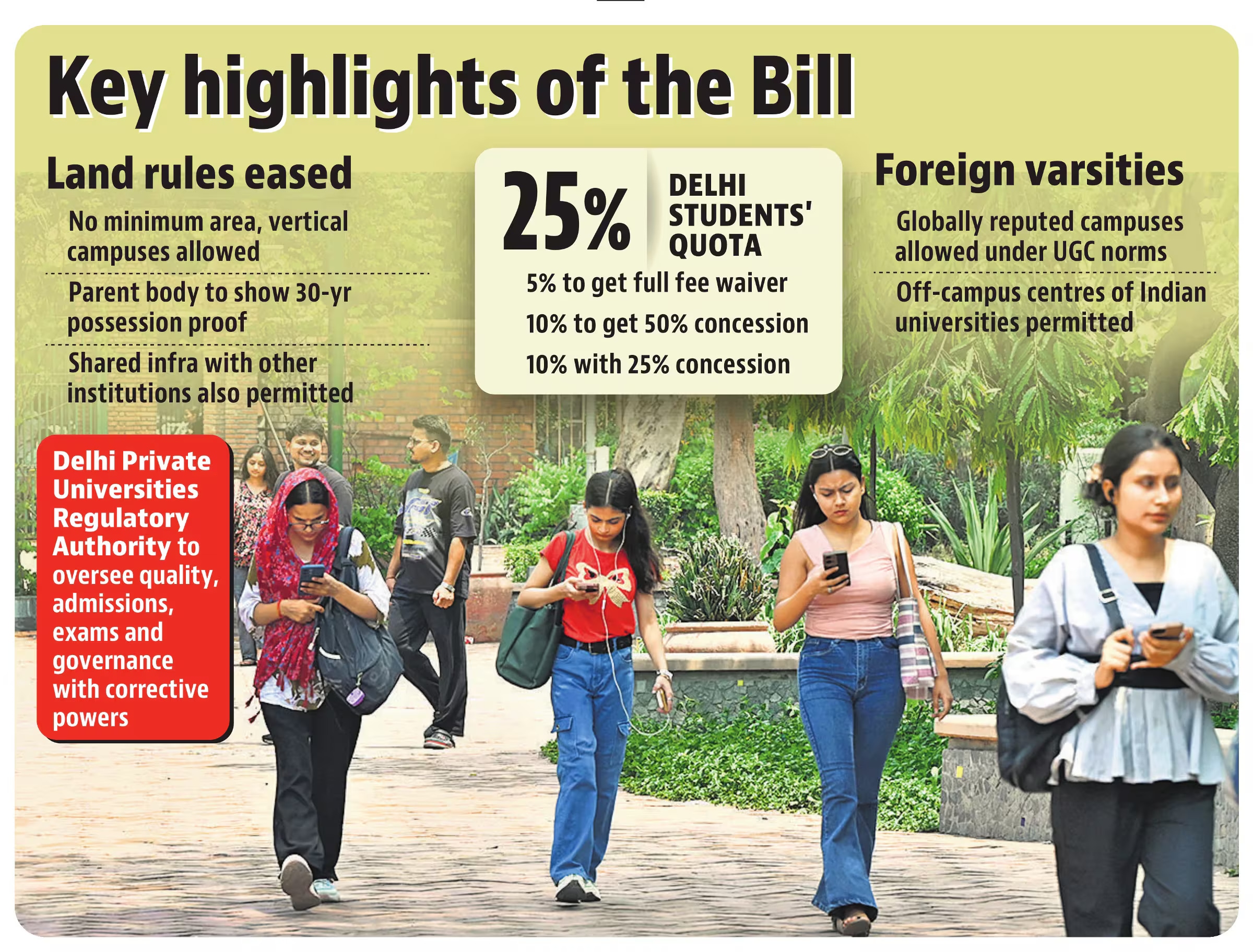
The draft also proposes reserving 25% of seats in every course for Delhi students in accordance with the applicable reservation policy. Of these, 5% of seats will receive full fee waivers, 10% will receive 50% fee concessions and the remaining 10% will receive a 25% concession on a merit-cum-means basis.
Universities will also have to disclose the fee structure for the entire duration of a course at the time of admission, with no fee enhancement permitted during the course.
Also read: Centralised education policy can’t deliver true reforms
New regulator to oversee universities
Proposals to establish universities will be scrutinised by an expert committee comprising senior government officials, UGC representatives, finance experts and academicians. The committee will assess the financial capability and educational credentials of the sponsoring body, the relevance of proposed academic programmes and their alignment with NEP 2020 before recommending approval.
Further, it also proposes creating a Delhi Private Universities Regulatory Authority to oversee quality standards, inspections, admissions, examinations, student records and governance, and issue corrective directions where necessary.
The legislation stipulates that private universities will be self-financing and will not be entitled to government grants, although they may compete for government-funded research projects and academic funding under applicable rules.
The government said the proposed framework aims to attract investment, strengthen research and innovation, generate employment and position Delhi as a national and international higher education hub.
Frequently Asked Questions



Stay updated with all top Cities including, Bengaluru, Delhi, Mumbai and more across India. Stay informed on the latest happenings in World News along with Delhi Election 2025 and Delhi Election Result 2025 Live, New Delhi Election Result Live, Kalkaji Election Result Live at Hindustan Times.


