
 E-Paper



Delhi: Share of farm fires in bad air on rise, may peak near Diwali
Experts said the stubble smoke coupled with firecracker-bursting across states in north India during Diwali (November 4) is likely to push the Capital’s air into hazardous zone.

 Prefer HTon Google


Rain and favourable wind might have delayed the onset of winter pollution in the national capital, but air quality forecasts for the coming days suggest that Delhi is headed towards an air emergency as stubble fires are expected to peak -- coinciding with Diwali (to be celebrated on November 4), when pollution levels usually spike because of large-scale bursting of firecrackers in violation of bans.
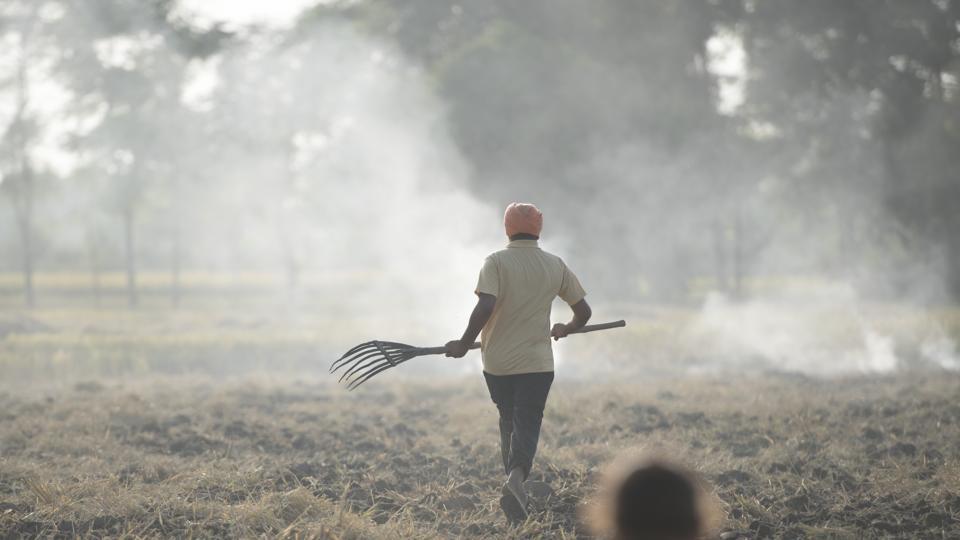
Air quality forecast by the Indian Institute of Tropical Meteorology’s (IITM) decision support system — an air quality monitoring and forecasting system that helps government agencies take prompt decisions to prevent pollution peaks —said the contribution of stubble smoke in Delhi’s PM 2.5 (particulate matter with diameter less than 2.5 micrometres) levels is expected to reach around 65% by the first week of November. The current contribution of farm fires to Delhi’s particulate matters is around 40%.
Experts said the stubble smoke coupled with firecracker-bursting across states in north India during Diwali (November 4) is likely to push the Capital’s air into hazardous zone.

The air quality forecast for Delhi says stubble fires are likely to peak in parts of Punjab and Haryana from October 27. On October 27, the share of stubble smoke in Delhi’s PM 2.5 levels is likely to be 43.28%, and in the next few days the contribution of smoke from farm fires will climb to nearly 65%.
The forecast also shows that during the first week of November, leading up to Diwali, stubble smoke share will remain 60-63%.
The Supreme Court has banned the use of conventional firecrackers. This year, the government has said firecrackers cannot be used as the ban remains in force.
Experts said that the delayed withdrawal of monsoon from north India and the heavy post-monsoon showers in the month of October has resulted in the slow start to the stubble burning season this year as compared to previous years. This, however, does not surely indicate that this time there will be a drop in the cumulative stubble fire numbers in the agrarian states of Punjab and Haryana, where carry out the practice in order to clear their fields quickly for the next cropping season.
Experts also pointed out that no rains are predicted for the coming week; and the number of stubble fires being spotted on satellite imagery started seeing a rising trend.
LS Kurinji, programme associate at the Council on Energy, Environment and Water (CEEW), said smoke from farm fires, coupled with the risk of large scale cracker bursting, emissions from local sources and dropping temperature will worsen the air quality in Delhi-NCR in the coming days, and that the government agencies need to tighten action against pollution sources to prevent a severe spike in pollution levels.
“We are already in the last week of October and have witnessed over 6,678 and 2,820 fires in Punjab and Haryana between September 1 and October 25. So far, farm fires have remained lower this year compared to the corresponding period in the previous years, but satellite-derived fire events data over the last few years indicate peak (stubble) burning between late October and early November with fire count ranging from 3,000-4,000 per day,” Kurinji said.
She added, “The smoke from farmlands coupled with emissions from local sources, declining temperatures and reducing wind speeds will deteriorate the air quality in NCR and beyond. Deeper and timely emission cuts across sectors are needed to keep pollution levels under check in the region.”
According to the data procured from Punjab Remote Sensing Centre (PRSC), between September 1 and October 26, 6,463 fires were reported from the state this season. On Tuesday, 329 fires were reported in the entire state, out of which the most were reported from Faridkot (56), Tarn Taran (55), Patiala (53) and Muktsar (33).
According to their data, in 2020 Kharif season, 76,590 stubble fires were reported between September 1 and November 30. In 2019, there were 55,210 incidents of farm fires, it said.
“This year because of delayed monsoon withdrawal and several episodes of rain and cloudy skies, which prevents satellite from detecting stubble fires, the number of such fires have been very low compared to the same period last year. But we will have to wait and watch because burning of stubble continues till November 15, before it drops,” a senior official of the PRSC said, asking not to be named.
Anumita Roychowdhury, executive director (research and advocacy), Centre for Science and Environment (CSE), explained that analysis of winter pollution in the last few years has shown that Delhi tends to record its first smog episode around Diwali.
“This concentration of pollution because of delayed stubble fires and Diwali crackers, because of late monsoon withdrawal was something that we all had anticipated, what needs to be seen is how severe this peak is going to be and how prepared the governments are to handle this peak,” said Roychowdhury.
She added, “The governments will have to work together to come up with a plan to stop the worst. Delhi might have banned crackers but it will still be impacted by cracker emissions in the neighbouring states. For preventing stubble fires, the governments need to provide farmers with the required machinery and assistance so that they are not forced to set their fields on fire.”


