E-Paper



Corridor proposed in Delhi to unclog key stretch to Dhaula Kuan
NDMC officials said the proposal is in its initial stages and the civic body will explore the feasibility of the project.

 Prefer HTon Google


The Delhi Traffic Police has proposed that a 5.3km signal-free corridor be built between the Dhaula Kuan flyover and Talkatora Stadium to decongest Sardar Patel (SP) Marg, a key access route between Central Delhi and the Indira Gandhi International (IGI) airport. The proposed corridor will be elevated or have tunnels, and will pass through the Central Ridge, officials associated with the project said on Tuesday, adding that it will also facilitate VIP movement.
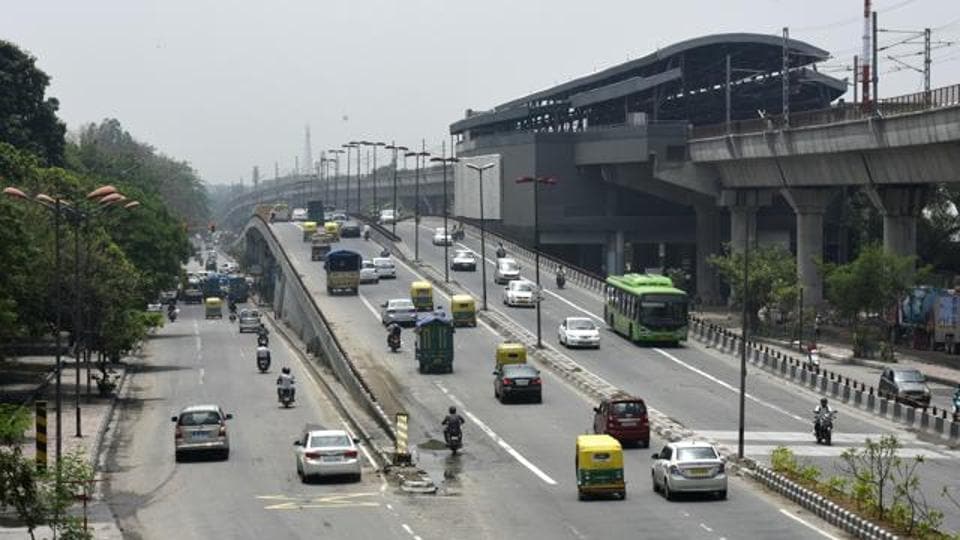
However, experts warned that the corridor may result in high environmental costs, and pointed out that building tunnels in the Aravalli rock strata of the Central Ridge may prove difficult. The experts instead suggested that the existing SP Marg be redeveloped to cater to a higher traffic volume.
The plan was tabled at a New Delhi Municipal Council (NDMC) meeting on May 15, civic body officials said. HT has seen a copy of the proposal.

R Sathiyasundaram, additional commissioner of police (traffic), in a letter addressed to the NDMC chairman, said SP Marg connects the New Delhi area with IGI airport via NH-48, and important government and commercial establishments are located in the vicinity of this road. “Consequently, it witnesses heavy volume of time-specific directional traffic which is why it is one of the traffic choke points during the peak hours. To make matters worse, time and again buses and LGVs suffer breakdown on SP Marg, leaving general public stuck with no other option to reach Dhaula Kuan,” the communication said.
The letter also noted that Vande Mataram Marg — which runs parallel to SP Marg and connects Jhandewalan to Dhaula Kuan — witnesses heavy traffic volume throughout the day, and VIP route movements lead to increased congestion on this stretch. “It is imperative to construct a flyover or tunnel from Talkatora to Dhaula Kuan which will provide multiple benefits,” the plan said.
Also Read: Encroachments, broken roads make commuting difficult on Old Delhi Gurgaon road
NDMC officials said the proposal is in its initial stages and the civic body will explore the feasibility of the project.
One official said the plan proposes a tunnel or an elevated corridor between RR hospital and Talkatora Stadium, with two arms extending near the Dhaula Kuan flyover towards the Ring Road. “A smaller underpass is also proposed, that will pass beneath SP Marg and connect Simon Bolivar Marg with Panchsheel Marg. The signal-free corridor will also have two loops for access from Simon Bolivar Marg,” the official said, declining to be named.
Experts, however, warned that constructing such a corridor will face multiple challenges, and may cause irrevocable environmental damage.
Dr S Velmurugan, chief scientist and head of traffic engineering and safety division at the Central Road Research Institute (CRRI), said a tunnel may be difficult to construct in the Central Ridge due to the Aravali rock strata, and while an elevated corridor seems a preferred option, it will face multiple challenges in terms of tree cutting and an environment impact. “The Central Ridge area is full of trees, and even mobile towers are not allowed inside the area. SP Marg needs an alternative plan as the congestion levels are increasing, but the feasibility report for the project will have to explore how much relief can be provided by such a corridor and against what environmental cost. VIP movement should be managed by better intelligent traffic systems, and by informing commuters well in advance,” he said.
Sewa Ram, professor of transport planning at the School of Planning and Architecture, said the two-lane SP Marg has a large number of perpendicular feeder access roads on one side, and the Ridge on the other side. “While the capacity and traffic volume on these feeder roads has increased, the capacity of SP Marg remains stagnant. The 8-10 lane traffic from the IGI airport is subdivided into Ring Road, Vande Mataram Marg, SP Marg and other branches. SP Marg has frequent VIP movement and the two-lane road is not able to handle the shock wave and queue length build-up and very slow discharge,” he said.
He said a tunnel could be a better option if it runs along the Ridge line. “In no circumstance should the Ridge line be disturbed due to its environmental significance for the city. The alignment can be a mix of elevated section and underground tunnel to minimise the impact. Similar problems were faced during the construction of the Delhi Metro Airport Express Line,” he said.
Environmental activist Diwan Singh, who was the coordinator of the Ridge Bachao Andolan (Save the Ridge Movement), said the environmental cost for such a corridor will be very high. “The Ridges are the last remaining lungs of the city, and we should not trade them for new corridors. There is no end to new roads, which lead to an increase in demand and more cars on the road. Efforts should be made to control the demand for cars. If a corridor is allowed to be built through the Ridge, it will lead to more pollution in Delhi’s forest areas and will disturb one of the last remaining pockets of wildlife in the city,” Singh said.