E-Paper



Delhi University opens its seat allocation portal, session starts August 16
The portal was also launched for UG admissions to the School of Open Learning (SOL) and Non-Collegiate Women’s Education Board (NCWEB)

 Prefer HTon Google


Delhi University (DU) on Wednesday kicked off its undergraduate admissions process with the launch of an automatic seat allocation system that will assign applicants seats based on their Common University Entrance Test (CUET) scores and declared college-course preference.
The UG session will commence on August 16, said DU officials, nearly 2.5 months before it did last year.
Students vying for a seat at the sought-after university will need to register on the portal, called the Common Seat Allocation System (CSAS) — which was first used last year, when DU began admitting based on CUET scores — as part of the first phase of the entry process.
The portal was also launched for UG admissions to the School of Open Learning (SOL) and Non-Collegiate Women’s Education Board (NCWEB).
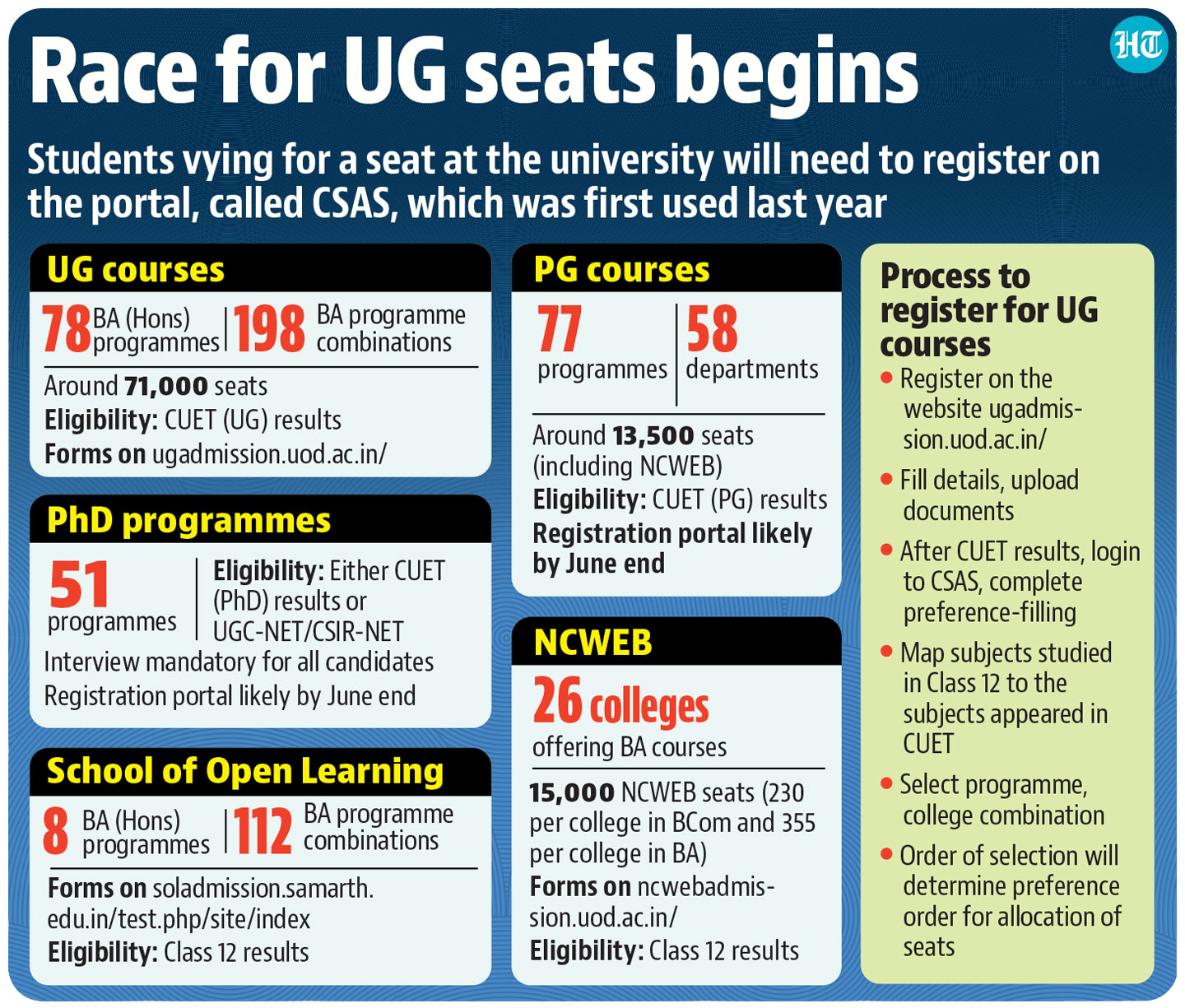
DU’s 68 colleges offer a total of 78 UG programmes and 198 BA programme combinations, its vice-chancellor Yogesh Singh said.
“DU offers around 1,550 unique programme and college combinations,” he said, adding that three new BTech programmes — computer science and engineering, electronics and communication engineering and electrical engineering have also been launched.
Till 2021, admissions to DU undergraduate courses were done on the basis of cutoff marks premised on Class 12 board exam scores. All applicants who met the criteria announced by the varsity for a particular course were eligible for admission to that course.
“Students are advised to begin registration and submit their personal details and other documents like Class 12 marks. Some details will be automatically updated by the portal, based on the CUET registration details. All details have to be filled carefully as they cannot be edited once submitted,” said Singh.
The next stage of admissions will commence after the CUET results when candidates need to specify their preferred course-college combination.
“The order of the programme and college combination selected then will become the priority list, which will determine allotments,” he added.
DU officials said once a seat is allocated in a particular round, the candidate must “accept” the allocated seat before the last date for the given allocation round, with inactivity or inaction to be taken as non-acceptance to the allocated seat.
After each allocation round ends, DU will publish the details of the vacant seats in each programme in all colleges. Admitted candidates can then opt for an upgrade or freeze their seat.
There will also be 77 postgraduate courses in 58 departments, with 13,500 seats available this year. However, the PG registration process is likely to commence towards the end of the month, Singh said.
“DU is also introducing a financial support scheme (FSS) to extend the benefits of equity and access to quality education to students from economically weaker sections (EWS) for the BTech programmes,” he said, unveiling the contours of the new programme.
“Candidates whose parents’ income is ₹4 lakh or less will be given a 90% fee waiver and between ₹4 lakh to ₹8 lakh will be given a 50% waiver. The university has also included a supernumerary quota for orphan students this year and all DU affiliated colleges will admit two candidates (one male and one female) under this quota at both UG and postgraduate (PG) levels,” the V-C said, adding that for BTech students at DU can get a reimbursement ₹50,000 for their new laptops.
DU said so far, BCom (hons) has emerged as the most sought-after UG course with around 130,000 students showing their interest in the subject during CUET UG, followed by BCom with around 126,000 students.
For PhD admissions, DU will be offering 51 different programmes, with the registration to once again commence tentatively towards the end of this month. Singh said candidates will be selected on the basis of CUET (PhD ) or on the basis of UGC-NET, CSIR-NET or other similar national based tests.
“However, the interview process will still be mandatory for PhD students, even after they are selected through these tests,” the vice chancellor said.
CSAS was introduced for the first time last year for DU admissions, with the University stating this year too, it had tried to put as much information as possible on the website in the form of bulletins with text, infographics, flowcharts illustrating eligibility and webinars and video recordings of filling on how to fill the form.
DU said unlike regular UG courses, admissions to the bachelor’s programmes of NCWEB and SOL will be based on the merit of the marks obtained in Class 12. SOL offers eight BA (Hons) programmes and 112 BA programme combinations. NCWEB offers two undergraduate programmes — BA and BCom in 26 DU colleges. Each college has 230 seats in BCom and 355 seats in BA, taking the total NCWEB seats to around 15,000.
DU also said it had identified 26 games and sports under its Sports Supernumerary Quota and 14 categories (including NSS and NCC) under the Extra Curricular Activities supernumerary quota.