
 E-Paper



Govt starts work on building database of Delhi’s migrants
Tens of thousands of migrant workers left the Capital after the Union government put in place a hard lockdown in March last year to limit the spread of Covid-19.

 Prefer HTon Google


The Delhi government is working on building an Aadhaar-linked database of all migrants in the city engaged in the unorganised sector, a move that comes in light of large-scale exoduses during the Covid-19 lockdowns in the Capital as tens of thousands of workers left Delhi for their towns and villages.
“In order to create a comprehensive database of migrant workers, the government of Delhi has also issued a letter to states from which majority of the migrant workers come to Delhi, namely Uttar Pradesh, Bihar, Haryana, Rajasthan, West Bengal, Jharkhand and Odisha, to share the database of migrant workers prepared by them,” showed Delhi government documents that HT has seen.
A senior Delhi government official said, “There is no integrated and complete database of migrant workers in Delhi so far, which affects government estimates and budget allocations... It is also a question of implementation and delivery. We recently saw how the government faced problems in accurately assessing the requirement of food grains for people — mostly migrants — without ration cards, which led to a shortage.”
The unorganised sector remains largely undocumented across the country, creating blind spots for the state and hindering policy drafting and implementation. Almost 90% of the country’s workers are employed in the informal unorganised sector.
The documents also highlighted that such a database will be essential to efficiently implement The Code of Social Security Act, 2020, which merges eight existing labour laws and is supposed to include migrant workers in the unorganised sector in its ambit. The Union government also began an independent survey of migrants across the country in 2020 and individual state databases are supposed to enhance its strength. The survey was suspended mid-March in the light of uptick in Covid-19 cases but is likely to resume soon, said a senior official, adding that the national database will be necessary to properly implement The Code of Social Security Act.
Further, the Supreme Court in May this year, during a suo motu proceeding in light of problems faced by migrant workers, identified the slow registration of workers in the unorganised sector as a major implementation flaw in schemes for their benefit.
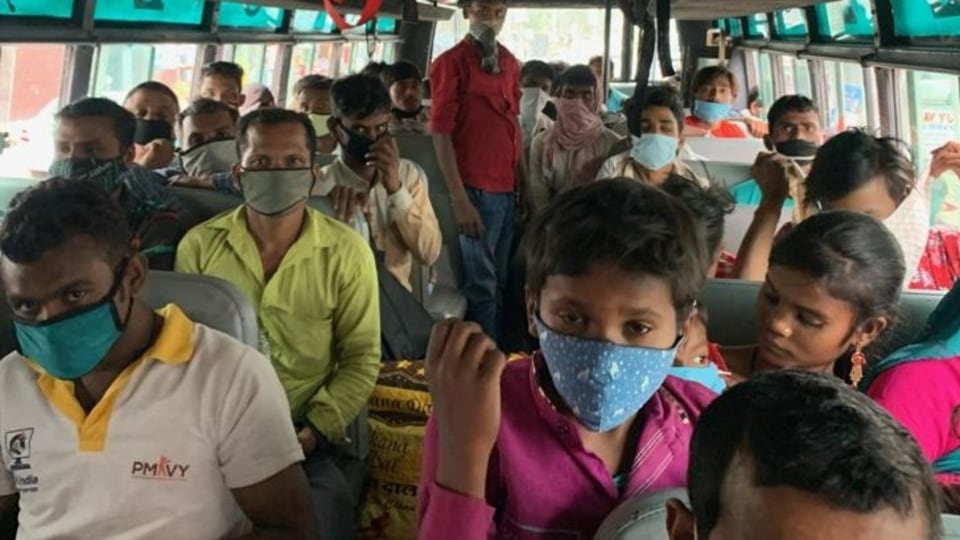
Tens of thousands of migrant workers left the Capital after the Union government put in place a hard lockdown in March last year to limit the spread of Covid-19. With a blanket ban on all public transport in the initial phase of the curbs, several of these migrants left on foot, forcing the government to step in and set up food camps, arrange transport, implement schemes subsidised ration, health and financial assistance schemes.
While the government did not keep a record of migrants leaving Delhi during the 2020 lockdown, more than 800,000 of them left in buses in the first four weeks of the lockdown imposed from April 19 this year as the Covid-19 caseload hit record levels.
The Delhi government document also said, “Registration of principal employers and contractors has now been facilitated through an e-district portal and it is mandatory to provide certain details regarding the migrant workers being employed by them at the time of registration.”
“It is further submitted that on 03.05.2021, Section 142 of the Code of Security came into effect by notification in the official gazette. Section 142 provides for submission of details of Aadhaar by any employee or unorganised worker or other person for registration as a beneficiary under the Code,” the documents said.
The documents also said, “This development will enable it [the Delhi government and the Centre]to collect Aadhaar details of unorganised workers including migrant workers to create a national database of beneficiaries. It further stated that the National Data Base for Unorganised Workers, which is being developed by the National Informatics Centre is at an advanced stage and an inter-state migrant worker can register himself on the portal on the basis of Aadhaar details.”
While the Census also tracks migration numbers, the available figures have turned out to be inadequate especially after mass movements during the pandemic and the next figures are expected to come late, said the state government official quoted above.
Delhi has the second highest population of inter-state migrants in India, according to 2011 Census data on migration released in July 2019, which shows that marriage and work or business drive the influx. The city-state only trails Maharashtra, a much larger and more populous state.
The data also said that more than 6.3 million people in Delhi – which is nearly 40% of its 2011 census population of around 16 million – were migrants from other states. Of these, around two million were recorded to have migrated for work. But the data did not bifurcate employment in the organised sector and the unorganised sector.
Labour unions in the city peg the number of migrants engaged in the unorganised sector at two million, of which around 60% would be in the construction sector and the remaining would be in industries and daily wage work. “With their families, the collective population of migrants associated with the unorganised sector in the Capital would be around 8 million by now,” said Animesh Das, president of the Delhi unit of Indian Federation of Trade Unions.
Experts called the state government’s database plans an “essential initiative”.
“Creation of a robust and dynamic database of migrant workers in unorganised sector will not only enable the state to plan and prepare initiatives and policy response to pandemic or similar crises in future, it will also greatly help the state to understand their living conditions, family size, sources of income, skills, social status, etc,” said Niranjan Sahoo, a senior fellow with ORF’s governance and politics initiative.
“Creating a comprehensive and reliable database is challenging for Delhi considering labour moves seamless in the National Capital Region (NCR). Therefore, it would need the active cooperation of neighbouring states like Uttar Pradesh, Haryana, and Rajasthan. It will also need support of the Union government given its National Capital Territory (status)… This would also help avoid duplication of data.”
Sahoo also said linking Aadhaar data is critical to avoid overlapping.
Debolina Kundu, professor at the National Institute of Urban Affairs, said: “At present, other than the 2011 Census data, there is no official database on migrants in Delhi which could help the government to work out their social protection strategies. It is important to have recent data on migrants by various indicators like their place of origin (states, cities and/or villages), period of stay, reasons for migration and other important parameters which may help the government work out a comprehensive policy for their overall well-being.”


