
 E-Paper



MCD proposes hike in parking rates at lots, plans to impose differential levy
The MCD now plans to introduce two separate groupings for such charges, the first comprising category A-D colonies and the second with category E-H colonies.


The Municipal Corporation of Delhi (MCD) has put forth a proposal to make a slew of changes in the parking policy, from introducing separate charges for parking lots in upscale colonies, in categories A to D, to tripling parking charges in spaces located within a 500-metre radius of multilevel parking lots, to discourage street parking.
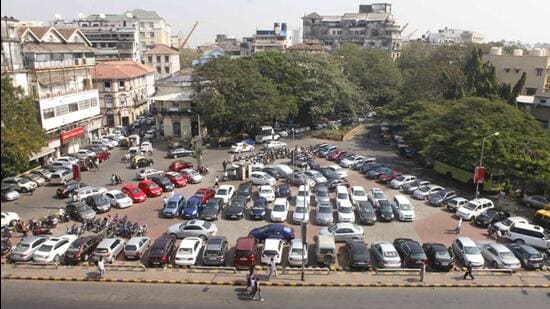
Effectively, this will end the practice of uniform parking rates, incentivise shorter parking periods and discourage street parking, officials said, adding that the changes were proposed in view of congested spaces and increasing vehicular pollution in the Capital. The proposal will need to be approved by councillors to take effect.
The proposal, moved by the municipal commissioner via letter dated June 19, said: “Differential parking pricing is important as land price is inextricably linked with parking sites. MCD is running 420 paid parking sites across the city, of which RFID parking features are being added to 39 sites and 17 locations are multilevel parking sites.
HT has seen a copy of the letter, detailing the proposal of the remunerative projects cell that has been concurred by the finance department.
Currently, MCD charges ₹20 per hour for cars for the first five hours, ₹100 for five to 24 hours and ₹2,000 for the monthly day and night pass. For two-wheelers, ₹10 per hour is charged for the first five hours, and ₹50 for five to 24 hours. The civic body now plans to introduce two separate groupings for such charges, the first comprising category A-D colonies and the second group comprising category E-H colonies.
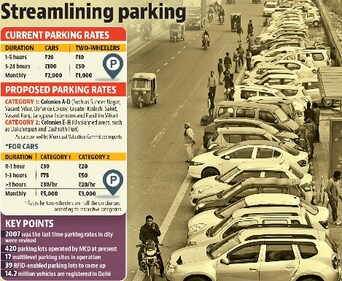
The civic body has categorised 1,393 residential colonies and villages as per the Municipal Valuation Committee reports, based on the state of infrastructure and amenities in the area. Areas of Sunder Nagar and Vasant Vihar fall under Category A, and unplanned areas of Dakshinpuri and Dashrath Puri are at the other end of the spectrum. Category B comprises Defence Colony and Greater Kailash, Category C has Saket, Shivalik and Vasant Kunj, and Category D has areas of Jangpura Extension and Paschim Vihar.
For categories A-D, the executive wing has proposed a charge of ₹30 for the first hour, ₹75 for one to three hours and ₹30 per hour, beyond three hours. The monthly day and night pass for such areas will cost ₹5,000. For categories E-H, a fee of ₹20 is proposed for the first hour, ₹50 for one to three hours and ₹20 per hour, beyond three hours. The rates for two-wheelers are half of the charges for four-wheelers.
Atul Goyal, who heads the United RWAs Joint Action, a collective body of residents’ welfare associations, said that parking lots must not be allowed near multilevel parking sites in the first place. He also disagreed with the proposal to increase the parking rates based on colony categorisation.
“People do not remain stationary in one locality. You may be residing in one area and may be using parking lots in another part of the city. Moreover, we also saw last time the parking rates were increased under Graded Response Action Plan (Grap), high charges were being levied despite the withdrawal of the order. There should be more transparency, prominent displays of legitimate parking spaces to curb illegal sites, and rate review should be based on individual road sites and its parking capacity vis-a-vis demand,” he said.
Delhi parking problem
Delhi has more than 20 million residents, 17,882 kilometres of roads and 14.2 million registered vehicles, but just 420 public parking sites. Together, this adds up to a big parking problem. The annual growth of the registered vehicles, year on year, was 32% in 2021-2022, but the demand for parking has not translated into more spaces due to a multiplicity of issues.
The draft Master Plan 2041 for Delhi says it is crucial to disincentivise private transport to complement initiatives aimed at increasing the use of shared modes and parking demand management is an important tool to decongest areas. In 2014, a special task force set up by the Delhi high court to decongest the city also recommended a complete overhaul of the parking pricing. In 2019, facing a lot of heat from the Supreme Court, the Delhi government notified the Delhi Maintenance and Management of Parking Places Rules to address the crisis in the Capital, through area-specific planning.
Anumita Roychowdhury, the executive director of research and advocacy, Centre for Science and Environment who worked on the parking policy for Delhi said the proposal was a good move. “This will not only help to improve usage of multilevel parking but also reduce parking congestion on street. Also, as per the Delhi parking rules, the augmented revenue from the increased rates can be invested for local area improvement. However, this will require physical demarcation of legal parking areas on street in each ward to prevent illegal parking and revenue leakages,” she said.
Barring two sites in Karol Bagh and Yusuf Sarai, the parking rates in the city have not been revised since 2007. To be sure, the proposal will need the consent of the House of councillors before implementation on the ground. “The proposal has been concurred by the finance department. The finance department has suggested that once the parking charges are revised, the department may revise the monthly licensing fee for the ongoing parking sites in accordance with the revision of parking charges,” the proposal letter said.
Stay updated with all top Cities including, Bengaluru, Delhi, Mumbai and more across India. Stay informed on the latest happenings in World News along with Delhi Election 2025 and Delhi Election Result 2025 Live, New Delhi Election Result Live, Kalkaji Election Result Live at Hindustan Times.


