E-Paper



Most of Delhi pollution coming from neighbouring cities, shows DSS data
Delhi’s native emissions are estimated to have contributed to just around 25% of the Capital’s pollution levels on Tuesday, with other towns and cities in the National Capital Region (NCR) responsible for the remainder.

 Prefer HTon Google


Most of Delhi’s air pollution right now is largely down to emission sources outside the Capital, despite the end of farm fire season in upwind states, showed data from the Decision Support System (DSS) forecasting model, used by the Centre for Air Quality Management (CAQM) to plan measures to mitigate bad air in the region.
Delhi’s native emissions are estimated to have contributed to just around 25% of the Capital’s pollution levels on Tuesday, with other towns and cities in the National Capital Region (NCR) responsible for the remainder, showed data from DSS, which was developed by the Indian Institute of Tropical Meteorology (IITM).
The Capital’s contribution to its own pollution will rise to between 32% and 37% over the next three days and other cities will be at fault for a lion’s share of Delhi’s “very poor” Air Quality Index (AQI), the model forecast.
Among these, emissions from cities and towns in the National Capital Region (NCR) like Jhajjar, Rohtak and Sonepat are the key contributors, owing to northwesterly winds bringing pollutants from these towns to the Capital.
The AQI in Delhi on Sunday hit the “severe” zone after nearly a month, and while the air has cleared to an extent, pollution levels continue to remain “very poor”. Delhi clocked an AQI of 407 on Sunday, 347 on Monday and 353 on Tuesday.
An AQI between 301 and 400 is considered “very poor”, and one above 400 is “severe”.
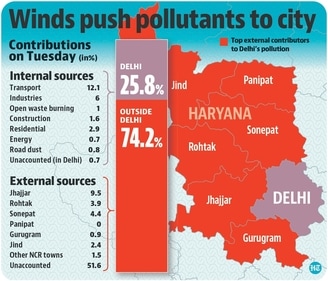
Jhajjar is the key contributor of the NCR cities and towns that pollute Delhi, with a 9.5% share on Tuesday, and forecasts of between 8% and 15% in the next three days.
For Rohtak on Tuesday, it was 3.9%, while for Sonipat, it was 4.4%, DSS data showed.
In comparison, the contribution of Delhi’s immediate neighbours — Gautam Budh Nagar, Faridabad and Gurugram — is minimal.
Delhi usually sees two broad spells of hazardous air quality — one between October and mid-November, and the other from December to early January. The first spell is driven largely by smoke from farm fires in Punjab and Haryana that usually come to a close by the second week of November. The second spell is largely due to the base effect of pollution that is worsened by the sharp dip temperatures.
An IITM official said DSS was a forecast-based model and did not display real-time data, explaining that the system estimates the quantum of emissions and source-wise contributions, based on a long-term emissions inventory.
An emissions inventory is generally a database that calculates the amount of pollutants discharged into the atmosphere during a specific period.
“Based on the emissions inventory of each source and factors such as the wind direction and other meteorological conditions, DSS estimates the contribution of these sources. However, an accurate real-time contribution can only be gauged through a real-time source apportionment model,” said the official, who asked not to be named.
The official added that the system allows the Commission for Air Quality Management (CAQM) to plan policies around air pollution in NCR.
“DSS is meant for long-term planning.... Decisions are taken based on the sources impacting Delhi,” added the official.
Within Delhi, the transport sector continues to be the source of air pollution, contributing to 12.1% of the total load of PM2.5 (particulate matter less than 2.5 micron thick) on Tuesday. The forecast system said that it will range between 15 and 17.5% over the next three days.
The next biggest contributor from within Delhi is the industrial sector, with its contribution ranging from 6-8.5% between Tuesday and Friday.
DSS data is also in line with a source apportionment study carried out by The Energy and Resources Institute (TERI) in 2018, which found the contribution of Delhi’s own sources to its pollution to be just 36%, with the remaining 64% travelling into the city from other cities and towns. Within this, 34% came from NCR towns, 18% from upwind regions outside NCR and the remainder from upwind regions outside India.
Anumita Roychowdhury, executive director, research and advocacy at the Centre for Science and Environment (CSE) called for greater focus on curtailing emissions in NCR towns, and not just Delhi.
“We have seen that the Capital’s pollution problem is not limited to Delhi alone. Similarly, pollution from other NCR towns can easily travel to Delhi, based on the wind direction. While the cities in the path of the wind direction are directly impacted, local level pollution can still travel across the border, even when there is no wind,” she said.
Dipankar Saha, former head of the Central Pollution Control Board’s (CPCB) air laboratory, said that until all of NCR and the Indo-Gangetic Plains are treated as one large air-shed, the impact of state-wise policies will be negligible.
“Due to the geographical pattern of the Indo-Gangetic Plains and the flow of wind direction which is northwesterly, trans-boundary pollution is a problem and that requires coordination between states. At any time, pollutants can also travel from one town to another, so it is important to have policies that tackle sources in the entire region,” he said.