
 E-Paper



Need-based curbs helped Delhi balance BRICS security, traffic
Delhi faces challenges balancing security for VVIPs and traffic flow during global events. Innovations from cities like New York and Dubai offer valuable strategies.

 Prefer HTon Google


Every time Delhi hosts a gathering of world leaders, it must balance two competing demands: securing visiting dignitaries while keeping traffic moving. At the India AI Impact Summit in February, that balance was tested in ways that brought the cost of VVIP movement into sharp focus.
Former British PM Rishi Sunak arrived a few minutes late to a session and joked that AI could do many things, but it “can’t yet fix Delhi’s traffic”. For Sara Hooker, co-founder and chief executive of Adaption Labs, it was more than an anecdote. Invited to a dinner hosted by Prime Minister Narendra Modi, she returned to her hotel to change, got stuck in traffic for four hours and missed the dinner.
But such disruptions raise a familiar question: how much of the city should bend around a big-ticket event?
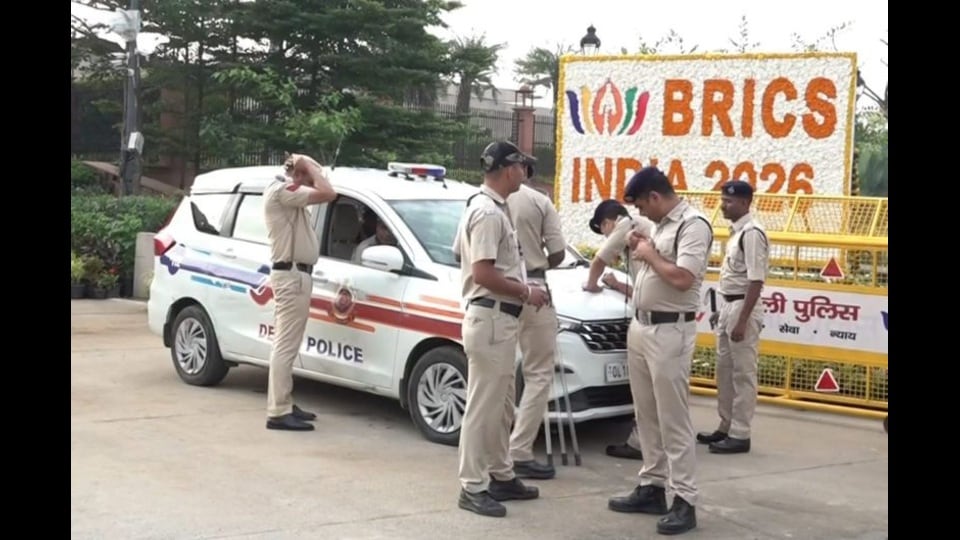
For the BRICS summit, Delhi Police enforced a more dynamic approach than blanket restrictions. A senior IPS officer overseeing traffic said restrictions were imposed on a “need basis”, with specific junctions stopped only shortly before a delegation’s motorcade arrives.
Cities that regularly host major international events have developed different ways of managing the inevitable disruption. New York, London and Dubai offer lessons in accommodating VVIP movement without making it the organising principle of the city’s traffic.
New York’s annual UN General Assembly is one example. Dozens of heads of state converge on Manhattan, but the city focuses on warning commuters early and offering alternatives, said Parul Agarwala, a former India programme manager at UN-Habitat who also worked in New York City’s department of city planning.
The Metropolitan Transportation Authority issues detailed gridlock alerts days in advance, including maps of affected corridors, and increases subway frequency on key lines, from 4.5 minutes to two minutes, with some services running 24/7.
Manhattan is denser than central Delhi, Agarwala noted. But decades of investment in public transport and pedestrian access mean fewer journeys depend on cars. Parking in core areas is deliberately expensive, while subway stations are typically a five-minute walk away.
Dubai offers a different lesson: managing demand before it reaches the road. Misha Mittal, founder at Hikmah Group and former senior manager at Expo City Dubai, said Expo 2020 relied on free shuttle buses, Dubai Metro and parking management, while digital signboards provided real-time information to redirect traffic before bottlenecks formed.
The expo drew 24 million visits over six months, with peak daily footfall exceeding 100,000, while the city continued to function normally, Mittal said.
“Even during COP28, the priority was redirection over road closures,” Mittal said. “We avoid blockages to ensure daily life remains uninterrupted.”
London’s approach focuses more directly on security movements. Shashi Verma, CTO at Transport for London, said even the 2012 Summer Olympics, which hosted 93 heads of state, avoided prolonged citywide closures.
“Even when the US President is in London, traffic closures do not last 40 minutes,” he said. “A moving security bubble is created ahead and behind.”
Roads are closed for planned events such as the London Marathon, but diversions are advertised weeks in advance, Verma said.
Delhi, too, has experience of managing VVIP movement through defined corridors rather than sealing off large stretches. A retired IPS officer who headed Delhi Traffic Police recalled a “fishbone” arrangement used for a summit involving more than 50 African leaders at Pragati Maidan. A central arterial “spine” was reserved for VIP movement while delegates joined it through designated feeder routes.
“When you restrict everyone to a defined spine and prevent deviations, you can regulate gaps and allow cross-traffic in between convoys,” he said.
For Jagan Shah, professor of practice at the TRIP Centre at IIT, the bigger opportunity lies in making the city’s existing systems easier to navigate during major events. Clearer public communication and real-time rerouting maps can help people make decisions before entering corridors, he said.
Venue selection also matters. Shah pointed to Yashobhoomi near Delhi airport, which has metro connectivity and was designed to host large events without drawing associated traffic into central Delhi. “The idea of building peripheral convention districts is precisely to avoid shutting down the city every time a summit is held,” Shah said.

Stay updated with all top Cities including, Bengaluru, Delhi, Mumbai and more across India. Stay informed on the latest happenings in World News along with Delhi Election 2025 and Delhi Election Result 2025 Live, New Delhi Election Result Live, Kalkaji Election Result Live at Hindustan Times.


