
 E-Paper



PM unveils plan for new national museum, inaugurates int’l expo
PM Modi on Thursday unveiled the plan for what is set to be the world’s largest museum, Yuge Yugeen Bharat, which will capture 5,000 years of India’s history.

 Prefer HTon Google


Prime Minister Narendra Modi on Thursday inaugurated the international museum expo-2023 and unveiled the plan for what is set to be the world’s largest museum, Yuge Yugeen Bharat, which will capture 5,000 years of India’s history.
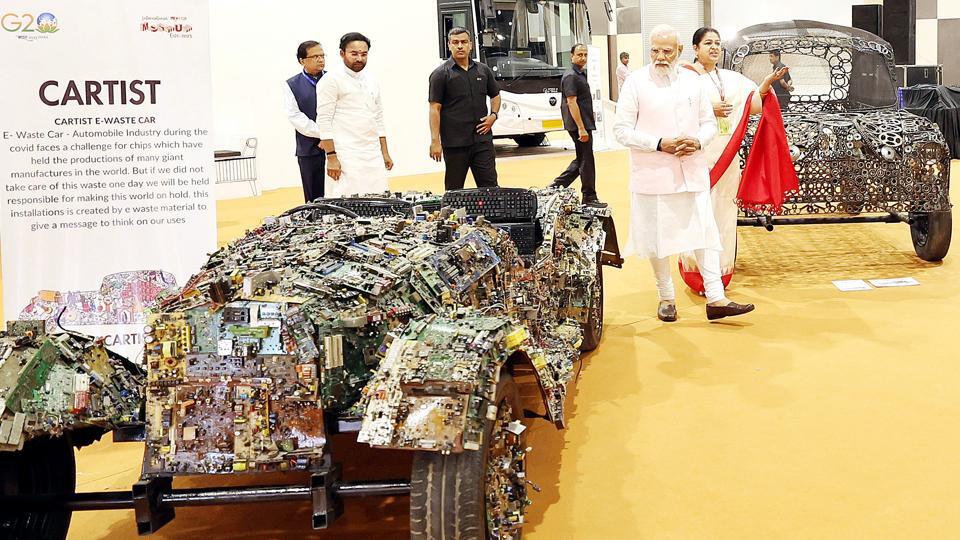
“When we enter a museum, we engage with the past and the museum presents fact and evidence-based reality and it provides inspiration from the past and also gives a sense of duty towards the future,” Modi said after inaugurating the expo at Delhi’s Pragati Maidan.
Also read: PM Modi to inaugurate new Parliament building on May 28, Om Birla confirms date
The theme of the expo “museums, sustainability and well-being” highlights the priorities of present circumstances, the prime minister said. The inauguration of the expo coincided with the International Museum Day which falls on May 18.
Modi also underlined the loss of India’s heritage during the “period of slavery which lasted for hundreds of years”, saying many ancient manuscripts and libraries were burnt to the ground at the time.
“This is not just a loss for India, but for the world,” Modi said. “But during this Amrit Kaal (period leading up to 100 years of India’s independence), we reclaim our pride in our past by creating a new infrastructure that will capture not just India’s freedom movement, but millennia of the country’s history.”
Modi also stressed that in the last nine years, the government has recovered nearly 240 artifacts that belonged to India, whereas the earlier governments managed to recover only 20. “We have to be grounded in the past but work for the future. We have to honour our legacy, as we work to create a better and brighter future,” he said.
The prime minister further said that for the first time, museums will also commemorate tribal freedom fighters. He highlighted the contributions of Mahatma Gandhi, Dr BR Ambedkar and Vallabhbhai Patel.
“The redevelopment of Mahaparinirvana Sthal of Dr BR Ambedkar into a National Memorial at 5, Alipore Road in Delhi (is underway)… along with the development of Panch Teerth related to his life, in Mhow where he was born, in London where he lived, in Nagpur where he took initiation, and the Chaitya Bhoomi in Mumbai where his Samadhi exists today,” he said.
Modi also cited examples of the museums at Patel’s Statue of Unity, Jallianwala Bagh in Punjab, Govind Singh’s memorial in Gujarat, the Man Mahal Museum in Varanasi and the Museum of Christian Art in Goa.
“It is only when a country embraces its legacy that new opportunities to connect with likeminded cultures across the world emerge,” Modi said. “The holy relics of Lord Buddha, which were conserved over the generations, are now uniting followers of Lord Buddha all over the world. We also sent four holy relics to Mongolia on the last Buddha Poornima, and received holy relics from Sri Lanka in Kushinagar.”
He added: “Similarly, the legacy of St. Ketevan of Goa is safe with India and generated immense remembered the enthusiasm in Georgia when the relics were sent there. Our heritage can become the harbinger of world unity.”
The PM added that the museums will also offer a gastronomic experience, capturing years of India’s history of Ayurveda and millets that are now turning into a global movement. “Museums should become active participants in conserving the resources for the coming generations,” he said. “It is encouraging to see that the young generations are drawn to these museums, and they are becoming not only places to visit but also career opportunities.”
Also read: PM Modi to have over 40 engagements during 3-nation visit
During the event, a short video was released through which the government offered a virtual tour of the proposed Yuge Yugeen Bharat, set to be the largest museum in the world in terms of its size, covering 117,000 square metre across North and South blocks with 950 rooms spread over a basement, ground plus two floors. It will capture 5,000 years of India’s history. The Louvre in Paris, France, is currently the largest museum, with nearly 73,000 square metres of exhibition space.
The museum will capture the scientific and cultural achievements of ancient India, the Indus Valley Civilisation, the Vedic age, and India’s premier educational institutions such as Takshashila and Nalanda.
It will also highlight the Maurya, Gupta, Pandya, Pallav, Chola, Kashmir and Rashtrakut dynasties, which had trade relationships with countries such as Rome and Greece. The valour of the Rajput, the age of the Mughals and the Sultanate will feature next. The British empire, and India’s freedom struggle will also be highlighted.


