
 E-Paper



Uncertainty looms over occupants of 150-year-old Sunehri Bagh Masjid in Delhi
On December 24, NDMC published a public notice in various newspapers seeking opinions on the demolition of the historical mosque

 Prefer HTon Google


On a cold January afternoon, 52-year-old Shakil Ahmed was offering his prayers at the Sunehri Bagh mosque, amid copies of the Quran stacked on shelves. Ahmed’s is among the two families that live on the floor below the mosque — a 150-year-old structure whose fate now hangs in the balance.
Peeking from behind the blue curtains in the basement of the building that houses the mosque, Mrs Ahmed, 38, who does not want to reveal her first name, quipped, “Why now? Our families have been here for at least 80 years… before the roads and the Metro were here. The Mughals didn’t touch the mosque, nor did the British… So why now?”
On December 24, the New Delhi Municipal Council (NDMC) published a public notice in various newspapers seeking opinions on the demolition of the historical mosque — near Udyog Bhawan Metro station, at the intersection of Maulana Azad Road, Motilal Nehru Marg and Kamraj Road — by January 1, to ease alleged traffic congestion in the area.
Ahmed’s family’s history is inextricably tied to the history of the mosque, they said, adding that they settled in a one-room apartment around 80 years ago. Ahmed, a father to four children — one boy and three girls — said, “If it is demolished, we will have to look for a new house. We are all very stressed and my eldest daughter is about to appear for her pre-board exams.”
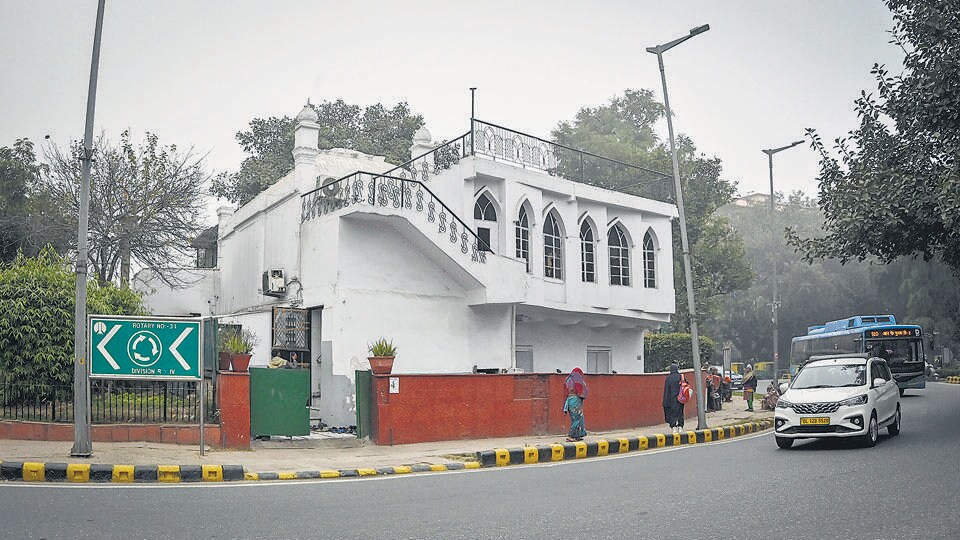
The mosque itself is a two-storey structure with a modest Bangla dome and four minarets. His family currently occupies a small room in the mosque’s basement. The two-storey structure comprises a staircase that leads to the prayer area. The park surrounds the ground floor and a few steps below that is the basement with small rooms that function as homes or shops.
Ahmed works as a peon in a government office and worries that he might not be able to pay rent while educating his four children. He said that his father, originally from Uttar Pradesh’s Bijnor, moved to Delhi for work and found a job as a barber.
“When my father came here for work, he found this place. The rooms were empty but it was in ruins. Our family turned it into a home and in a year or two, we began paying rent to the Waqf board,” said Ahmed, to which Mrs Ahmed added, “It is an active mosque. People pray and live here, there are shopkeepers too. Where will they all go?”
HT reached out to the Waqf Board chairman Amanatullah Khan about the families but he did not respond to queries.
NDMC proposed removing the mosque, designated as a grade III heritage structure by the Delhi government in a 2009 notification, alleging that it is obstructing the safe and smooth flow of traffic.
Last year, the Delhi Waqf Board moved the high court anticipating the demolition of the mosque. The court disposed of the plea on December 18 after the civic body said that the petitioner had no reason to hold such an apprehension.
A network of lawyers, including the Indian Civil Liberties Union (ICLU) and historians, wrote to NDMC about the significance of the mosque and suggested alternatives.
Advocate Anas Tanwir, who founded ICLU, said, “Its architectural elements are typical of the period — Lakhori brick masonry, sandstone flooring, and the quintessential vaulted roof of brick. However, its history is not merely contained within its walls... it extends to the annals of India’s freedom struggle.”
The letter added that Maulana Hasrat Mohani, a freedom fighter, chose to live at the mosque, departing from his official residence as a member of Parliament, upholding the ideals of Inquilab Zindabad and Purna Swaraj (complete independence). It concluded that the “mosque predates the roads, and cannot be termed as a structure encroaching upon the land”.
While not much is known about who built the mosque, historian and author Swapna Liddle said that the architecture is typical of the Mughal Period. “The architecture could be from the 17th century, or even older. The mosque certainly predates the roads, which were built between 1910 and 1920,” said Liddle.
The objections and suggestions to NDMC’s notice serve as a ray of hope for residents.
The Imam of the mosque on December 30 moved the high court against the proposed demolition. The petition is listed for hearing on January 8, following an assurance that nothing will happen in the meantime as a final call has to be taken by the Heritage Conservation Committee (HCC).
An NDMC official said that around 8,500 suggestions have been received as public feedback. “We are in the middle of compiling these reactions and removing the duplicate ones. The compiled report will be submitted to the committee and the Delhi government for further consideration. We cannot take any action without HCC approval. This property does not fall under the Waqf board,” said the official, asking not to be named.
The mosque is enclosed within a park at the centre of the road which is opposite Udyog Bhavan Metro station. This park gives way to the basement of the building. A part of the basement is covered in a tin shed.
Jaya Kishan Gupta, 70, has been running a chai stall out of two rooms in this basement for decades and right beside the Ahmed house are two aluminium folding doors that open into the stalls. Small idols of Ganesh and Lakshmi adorn on a wooden shelf outside the stalls.
Gupta brought out his phone to show a Hindi newspaper article that said that the mosque is over 200 years old. “My father used to run this stall. I started coming here when I was in Class 6, and I would go to school from here.” Around 60 years ago, they used to pay a rent of ₹250, he recalled. The rent kept increasing by around 10% annually.
Gupta is a Chirag Delhi resident but considers the mosque his home. “Worshippers and office goers stop here for tea after praying. Many are pleasantly surprised to see a Hindu family running a stall in a mosque,” he smiles, adding, “Magar hum sab hamesha se bhaichare se reh rahe hai (We have always lived in brotherhood)”.
“I have run this store all my life, I have never had any other job… if demolished, we will lose our store. Will we get any compensation?” asked Gupta.
He pulled down the stall’s shutters amid talks of a possible demolition last week and the employees only visit to cook their own meals. They spend their days in the park, anxiously discussing the possible demolition. The stall employs eight others — mostly migrants, who stare at uncertainty. “We don’t know what to do,” says Sarjeevan, an employee who has spent 20 years here, earning ₹15,000 monthly. “We eat our meals here, sleep here sometimes, celebrate Diwali here,” he says.
Another employee, Anuj Kumar, 23, started working here a year ago after moving from Sultanpur in UP. “The best thing about the mosque is that we can have a puja on Diwali while people offer namaz on the floor above. They hug us on Diwali and we hug them on Eid,” he says.
The same floor also houses the Imam’s family, who said they did not want to talk to journalists.


