
 E-Paper



Will take 4-5 years to properly resolve stubble burning issue: Punjab pollution control board
Crop diversification and using short duration varieties of paddy are among several initiatives proposed by the Centre and experts to resolve the stubble burning issue in Punjab and Haryana.

 Prefer HTon Google


Crop diversification is not a long-term solution to the problem of stubble burning and it will take four to five years to properly resolve the issue, a senior official of the Punjab Pollution Control Board (PPCB) has said.
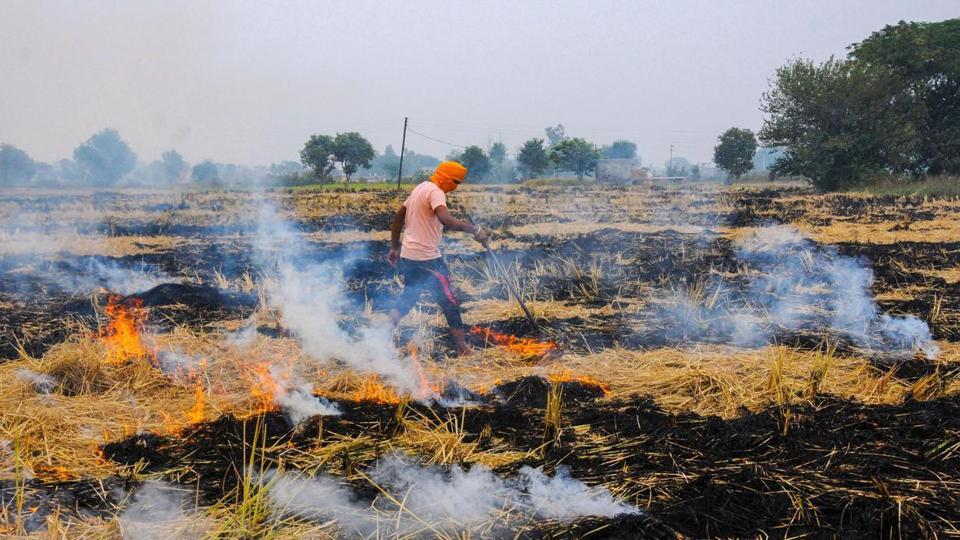
Crop diversification and using short duration varieties of paddy are among several initiatives proposed by the Centre and experts to resolve the stubble burning issue in Punjab and Haryana.
At a workshop organised by the Delhi-based Climate Trends in Chandigarh on Monday, PPCB member secretary Krunesh Garg said counting the number of farm fires is an inaccurate measure of ascertaining the scale of stubble burning and that the acreage of land being put on fire is the parameter to be measured. “It is not that the problem is not being addressed, we are mapping it down to the block and village level, but it will take four-five years for proper resolution,” Garg said. The area under paddy cultivation in Punjab has increased from 29.61 lakh hectares in last year to 31.13 lakh hectares this year. This would result in the generation of 19.76 million ton of paddy straw this year as compared to 18.74 MT last year.
Crop diversification is not a long-term solution because it does not mean that biomass will not be produced by other crops. It will just be another kind of biomass waste, like cotton sticks, mustard straw waste etc. “Issues with respect to (stubble) burning will always remain. So, we need to find solutions, both in situ and ex-situ. A combination of these can only be effective, Garg said.
PPCB chairman Adarsh Pal Vig said, “It is a social and a psychological problem where behaviour and attitude of farmers also needs to be addressed.” He said urbanisation and the exploding population in cities are causing a problem. Due to such factors, big cities like Delhi are already sitting on a tipping point and stubble becomes the last straw every season.
A prolonged spell of rains in September end delayed paddy harvesting and subsequent farm fires in some regions of Punjab and Haryana.
Another weather system is predicted to bring rain in parts of north India between October 4 and October 8, which could further delay harvesting in some areas, forecasters said.
Experts say farmers are more likely to burn stubble to make up for the lost time and quickly prepare their fields for the next crop. Stubble burning begins around September 20 but the number of fire events remains low till October 12-14.
Along with unfavourable meteorological conditions, paddy straw burning in Punjab and Haryana is a major reason behind the alarming spike in air pollution levels in the national capital in October and November. Farmers set their fields on fire to quickly clear off the crop residue before cultivating wheat and potato.
‘Bio-decomposers not very encouraging’
The Punjab Pollution Control Board (PPCB) has also said the results of the trials of bio-decomposers conducted in the state last year are not “very encouraging”.
Bio-decomposers are microbial solutions which, their manufacturers claim, can turn stubble into manure in 15-20 days and prevent farm fires.
The Delhi government has hailed the Pusa bio-decomposer, developed by scientists at the Indian Agricultural Research Institute (IARI), as a cost-effective solution to the problem of stubble burning.
On September 15, the governments of Delhi and Punjab announced that the Pusa bio-decomposer will be used on 5,000 acres of land in the agrarian state to prevent stubble burning on a “trial basis”.
The results of the trials “are not very encouraging”, according to a presentation made by PPCB member-secretary Krunesh Garg.
“In the year 2020-21, two bio-decomposers were evaluated at five locations. All experiments were done as per the guidelines of the IARI, but the overall decomposition was not significant,” according to the presentation made by Garg.


