
 E-Paper



Another cave-in on Basai Road, second one in two days
Officials of the Gurugram Metropolitan Development Authority (GMDA) reached the spot around 11am Wednesday and started filling up the crater. They also asked Municipal Corporation of Gurugram (MCG) to repair or change the sewer pipeline at the earliest

 Prefer HTon Google


Barely 48 hours after a portion of the Basai Road caved in on Monday morning, another portion of the road gave way on Wednesday morning, leaving a gaping six metre wide and 20 foot deep hole adjacent to the spot of the first cave-in. The new crater again threw traffic out of gear during the morning rush hour and the traffic police diverted vehicles towards Pataudi and New Colony to clear the congestion that persisted on the stretch for over an hour, with tailbacks stretching as far back as 3km.
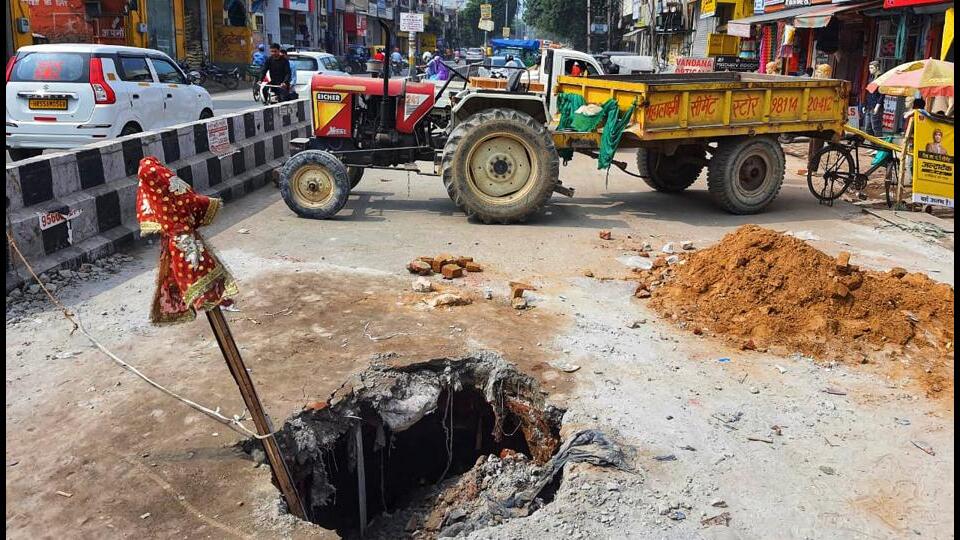
Area residents said they noticed the fresh cave-in near Khandsa Chowk on Wednesday morning and reported the matter to the traffic police team, which deployed about 10 personnel on the stretch to manage the snarl.
After the first cave-in on Monday morning, civic officials said a sewer pipeline running beneath the road had burst, causing the road to give way.
Officials of the Gurugram Metropolitan Development Authority (GMDA) reached the spot around 11am Wednesday and started filling up the crater. They also asked Municipal Corporation of Gurugram (MCG) to repair or change the sewer pipeline at the earliest.
A senior GMDA official said they are trying to ascertain the reason for sinkholes appearing frequently on the stretch even after repair works.
Arun Kumar Dhankhar, superintending engineer of Infrastructure 1, GMDA, said, “They (the MCG) will be asked to rectify this issue. Our team will meanwhile repair the road to make it motorable,” he said
Virender Singh Sangwan, deputy commissioner of police (traffic) said they removed four trolleys of mud from the cave-in site and barricaded the spot.
“We diverted vehicles away from the spot in the morning as soon as the volume of traffic started increasing. The cave-in was deep and we wanted to ensure the safety of commuters; so personnel were deployed at both sides of the stretch to manage traffic,” he said.
Sangwan said the stretch is one of the worst hit in terms of traffic and road conditions. “We had informed civic agencies earlier too about the problem and they did only temporary repairs, causing the cave-ins to recur. There are over 50 shops on both sides of the stretch and many park their vehicles on the road, risking their lives and the safety of others. The stretch cannot take the load due to the seepage and leakage below,” he said.
The Basai Road connects to sectors near the Dwarka Expressway, the Kundli- Manesar-Palwal Expressway, and Jhajjar. The police diverted vehicles to the intact carriageway on Monday, and again on Wednesday, but that still did not help matters and congestion was reported on Wednesday morning and evening, officials said.
Commuters, meanwhile, are worried by the frequent cave-ins on the stretch.
Mukul Saini, a resident of Basai, said they are afraid of driving on the stretch these days. “The authorities are not taking any interest to repair the stretch properly and we travel five kilometres extra every day for our safety,” he said.
Mukul Saini, a resident of Basai, said the situation is getting worse by the day. “A 1km stretch of the road witnesses cave-ins every now and then. A portion of the stretch had collapsed on Monday and about 15 days prior to that. The authorities are waiting for a mishap to happen before they act,” he said.


