
 E-Paper



Properties demolished in Nuh were legal, say local residents
The Haryana government is facing backlash after demolishing several properties in Nuh, with owners claiming the demolitions were illegal.

 Prefer HTon Google


A tiles store, a kiosk, five stores and a dhaba, a hotel, 19 shops and restaurants , and a house -- six case studies in demolition showcase the Haryana government’s response to the Nuh violence before the Punjab and Haryana high court stepped in on Monday to stop a drive that appeared to be targeting Muslims.
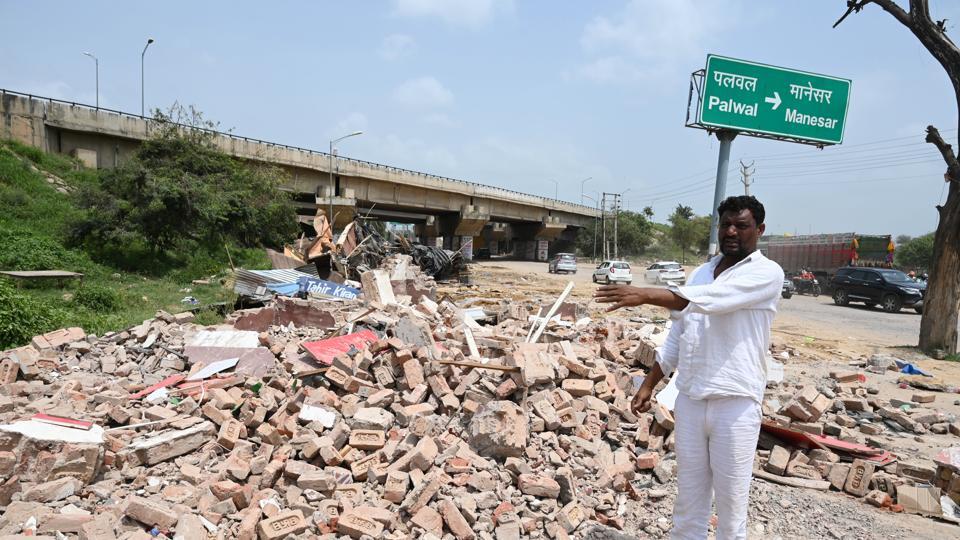
Liyakat Ali, tiles store owner, Kherli Kankar , Nuh
A three-storey tiles showroom, the only one in the entire Tauru and Nuh area with over 3,000 varieties of tiles, occupying almost 3000 sq ft at Tiranga Chowk in Nuh was demolished on the grounds that it was constructed illegally, without an approved building plan. However, the owner Liyakat Ali said the property was legal , operational for the last six years, and that he lost stock worth ₹6 crore.
Ali said he along with other property owners will approach the courts against what he termed an illegal action and demand compensation. “Many owners have their CCTV cameras and they show that the (demolition) notice was pasted minutes before the demolition.”
Prashant Panwar, former deli commissioner of Nuh claimed that the building did not have an approved building plan .
Din Mohammad , kiosk owner, Nuh Crossing
Mohammad set up a kiosk registered with the municipal corporation of Nuh after investing ₹1 lakh . His son, ran a barber shop there.
“We are law-abiding citizens and we invested all our life savings for our son so that he could support us and his eight younger brother and sisters. My wife and I work as daily-wage labourers at construction sites to run the house and managed to save money in the last seven years so that our children could lead a better life,” he said.
The structure was not illegal, he claimed, and came under the municipal policy to set up more than 20 kiosks at the Nuh crossing. They were not even given a chance to remove the furniture and the equipment that were bought on loan, Mohammad said. Renu Sogan, additional deputy commissioner of Nuh said that she has no record of the demolition drive and why the kiosks that fall under the municipal committee were demolished.
Akhtar Hussain , owner of five shops and a dhaba on Sohna-Tauru Road
At least 10 truck- and cab-drivers were having lunch at his dhabha on August 5 when the bulldozed same. Hussain claims that apart from the structure two deep freezers, two refrigerators, and 12 inverters, were destroyed.
“They did not let us remove anything. If other properties were targeted because of their owners’ involvement in violence, then nothing happened in our area So, why us?”
Narendra Bijraniya, Nuh superintendent of police ,said that shops and dhaba were constructed on agricultural land and the land use was not changed .
Mohammad Akil, owner of Sahara Hotel at Khedli crossing also known as Mevli crossing
Akil bought a patch of land some 20 years ago and constructed a double-storey hotel on it in 2010. While the hotel, a landmark in the area, was rented out, he continued to pay property tax on it with the municipal authorities never raising an objection, Akil claimed.
“The hotel was doing well and officials of government departments often visited . If the hotel was illegal, then the authorities should have rejected the property tax . I pay ₹8,000 as property tax . They claim my hotel was used to pelt stones and fire guns, but there is not even a single video that shows my building was used,” he said.
Bijarnia said even this building had no approved plan and was running without the permission from the concerned department. “Several notices were sent in the pas.”
Nawab Sheikh , owner of 19 shops and restaurants in Nalhar
When the authorities arrived at his premises on August 5, they told him his properties were built on forest land and would be demolished at once. He presented land and court documents declaring the patch as agricultural, but claims the police tore the papers and took him to police station where he was assaulted. “Policemen abused me, assaulted me and humiliated me just because I was trying to save my property. The shops and restaurants were there for many years but suddenly became illegal on August 5,” he said.
“Half of the shops and restaurants were run by Hindus and the place was not used by any stone pelters. But we were still targeted,” he added, pointing out that because of an existing legal dispute, there is already a court stay on any changes on the land.
Prashant Panwar, former DC said the land belonged to forest department . “Notices were served to them but they still continued to run,” he added.
Akbari Begum , house-owner Nagina
Begum said she was allotted a house under the below poverty line (BPL) quota under the aegis of the state’s Priyadarshni Awaas Yojna scheme in 2013. The government gave her ₹1 lakh to construct the house; the land was allotted by the panchayat. The project was targeted at empowering women ; the houses were in the name of the woman of the house.
“I filled out the forms and the house was allotted to me . I took a loan from my relatives (to add to the money I got from the government) to build the house. If this is called empowerment, then no woman needs this kind of support.”
There are four such BPL quota houses that have been demolished in Nagina village. Officials claim the houses were constructed on panchayat land.
“The demolition was carried to free panchayat land,” Panwar said.
Rajuddin Meo, a social worker who is active in the region said that the panchayat gave the land to the families in 2013 . “The affected families have no place to go. They were unnecessarily targeted by the authorities out of suspicion of involvement in the violence,” he said.


