
 E-Paper



GRAP-3 lifted as Delhi air improves, but Gurugram AQI worsens
The wind direction has shifted since Monday, while dry weather and falling temperatures are further limiting the dispersion of pollutants. As a result, particulate matter is accumulating closer to the surface, said an IMD official

 Prefer HTon Google


Gurugram’s air quality deteriorated on Tuesday, with the air quality index (AQI) rising 43 points to 290, even as the Commission for Air Quality Management (CAQM) revoked Stage 3 restrictions under the Graded Response Action Plan (GRAP) across Delhi-NCR following an improvement in Delhi’s pollution levels.
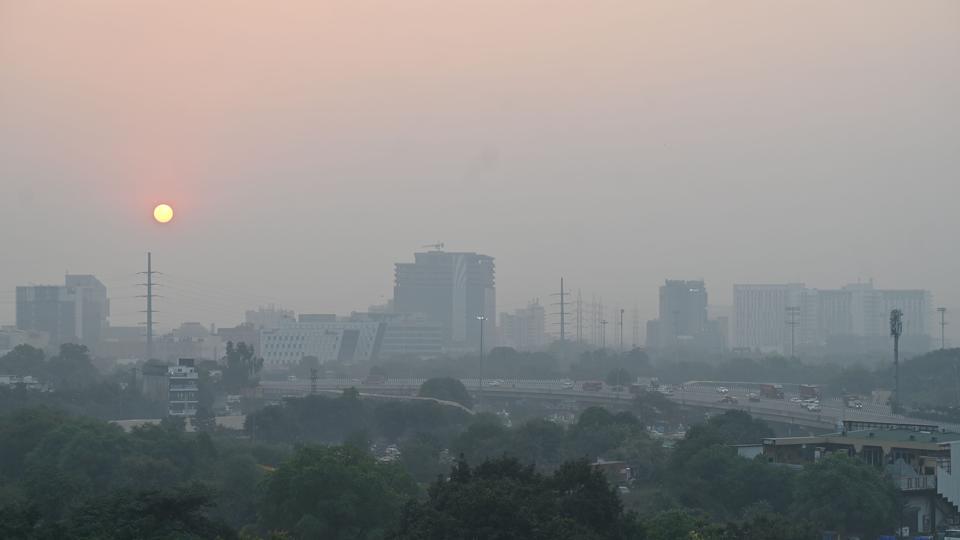
Delhi recorded an AQI of 204, also in the ‘poor’ category, while one of Gurugram’s four monitoring stations registered ‘very poor’ air quality. Restrictions under GRAP Stages 1 and 2 will remain in force across the region.
According to the Central Pollution Control Board (CPCB), Gurugram’s AQI rose from 247 on Monday to 290 at 4pm on Tuesday. The reversal followed an improvement over the weekend, when the AQI had declined to 296 on Sunday and 247 on Monday, aided by a change in wind direction following a western disturbance.
“The wind direction has shifted since Monday, while dry weather and falling temperatures are further limiting the dispersion of pollutants. As a result, particulate matter is accumulating closer to the surface,” a senior India Meteorological Department (IMD) official told HT.
Among the four monitoring stations, Sector 51 recorded the highest AQI at 328, in the ‘very poor’ category. Teri Gram recorded 298, Gwal Pahari 282 and Vikas Sadan 251, all in the ‘poor’ category, according to CPCB’s Sameer app at 4pm.
Fine particulate matter (PM2.5) remained the dominant pollutant. According to the HT Pollution Dashboard, which analyses CPCB data, pollutant-specific AQI scores for PM2.5 ranged from 251 to 328 across the monitoring stations, while PM10 scores ranged from 175 to 266.
Amid continuing concerns over dust pollution, the Municipal Corporation of Gurugram (MCG) on Tuesday approved projects worth ₹61.1 crore through its finance and contracts committee (F&CC), including two construction and demolition (C&D) waste processing plants, 16 truck-mounted road washers and 10 anti-smog guns.
The two C&D waste processing plants, proposed at Aravalli Biodiversity Park and Wazirabad, will cost ₹6.64 crore each, taking their combined estimated cost to ₹13.28 crore.
The proposal to establish a processing facility at Aravalli Biodiversity Park comes months after HT reported extensive illegal dumping of construction debris and other waste in the ecologically sensitive area.
In March, an HT investigation found tractors and trolleys entering the protected area through broken boundary walls and unauthorised dirt tracks to dump waste. A follow-up investigation in July found that dumping continued despite assurances of action from MCG. Vehicles without visible registration plates were found accessing the area through MCG-owned land, while unauthorised roads, borewells and semi-permanent structures had also come up.
In September, the MCG commissioner said the corporation would clear four large mounds of accumulated waste from the area.
A senior MCG official said the corporation has now decided to establish a temporary, mobile C&D waste processing facility at the location to process the accumulated debris without incurring the additional cost of transporting it to another facility. The processing capacities of the two proposed plants have yet to be determined.
The corporation also approved ₹8.78 crore for 16 truck-mounted road washers, each with a capacity of 10,000 litres, to be deployed across two clusters. Another ₹5.45 crore was cleared for 10 truck-mounted anti-smog guns to control road dust.
Manesar intensifies enforcement
The Municipal Corporation of Manesar (MCM) ordered intensified inspections across its wards and villages to curb pollution-related violations.
MCM commissioner Pradeep Singh directed the formation of special ward-level teams, with engineering officials designated as nodal officers. Assistant sanitation inspectors have been instructed to conduct at least three inspections daily to monitor illegal waste dumping, garbage burning, construction debris and dust accumulation along roads.
Singh also directed officials to impose the maximum permissible fines and seize vehicles found dumping industrial waste on roadsides, vacant plots or other open spaces.
Traffic police, meanwhile, said 216 end-of-life vehicles were impounded between November 1 and 16 during a special enforcement drive. Police also conducted awareness campaigns under the Suraksha Rath initiative.
Although the withdrawal of GRAP Stage 3 lifts restrictions on BS-III petrol and BS-IV diesel four-wheelers, measures under Stages 1 and 2 will continue. CAQM has also retained separate restrictions on dust-generating construction and demolition activities across NCR, barring exempted projects.
The IMD has forecast dry weather across Haryana, with dense fog at several places.

Stay updated with all the Breaking News and Latest News from Mumbai. Click here for comprehensive coverage of top Cities including Bengaluru, Delhi, Hyderabad, and more across India along with Stay informed on the latest happenings in World News.


