
Sign in

Striking sanitation workers in Gurugram asked to resume work by Monday or face action

Officials said that workers have been on strike for the last 50 days and are not letting private agencies to carry out sanitation work

Updated on: Dec 2, 2023, 05:10:03 IST
Share
Share via
  • facebook
  • twitter
  • linkedin
Copy link
  • copy link

The district administration and Municipal Corporation of Gurugram (MCG) have given a final ultimatum to over 2,000 sanitation workers to return to work by Monday or else face action, officials aware of the matter said on Friday.
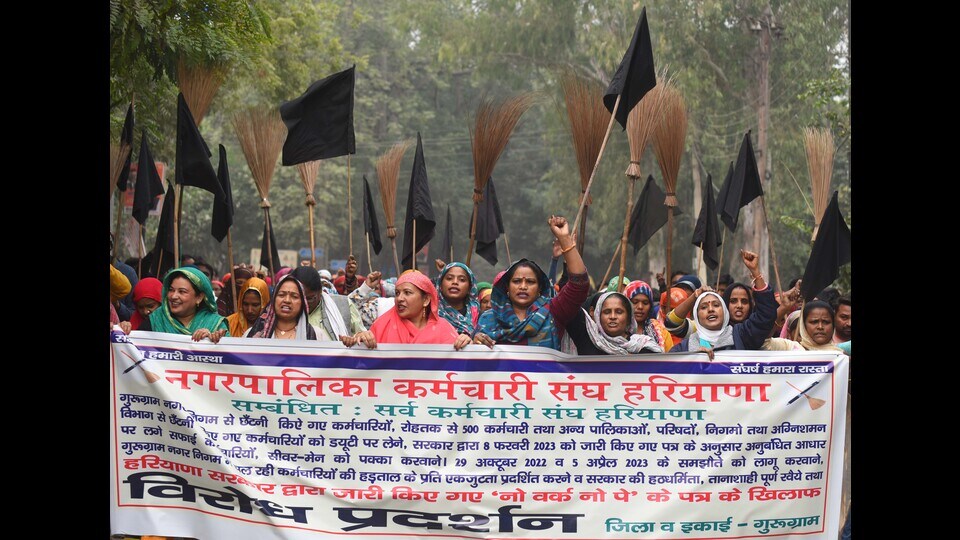
Sanitation workers protest in Gurugram on Friday. (Parveen Kumar)

Officials said that the workers have been on strike for the last 50 days and are not letting private agencies to carry out sanitation work across the city except a few areas.

Gurugram deputy commissioner (DC) Nishant Kumar Yadav said if the sanitation workers did not resume work, they will initiate criminal proceedings against them as sanitation work falls under essential services.

Yadav and MCG commissioner PC Meena held a meeting with striking employees on Thursday. “The protesting sanitation workers have been disrupting essential services. We have received hundreds of complaints from resident welfare associations and we cannot afford to see garbage piling up in the city,” said Yadav.

Meena said that the sanitation workers are creating ruckus and have been involved in several assault and life-threatening complaints. “We have given them enough warnings but to no avail. If they did not resume work till Monday, they will face serious action. We have already terminated around 50 workers, and 400 are in the line of fire,” he said.

Officials said that despite orders from DC to vacate the current protest site at MCG office and shift to a designated place in Sector-37, the workers have refused to comply with them.

Sanitation workers said that until their demands are met, they will not resume work. “We are ready to face action, but we will not resume work. We have held several meetings, but there has been no outcome. We are not scared of these threats anymore,” said a senior leader requesting anonymity.

The Gurugram civic body has been grappling with the sanitation workers’ 50-day strike, which has paralysed the entire sanitation system of the city. Nearly 3,400 workers are protesting to demand an increase in salary, regularisation of staff on pay roll and reinstating services of those who have been laid off.

The sanitation workers said that they are demanding that services of 946 employees should be brought on roll of the MCG, while the remaining 2,534 should be given job under the Haryana Kaushal Rozgar scheme. The union members said that they are also demanding the pending salaries of the workers of last three months, and workers should also be paid money for Provident Fund and ESI pending for the last nine months.

  • Leena Dhankhar
    ABOUT THE AUTHOR
    Leena Dhankhar

    Leena Dhankhar is Senior Editor and Bureau Chief, Gurugram, at Hindustan Times, where she has spent over 17 years chronicling the transformation of one of India's fastest-growing urban regions. From starting her career as a crime reporter to leading the Gurugram bureau, her journalism has been defined by investigative reporting, in-depth storytelling and an unwavering focus on public interest. Over nearly two decades, she has reported extensively across crime, politics, civic governance, elections, real estate, environment, courts, sports, education and entertainment, covering Gurugram, Faridabad, Nuh and Palwal. Her reporting has exposed several major scams and systemic failures, including insurance frauds, waste management irregularities, illegal arms manufacturing units in Nuh, illegal mining in the Aravallis, organised crime networks and governance lapses affecting millions of residents. Known for her investigative work and exclusive stories, Leena has reported on high-impact national issues, including the Nicaragua charter flight carrying Indian migrants that was turned back amid allegations of human trafficking, exposing the growing network of illegal immigration rackets. Her work has also focused on gang wars, prison administration, juvenile crime, women and child protection systems, the functioning of the Juvenile Justice Board and Child Welfare Committee, and environmental challenges such as pollution, waterlogging and deteriorating civic infrastructure. Beyond hard news, Leena has extensively documented Haryana's rich heritage, forests and wildlife, bringing attention to the state's historical landmarks, biodiversity, conservation efforts and ecological challenges through immersive reportage and feature writing. Her journalism has consistently gone beyond breaking news. She has documented Gurugram's rapid urbanisation through long-form narratives and enterprise reporting on issues ranging from pothole-ridden roads, flooding and waste management to the changing social fabric of India's Millennium City. She also writes widely read feature columns, including The Outsider, Changemaker, and Concern for Gurugram, profiling people, places and ideas shaping the city's identity. Leena is the author of Gurugram School Murder, published by Juggernaut Books, a deeply reported account of one of India's most high-profile school murder investigations. She is currently working on her second book, an investigative work exploring some of India's most significant scams and fraud investigations. Beyond print journalism, she has expanded her storytelling through public speaking and digital media. She is a TEDx speaker and has produced podcasts exploring Gurugram's transformation, civic challenges and untold stories. Her work reflects a commitment to narrative journalism that combines rigorous reporting with compelling storytelling. A law graduate with an MBA in Human Resources, Leena brings a multidisciplinary perspective to her reporting, particularly on governance, public policy and legal affairs. She has travelled extensively across India to pursue investigative assignments, often reporting from remote locations and conflict-prone areas in search of stories that matter.Read More