
 E-Paper



With 800,000 traffic challans in 2022, Gurugram’s fine collection doubles to ₹15 crore
Police also said that 135,166 challans were issued in December, of which the most were for driving in the wrong lane, driving without helmets, and speeding

 Prefer HTon Google


At least 800,000 challans were issued for various traffic violations in the city in 2022, a massive spike from 2021 when 253,000 challans were issued, police said on Monday, adding that most violations were life-threatening--driving without helmets, seatbelts and unauthorised parking.
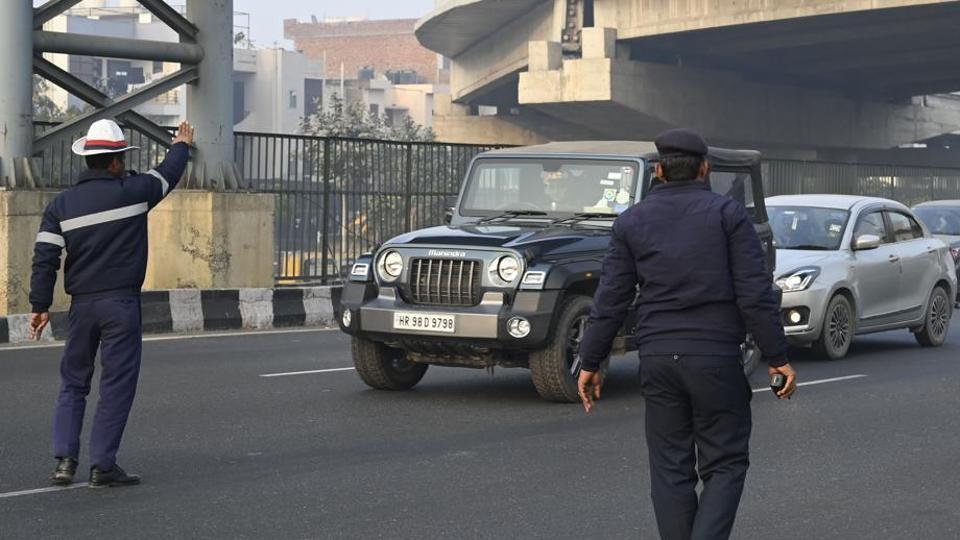
In 2021, police collected ₹7.61 crore in revenue whereas, in 2022, they collected ₹15.73 crore in revenue, police said, adding over the past five months, traffic fine payments have risen sharply after they launched special drives in the latter half of the year. The payment of fines in September, October, November and December was almost double the amount paid between January and August, they added.
Deputy commissioner of police (traffic) Virender Singh Sangwan said riding without a helmet, not fastening a seatbelt, unauthorised parking and driving in the wrong lane comprised the maximum number of violations in 2022. “We conducted at least 10 drives across the city between September and December when the most violations were reported,” Sangwan said, who joined as DCP (traffic) in July in 2022.
Gurugram traffic police in September launched a drive against people driving in the wrong lane and acted against those driving without seatbelts and driving rashly. “Unauthorised parking comprised the most violations. As many as 53,530 challans were issued for this violation as it was the reason behind traffic congestion near markets and malls on MG Road, Golf Course Road, Golf Course Extension Road and Sector markets,” he said.
Meanwhile, traffic police issued 38,339 challans for triple riding, 1,774 for speeding, 843 for drink driving and booked 205 school bus drivers for violating traffic rules and regulations.
Police also said that 135,166 challans were issued in December, of which the most were for driving in the wrong lane, driving without helmets, and speeding. “Riding motorcycles without a helmet, which is the most commonly flouted rule, accounts for 45,546 challans. While wearing a helmet is compulsory for riders and pillion riders, the rule is not followed majorly by young people because, according to violators, it does not feel comfortable and is not their style. Many violators were penalised multiple times,” Sangwan said.
Gurugram traffic police fine a person ₹5,000 for driving rashly and ₹2,000 for speeding. If an offence takes place the third time, the driver’s licence is suspended. On average, around 90 fines are issued for speeding a day, said traffic police.
Traffic police have also imposed a generic speed limit across Gurugram. The speed limit for cars on highways is 90 kilometres per hour (kmph), and 50kmph for two-wheelers and heavy vehicles. On major municipal roads, the speed limit is 50kmph for cars and two-wheelers and 30kmph for heavy vehicles. On state highways, the speed limit is 80kmph for cars and 50kmph for two-wheelers and heavy vehicles.
Police said they also started a campaign in November to penalise motorists who make reels and videos while driving to share them onsocial media websites. “Despite penalising violators, rules are being violated repeatedly at major stretches such as Golf Course Road connecting to Cyber City and Sohna Elevated Road,” said Sangwan.
Police said they managed to decongest stretches that connected major markets after people were penalised. “On the days when special drives are carried out, we issue 600 to 800 challans for unauthorised parking, 200 to 300 challans for driving in the wrong lane and similar violations. However, for the department, traffic management and enforcement go hand in hand,” said Sangwan.
Sarika Panda Bhatt, a road safety expert, director, Nagarro and co-founder, of Raahgiri Foundation, said enforcement is one of the key components in road safety. “Enforcement of traffic safety laws has a positive and measurable impact by reducing dangerous driving behaviours that put road users at risk. But enforcement alone will not solve the safety crisis. We cannot simply enforce, build, design or educate our way out of this problem. The safe system necessitates a comprehensive approach to achieve our collective goal of zero traffic deaths, including equitable enforcement that focuses on risky driver choices that endanger all road users. Gurugram should soon notify speed limits and follow IRC guidelines for speed limits. We can’t keep on building highways inside the city so every road under Gurugram Metropolitan Development Authority should be treated as an urban road and its design and speed improved accordingly,” she said.


