
 E-Paper



13 artists set to pay tribute to Gieve Patel’s enduring spirit through 73 works
A polymath who moved fluidly between the worlds of art, literature and medicine, Patel was more than a creator—he was a quiet force, shaping conversations, mentoring minds and leaving behind an imprint that refuses to fade


MUMBAI: Since Dr Gieve Patel’s passing in November 2023, echoes of his absence have been felt in art studios, poetry readings and theatre halls alike. His absence has left a void in art circles because, as one of his mentees, artist Atul Dodiya said, “Patel’s thought-provoking paintings captured urban life, human vulnerability and existential struggles. While his brushstrokes were once alive with social commentary, his verses reflected mortality and human suffering. His exploration of social issues shaped theatre. His departure has left behind a profound silence.”
A polymath who moved fluidly between the worlds of art, literature and medicine, Patel was more than a creator—he was a quiet force, shaping conversations, mentoring minds and leaving behind an imprint that refuses to fade.
Now, the Jehangir Nicholson Art Foundation (JNAF) has gathered voices from across the artistic spectrum to honour his legacy in ‘A Show of Hands’, a group exhibition that brings together 73 works by 13 artists, including Sudhir Patwardhan, Gulam Mohammed Sheikh, Nilima Sheikh and Atul Dodiya.
Curated by poet, art critic and cultural theorist Ranjit Hoskote, the exhibition unfolds like a dialogue—between brushstrokes and verses, and between old friendships and artistic philosophies. “A Show of Hands is, above all, a celebration of the richness that Gieve Patel brought to those whose lives he touched—as friend, interlocutor and fellow painter,” said Hoskote. Many of the artists participating in the show are Patel’s close friends, while others are younger voices he listened to with keen interest. For Hoskote, this Mumbai phase of an exhibition that he first presented in December 2024 at Delhi’s Vadehra Art Gallery, is “more than a curatorial endeavour”. He called it “a personal offering, a quiet bow to a nearly 40-year friendship that spanned poetry, painting and shared wonder.”
I told him to take the plunge: Sheikh
Gulam Mohammed Sheikh, a towering figure in Indian art for over four decades, shared a deep and enduring bond with Gieve Patel, his contemporary whom he had known since the early 1960s. Reflecting on Patel’s artistic journey, Sheikh remarked, “Gieve came from a glorious Indian tradition where poets and writers were also accomplished painters—a lineage that includes luminaries like Rabindranath Tagore, J Swaminathan, Abanindranath Tagore, M F Husain and S H Raza.” He recalled encouraging Patel to embrace painting fully, saying, “When I was leaving for a tour abroad in 1963, I told him he had to take the plunge and find out if it worked or didn’t. The world of art should be glad he did.”
As a poet, painter and art critic himself, Sheikh found a kindred spirit in Patel. Their shared love for Renaissance paintings and Indian miniatures led to long, passionate discussions. “We could talk about them for hours,” he reminisced. Even as technology changed modes of communication, their friendship remained deeply personal. Patel suggested they exchange letters regularly — sometimes even just a few lines on a postcard about something he had seen. “I have more than 100 such letters from him, which I cherish,” Sheikh said.
While Patel’s paintings often depicted stark, unfiltered portrayals of everyday existence, Sheikh blended traditional and contemporary elements, creating layered narratives that reflected history, identity and memory. “But both us were essentially exploring existential concerns and the vulnerabilities of human existence – Gieve as a poet and playwright, me as an art historian and writer shared a commitment to blending visual and verbal storytelling; you will see that reflected in the work I have put up in the exhibition,” he said.
He had a cine buff’s eye for detail: Dodiya
One of India’s most distinguished artists, Atul Dodiya, who grew up in a middle class Gujarati home in Ghatkopar, first interacted with Patel when he was a second year student at the Sir JJ School of Art in 1980. “I attended an exhibition curated by Gulam Mohammed Sheikh featuring Patel’s works. I was completely blown away by how he articulated his expression,” he recalled.
When Dodiya learned that Patel was also a practicing physician with a clinic on Lamington Road, he decided to visit, waiting for hours till his last patient had left. “I feared he might ask me to leave or brush me off. But he was indulgent to a fault,” remembered Dodiya. “I started visiting regularly and we developed a strong bond. He became my mentor, friend and sounding board as I found my feet.”
Describing Patel as a “walking encyclopaedia on everything under the sun,” Dodiya fondly recalled the cine buff’s eye for detail—even in the most over-the-top Bollywood films. “A huge Waheeda Rehman fan, he could talk about her and her films for hours. He was also deeply moved by Naushad saab’s composition ‘Uran Khatole Pe Ud Jaoon’ from ‘Anmol Ghadi’ (1946) and would often hum the Shamshad Begum-Zohrabai Ambalewali duet fondly.”
Dodiya’s chosen canvas for the exhibition expresses “a deep appreciation for the human condition in art”, a theme that continues to shape his work even today.
He encouraged me to find my own voice: Patwardhan
Patel’s contemporary and practising radiologist Sudhir Patwardhan shared a deep connection with Patel, beyond their backgrounds in medicine. Both artists explored the human figure with profound sensitivity marking its presence in urban and social spaces. Reflecting on Patel’s influence, Patwardhan said, “Apart from Bhupen Khakhar, Gieve was one of the first artists who inspired me and gave me new directions in my journey with art. I was deeply drawn to the respect he had for the human subjects he painted.”
Long before Dodiya’s visits, Patwardhan arrived at Patel’s Lamington Road clinic in 1975 to befriend him, which he followed up with an invitation to his studio in Girgaum’s Gaiwadi. “I can still picture sitting pillion behind him on the Lambretta scooter as we rode to Girgaum,” he recalled.
Their bond formed quickly and remained strong. “Though we both painted figuratively, my work was more politically inclined. But Gieve never tried to steer me in any direction—he encouraged me to find my own voice.” Yet, Patel’s philosophy on art and life stayed with him.
“His work was introspective and poetic, often exploring existential themes, the passage of time, and the quiet dignity of the individual. His figures, though rooted in realism, carried a lyrical quality, emphasising emotional depth over overt social commentary,” he said. “My art was more politically and socially charged, focusing on the urban working class, the struggles of everyday life, and the complex realities of city spaces.”
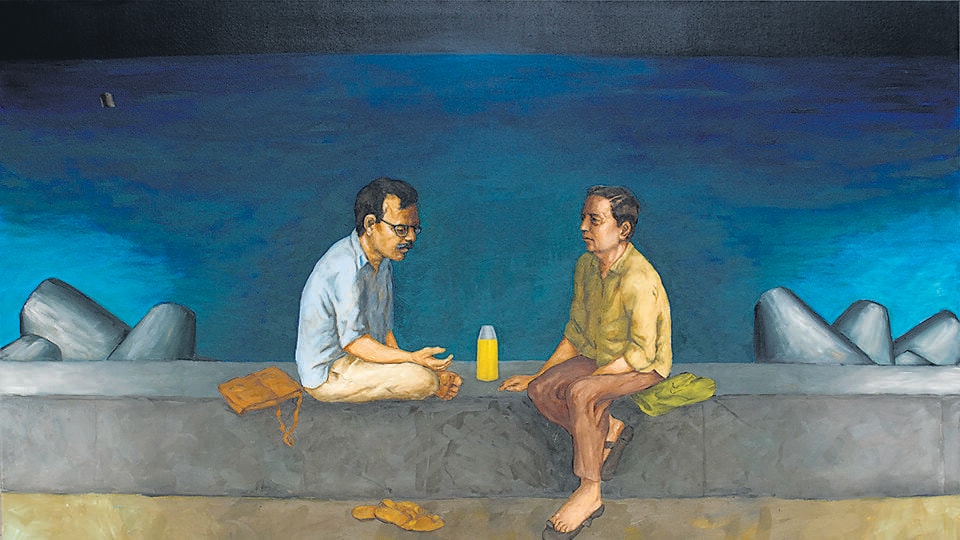
At other times, Patwardhan said, “We could talk about everything -- from the banal to profound -- spending entire evenings at Marine Drive, losing track of time.”
As a tribute to their friendship, Patwardhan created a painting of them on the Marine Drive promenade—which will now be part of this exhibition.
A Show of Hands: In Memoriam: Gieve Patel
Where: JNAF, CSMVS | When: March 20 onwards

Stay updated with all the Breaking News and Latest News from Mumbai. Click here for comprehensive coverage of top Cities including Bengaluru, Delhi, Hyderabad, and more across India along with Stay informed on the latest happenings in World News.


