
 E-Paper



Fadnavis launches infra projects, says NAINA to generate 1.5mn jobs
The proposed NAINA city could generate 1.5 million jobs, including 500,000 high-paying positions, and local residents should get the first right to such opportunities, Fadnavis said

 Prefer HTon Google


PANVEL: Chief minister Devendra Fadnavis, along with deputy chief ministers Eknath Shinde and Sunetra Pawar, on Sunday launched a host of infrastructure projects under the Navi Mumbai International Airport Area (NAINA). He also distributed property documents to eligible landholders and inaugurated airport-connectivity projects worth ₹953 crore, including three bridges and the Uran bypass, with an eye on accelerating development amid long-standing land-allotment disputes.
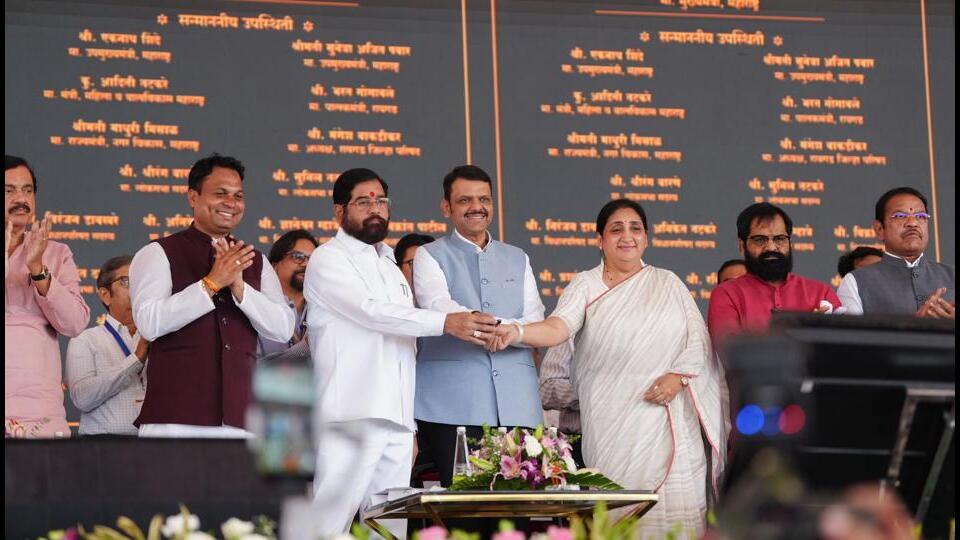
The proposed NAINA city could generate 1.5 million jobs, including 500,000 high-paying positions, and local residents should get the first right to such opportunities, Fadnavis said. The Navi Mumbai International Airport (NMIA) could contribute one percentage point to the regional gross domestic product, he noted, and projected signal-free connectivity between Worli and the airport within six to eight months.
NAINA’s first phase covers 46 villages across 42 square kilometres, with around 200 km of roads, water pipelines, sewage networks and other civic infrastructure planned. Its implementation has been delayed by disputes over final plot allotments, road alignments affecting existing homes and contractual difficulties. The City and Industrial Development Corporation (CIDCO), the project’s planning authority, has held consultations with villagers to address objections and facilitate distribution of property documents.
During his speech at the inauguration programme near Shirdhon in Panvel, Fadnavis acknowledged that allotment errors had eroded farmers’ trust in CIDCO. Some landholders who were promised 40% developed land in return for their land did not know where their plots were, while overlapping allotments and ownership discrepancies added to uncertainty.
“When we reviewed why work had stalled despite tenders being floated, we found that farmers had lost faith in CIDCO. They were promised 40% developed land but did not know where their plots were. In some cases, plots overlapped with those allotted to others,” Fadnavis said.
He said the CIDCO had been given special powers to correct errors in approved town planning schemes, including overlapping plots, incorrect plot numbers and ownership discrepancies. He described its booklet explaining plot allotments, floor space index (FSI), existing houses and adjustments for unviable plots as the “Gita of project-affected people”.
Deputy chief minister Eknath Shinde said farmers must receive appropriate benefits and facilities in return for land taken for development. He said betterment charges had been reduced to zero and a proposal to grant freehold ownership rights was in its final stages.
“Our government does not believe in forcing any project through. After taking people’s land, they must receive the appropriate benefits and facilities,” Shinde said. He also referred to the decision to regularise need-based village constructions.
Deputy chief minister Sunetra Pawar said essential infrastructure must precede urbanisation, referring to 36-metre- and 45-metre-wide roads planned under Town Planning Scheme 11 in Nandgaon.
“The real meaning of development is not merely building large roads, bridges and buildings, but ensuring that its benefits reach ordinary people,” Pawar said.
She said the airport links would improve access for commuters travelling from Pune, Panvel, Thane and Kalyan, while the Uran bypass would ease congestion and make daily travel easier for residents of Uran and surrounding villages, particularly fishermen and local farmers.
CIDCO managing director Ashwin Mudgal said, “The development of NAINA is not just about starting or inaugurating infrastructure works. It is an important step towards connecting future Navi Mumbai and the surrounding region more effectively.”
Mudgal said CIDCO was reviewing existing constructions, road alignments and final plot locations and sizes to address landholders’ concerns. In Nandgaon, changes had been proposed to minimise the impact of planned roads on existing houses, with similar exercises underway in other villages, he noted.
Panvel MLA Prashant Thakur said, “The success of NAINA should be measured by how much prosperity it brings to farmers, not merely by roads, buildings or investment.”
He claimed that Navi Mumbai received 280 litres of water per capita per day, against less than 120 litres in villages under the NAINA and Panvel areas, and called for coordination among authorities to address the disparity. He also said the decision to regularise need-based homes was not being implemented effectively, leaving residents of deteriorating houses struggling to rebuild without facing CIDCO action.
While the state government has formally notified the 323-sq-km Karnala–Sai–Chirner (KSC) New Town under MMRDA as ‘Third Mumbai’, leaders on Sunday linked the vision of the emerging megacity with CIDCO’s NAINA project and the airport-influence belt, highlighting the region’s development potential and assuring local farmers and bhumiputras that their interests would remain a priority.
“Third Mumbai will serve as a new growth engine for Maharashtra,” Fadnavis said. Shinde credited local residents with the project’s development, saying, “This new Third Mumbai is going to develop at a tremendous pace. Keeping in mind the amenities and facilities that will be needed over the next 250 years, CIDCO has incorporated them into the master plan,” he said.

Stay updated with all the Breaking News and Latest News from Mumbai. Click here for comprehensive coverage of top Cities including Bengaluru, Delhi, Hyderabad, and more across India along with Stay informed on the latest happenings in World News.


