
 E-Paper



Shankodhar at Vadhavan: A unique pilgrimage threatened by mega port
As the tide pulled back around 8:30am, it revealed the Shankhodhar Shrine, dedicated to Hindu deity Rama. As per native lore, Rama conducted his father Raja Dashrath’s post death rituals ‘pind daan’ and ‘asthi visarjan’ at this site, on the 27th day after the king’s passing.

 Prefer HTon Google


Mumbai: Every year, around Akshaya Tritiya, people from Dahanu and surrounding villages in Palghar undertake a unique pilgrimage into the sea.
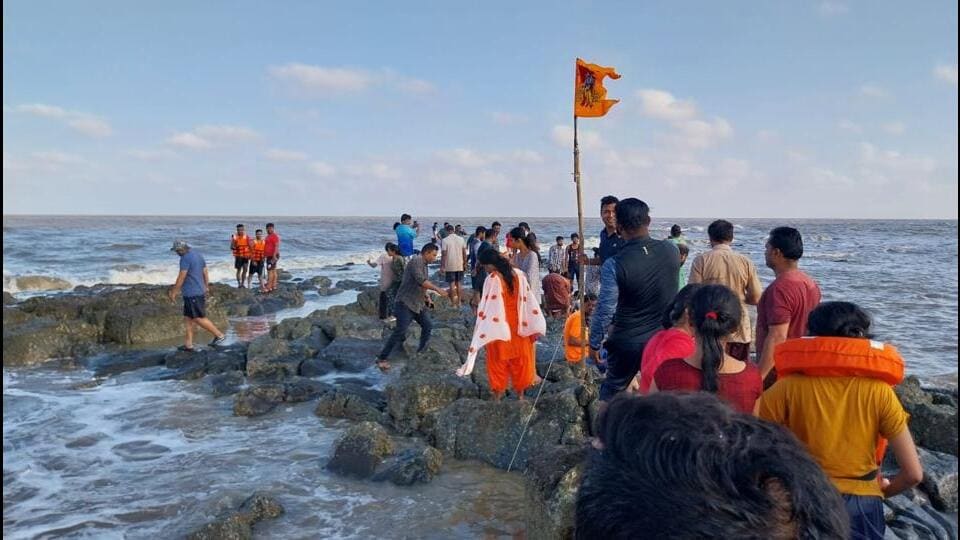
This year, too, at 5:30am on April 22, an estimated 600 pilgrims began a two-hour long journey by boat from Dahanu Creek, navigating a precarious rocky path known only to fishermen. By 7:30am, at least two dozen boats had dropped anchor a few hundred metres away from a rocky outcrop in the sub-tidal region off Vadhavan Beach. Then, they waited patiently for the water to recede.
As the tide pulled back around 8:30am, it revealed the Shankhodhar Shrine, dedicated to Hindu deity Rama. As per native lore, Rama conducted his father Raja Dashrath’s post death rituals ‘pind daan’ and ‘asthi visarjan’ at this site, on the 27th day after the king’s passing.
What makes this shrine unique is that it remains submerged for most days of the year, only revealing itself for durations of about 30 minutes to an hour during extremely low tides, which occur around Akshaya Tritiya. As soon as the shrine emerged on the morning of April 22, shouts of ‘Jai Sri Ram’ rang out as pilgrims waded across to the site, hoisted a saffron flag, and proceeded to perform a pooja.
This year, the pilgrimage took on a political overtone. Alongside chants honouring the deity, pilgrims also raised a singular slogan against the proposed Vadhavan Port: “Ekkach zidd! Vadhavan bunder radd kara!”
Shankodhar is located within the port’s limits, and there are concerns that the project — which will involve reclaiming 1,473 hectares of land from the Arabian Sea — may cause the shrine to become permanently submerged, putting an end to this annual pilgrimage.
Hemendra Kothari, a resident of nearby Barapokharan village, who made his first ever trip to Shankodhar this year, said, “The number of devotees is more than usual this time because people are worried that the port will wipe out the shrine. Even I have come here because of that. Most people I know have made the trip four to five times in their life. I had not seen this place even once, and I wanted to offer prayers here before the chance is gone.”
Incidentally, Shankodhar’s rocks are teeming with an unidentified marine organism that locals revere as the body of Rama himself. “It is believed that after conducting Raja Dasrath’s asthi visarjan, Lord Rama cut off a lock of his hair and left it behind in the ocean. His hair now lives on the rocks of Shankodhar,” said Bhuleshwar Tamore, a fisherman from Dahanu, who every year ferries eager pilgrims to the site.
“These organisms could be some sort of endemic polycheate tubes, algae, or bryozoans. We have yet to describe them taxonomically, but they hold immense cultural importance for the people of Dahanu. Every year, hundreds make the pilgrimage just to touch Rama’s hair. To reach the site requires an intimate knowledge of the tides,” explained Bhushan Bhoir, a marine zoologist from Palghar, who added that the site is immensely biodiverse.
Bhoir continued, the larger inter-tidal habitat around Vadhavan’s headland is considered sacred, not just the shrine itself. During unusually low-tides, people also gather to offer prayers and perform ‘asthi visarjan’ at Vadhavan Beach, where several name plates are engraved in the inter-tidal granite rocks.
“The word ‘Shankodhar’ is derived from ‘shankh’ meaning conch, and ‘udar’, meaning “womb”. It is believed that this region once abounded with ‘living conches’. Scientifically speaking, this refers to a kind of marine snail, whose shell (or shankh) is an artefact of ritual importance in Hinduism. Except fishing activities, no other exploitation of natural resources is allowed by locals,” Bhoir said, adding, “So, you can understand why the locals are so opposed to the port.”
To be sure, the draft environment impact assessment (EIA) for Vadhavan Port, prepared by the Jawaharlal Nehru Port Authority (JNPA) and Maharashtra Maritime Board (MMB) has proposed to preserve this shrine, which lies about a kilometre east of the reclamation zone. It also prohibits any dredging activity around Shankodhar, in addition to mitigating measures like use of silt-screens, to prevent the deposition of harmful sediments from construction.
A senior JNPA official said to HT while seeking anonymity, “Fears of the shrine being impacted are completely unfounded. The Central Water and Power Research Station (CWPRS), Pune, has conducted hydrodynamic studies and ruled out any impact. We will actively partner with the community to preserve Shankodhar in perpetuity. No dredging will be done near the shrine.”
Experts were quick to rubbish this claim. “The EIA report is not worth the paper it is written on. Simply because it nowhere accounts for impacts of climate change, sea level rise and increase in frequency and intensity of extreme climatic events. All the technical studies to assess the port’s environmental impact are based on 2D models, whereas the ocean is a highly dynamic 3D environment,” said Debi Goenka, executive trustee, Conservation Action Trust, who has been closely tracking this project.
“Shankodhar can potentially be affected by both tidal movements and siltation, which would kill off the biodiversity.”


