
 E-Paper



Tree activists file police complaint after 300-year-old tree axed at Santacruz
Angry members of The National Society of the Friends of the Trees filed a police complaint against MMRDA and BMC at the Santacruz police station


MUMBAI: Following the ruthless axing of a 300-year-old baobab tree for Metro-2B work on April 27 in Santacruz, tree enthusiasts organised a peaceful protest outside Muktanand Park on Sunday, only to have their plans disrupted.
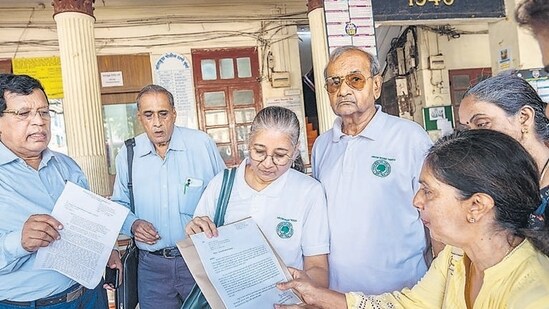
Angry members of The National Society of the Friends of the Trees (NS-FOT) opted to file a police complaint against MMRDA and BMC at the Santacruz police station, accusing them of violating environmental protection provisions.
Meanwhile, enthusiasts of baobabs explored St John the Baptist Church in the SEEPZ industrial area, which opens only once a year to the public and is renowned for hosting 13 baobab trees aged over 300 years. Another baobab thrives within the Tata Institute of Fundamental Research (TIFR) compound, two at Byculla Zoo, and the oldest, over 1,000 years old, stands within the Bhabha Atomic Research Colony (BARC). Tree enthusiasts are fervently advocating the conservation of these botanical treasures.
NS-FOT had been pleading with the authorities for years to safeguard the 300-year-old baobab tree in Santacruz. “Despite assurances that it would be protected, we were dismayed to discover that on April 27 midnight, it was ruthlessly cut down for Metro2b work and all evidence of its existence erased,” said Sakina Gadiwala, general secretary, NS-FOT. Added Dr Arun Sawant, president, NS-FOT, “We filed a complaint at the police station. This is a criminal act and an abuse of power.”
Sawant mentioned the case of a similar baobab tree when Pedder Road underwent expansion. Dr Homi Bhabha, a Nature lover spearheaded the effort with FOT, leading to the successful transplantation of the tree in the TIFR complex at Colaba. Subsequently, four additional baobab trees were propagated from it. “Today, it stands proud and has the best avenue of trees in Mumbai,” said Sawant. “We could have helped save the one in Santacruz too.”
Sawant also mentioned a baobab tree in the BARC compound at Chembur, which is reputed to be the oldest in Mumbai, surpassing 1,000 years in age. (The oldest baobab tree in India, documented in Tamil Nadu, is estimated to be 3,000 years old). Sawant explained that tree age was verified through annual ring formation and compression. “We also compare them with similar trees in other parts of the world where records are available,” he said.
In the meantime, tree enthusiasts explored St John the Baptist Church in Andheri East, located in the SEEPZ area, on Sunday. This historic church, dating back 440 years, is home to 13 baobab trees, which are only accessible to the public once a year. The baobab trees, with heights reaching up to 98 feet, were brought to our shores by the Portuguese from Madagascar. Andheri alone boasts 13 of these remarkable trees while botanists claim there are around 200 more scattered from Navy Nagar to Vasai Fort.
Advocate Godfrey Pimenta who visited the church premises on Sunday said that he cherished his childhood memories of the area surrounding the now-abandoned church. In the 1970s, the landscape within the SEEPZ Complex was abundant with thousands of cashew, mango and baobab trees with the occasional mahua,” he said. “My friends and I frequently ventured there to gather cashews and mangoes. Devool Talao, now named Devool Lake, was a tranquil spot where local women washed clothes while men fished. Occasionally, film crews would shoot scenes amidst the church ruins. The baobab tree fruits, when dried, have a powdery texture and tart flavour.”
In the 1970s, the Maharashtra Industrial Development Corporation (MIDC) acquired land from the local East Indian communities in Kondivita, Marol and Mulgaon to establish an industrial estate. This initiative gave rise to the Santacruz Electronic Export Processing Zone (SEEPZ), managed by the ministry of industry and commerce, Government of India.
The entire SEEPZ complex is designated as a Customs-bounded area, requiring special permission for entry, even for religious ceremonies. Local Catholics have been advocating for the church and its surroundings to be exempt from these restrictions, allowing unrestricted access throughout the year.
Sachin Pereira, a passionate tree lover and a member of the parish council at St John the Evangelist Church in Marol, mentioned that St John the Baptist Church in SEEPZ was shut down in the eighteenth century due to a plague outbreak and subsequently relocated to Marol.
“My ancestors are from that church and I belong there,” he said. As regards the trees he said: “People have put in efforts to transport them from other countries. They need to be preserved and not axed.”

Stay updated with all the Breaking News and Latest News from Mumbai. Click here for comprehensive coverage of top Cities including Bengaluru, Delhi, Hyderabad, and more across India along with Stay informed on the latest happenings in World News.


