
 E-Paper



Ghaziabad saw improved AQI, PM2.5 levels in 2022, says pollution control board
According to the UPPCB, Ghaziabad city recorded an annual average AQI of 256 in 2017, 250 in 2018, 238 in 2019, 204 in 2020, 227 in 2021 and 206 in 2022


The air quality in Ghaziabad city in 2022 was among the best in recent years, data kept by the Uttar Pradesh Pollution Control Board (UPPCB) has shown. The year recorded an annual average air quality index (AQI) of 206, which is just two points more than the all-time lowest annual average AQI of 204, recorded in the lockdown year of 2020, the data showed. Also, the city saw just two “severe” air days in 2022 -- when the AQI crossed 400 -- which is the lowest number of such days since 2017.
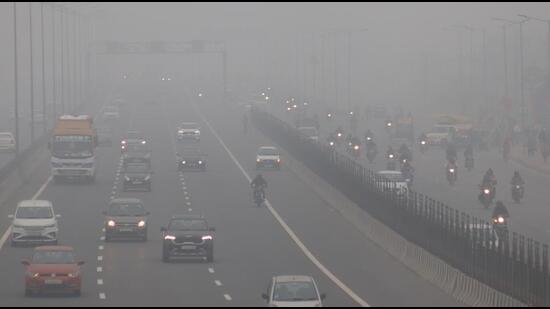
According to the UPPCB, Ghaziabad city recorded an annual average AQI of 256 in 2017, 250 in 2018, 238 in 2019, 204 in 2020, 227 in 2021 and 206 in 2022.
With the lowering of the annual average AQI, the average PM10 and PM2.5 (fine inhalable particulate matter) levels have also reduced.
The UPPCB figures indicate that the annual average PM2.5 level in 2022 was 93 micrograms per cubic metre (μg/m3), which is the lowest since 2017 and even better than the reading of 109 in the lockdown year of 2020. The PM2.5 level stood at 151 in 2017, 135 in 2018, 125 in 2019, 109 in 2020 and 116 and 2021, the data showed.
The national safe limit for PM2.5 is 60μg/m3.
“The figures outline a decline in pollution levels. This , we believe, is due to the completion of big infrastructure projects such as the Delhi-Meerut Expressway and the Eastern Peripheral Expressway, among others. The industrial emissions have also reduced due to a ban on pet coke and furnace oil and other types of non-compliant fuels,” said Utsav Sharma, regional officer of UPPCB.
However, the annual average PM.10 level in 2022 was only the second best since 2017, with a reading of the 221, the UPPCB said. Sharma said this reading too would go down once bad roads in industrial areas are repaired. The PM10 levels are still high and we expect the roads in 12 industrial areas in the city to get revamped at the earliest,” he said.
“We still have construction of the Regional Rapid Transit System ongoing and a majority of that work in Ghaziabad is likely to get over in 2023. So, a further decline in PM10 level is likely and better air conditions may prevail in the coming months,” Sharma added.
The annual average PM10 figures stood at 360 in 2017, 294 in 2018, 249 in 2019, 202 in 2020, 243 in 2021 and 221 in 2022.
The national safe limit for PM10 is 100μg/m3.
Ghaziabad is among the 16 “non-attainment” cities in the state of Uttar Pradesh and its pollution levels generally remain on the higher side during the onset of winter. Cities are declared “non-attainment” if they do not meet the National Ambient Air Quality Standards for particulate matter (PM10) or nitrogen dioxide (NO2) over a period of five years.
The city was ranked the second-most polluted city in the world after Bhiwadi in Rajasthan, on the World Air Quality Report in 2021. The annual report, prepared by Switzerland-based organisation IQAir, surveyed 6,475 cities across the world.
Environmentalists said better curbs on pollution are still needed in the city.
“The ground level enforcement needs to be much more stricter and the city also needs more online air quality monitoring systems -- there are just four operational currently. These four stations are not correct indicators of improved AQI. Road dust is still a major factor and broken roads and lack of greenery contribute to the dust. Industrial activities are on rise and there needs to be a control/cap on the number of such units,” said Sushil Raghav, a city-based environmentalist.
“In 2022, the pollution control board did not allow the operation of brick kins and that helped improve the conditions. They must ensure that industrial units get proper PNG supply so that cleaner fuel is widely used. Over the past several years, the ban on petrol vehicles (more than 15 years old) and diesel vehicles (more than 10 years old) has also impacted the overall scenario in NCR,” said Vikrant Sharma, another city-based environmentalist and lawyer.
The UPPCB figures also show that the city in 2022 had only two “severe” air days -- when the AQI crossed a reading of 400 -- as against 22 in 2021, 24 in 2020, 31 in 2019, 50 in 2018 and 47 in 2017.
An AQI between zero and 50 is considered “good”, 51 and 100 “satisfactory”, 101 and 200 “moderate”, 201 and 300 “poor”, 301 and 400 “very poor”, and 401 and 500 “severe.”

Stay updated with all the Breaking News and Latest News from Mumbai. Click here for comprehensive coverage of top Cities including Bengaluru, Delhi, Hyderabad, and more across India along with Stay informed on the latest happenings in World News.


