
 E-Paper



MNNIT’s 22nd convocation: India to launch space station by 2035, moon mission by 2040, says ISRO chief
ISRO chief highlighted that ISRO is developing the Next Generation Launch Vehicle (NGLV), designed to be 1,000 times more powerful than the SLV-3 and three times more powerful than the LVM-3, India’s current heavy-lift launch vehicle.

 Prefer HTon Google


India is set to achieve major milestones in space exploration over the coming years, with its own space station expected to be operational by 2035 and a fully indigenous Moon mission planned by 2040, Indian Space Research Organisation (ISRO) chairman and secretary of the department of space, V Narayanan announced on Saturday evening.
Speaking at the 22nd convocation ceremony of Motilal Nehru National Institute of Technology (MNNIT), Allahabad, ISRO chairman V Narayanan said that India is poised to reach new heights in space science in the coming years with the Chandrayaan-4 mission already approved and set to serve as a sample-return mission. He added that India’s own space station will become operational by 2035, with the first phase scheduled to begin in 2027.
“By 2040, Indian astronauts will land on the Moon using entirely indigenous technology and return safely,” he stated, emphasising India’s advancing self-reliance in space science. He also announced plans for the Venus Orbiter Mission, aimed at studying the planet in greater detail.
Narayanan highlighted that ISRO is developing the Next Generation Launch Vehicle (NGLV), designed to be 1,000 times more powerful than the SLV-3 and three times more powerful than the LVM-3, India’s current heavy-lift launch vehicle.
“These ambitious projects will greatly strengthen India’s space capabilities,” he remarked.
‘Education comes with responsibility’
The ISRO chief reminded students that education is not just about earning a degree, but also about the responsibility to give back to society.
“Your success is the result of support from your parents, teachers, taxpayers, and fellow citizens. Now is the time to serve the nation with your knowledge and skills,” he urged.
He shared nine guiding principles for a successful life, including lifelong learning, joyful hard work, character building, dreaming big, clear goal-setting, imagination, self-confidence, and leadership development.
Guest of honour’s advice
Prof Anil Sahasrabudhe, Chairman of the Executive Committee of the National Assessment and Accreditation Council (NAAC) and the National Board of Accreditation (NBA), addressed the convocation as the guest of honour. He emphasised that the journey of learning continues throughout life and advised students to adopt a professional attitude and remain dedicated to their work.
MNNIT director Prof RS Verma shared the institute’s progress over the past year. He reported that 83.29% of undergraduate and 81.79% of postgraduate students secured placements.
During the 2024–25 fiscal year, the institute received approval for 19 new research projects worth ₹5.31 crore. Additionally, 19 patents were granted, and 7 new patents filed. MNNIT also generated ₹6.58 crore in revenue through 303 testing and consultancy projects.
Alumni also played a vital role in the institute’s development. A scholarship fund of ₹5.83 lakh was established for Economically Weaker Section (EWS) students, while the 1998 batch contributed ₹1.81 crore towards constructing the new Student Activity Centre (SAC-98).
Vivek Lall, Chairperson of MNNIT’s Board of Governors, presided over the convocation virtually.
Degrees and awards
A total of 1,569 degrees were awarded during the convocation, including 1,032 BTech, 267 MTech, 114 MCA, 62 MBA, 23 MSc, and 71 PhD degrees. Around 350 female students were among those receiving degrees. Additionally, 51 foreign students admitted through Direct Admission of Students Abroad (DASA), including 22 males and 9 females, also received their degrees during the ceremony.
Meritorious students were awarded gold medals at the event. A total of 21 gold medals were presented to postgraduate students and 12 to undergraduate students. Furthermore, 13 sponsored gold medals, established by faculty, alumni, and industry, were also conferred upon students for their outstanding performance.
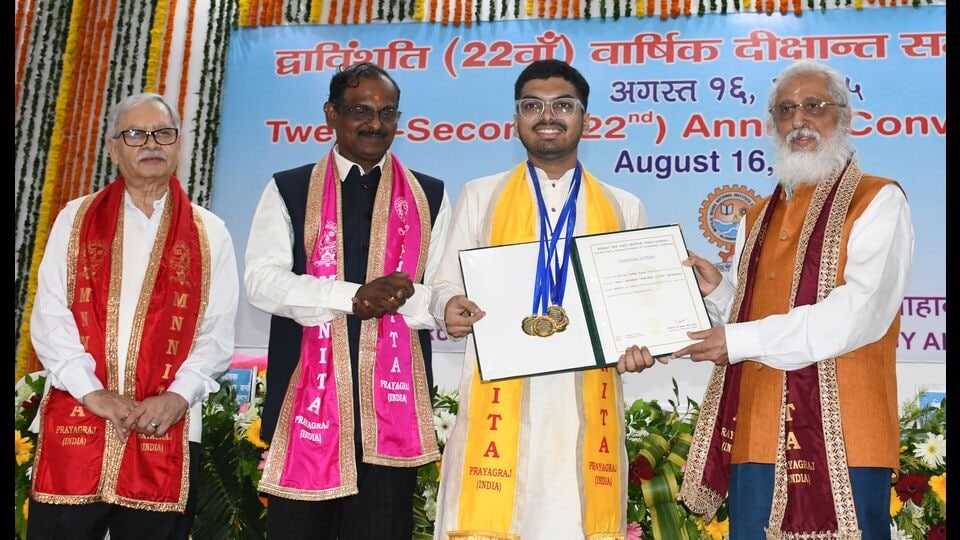
Vaibhav Kansal of BTech (Computer Science and Engineering) received the overall Institute Gold Medal as the best student among all the BTech final-year students of the 2025 batch.
In the Year-wise Gold Medal Category, Nishant Agarwal of BTech (Electronics and Communication Engineering) for the third year, Siddhant Prajapati of BTech (Civil Engineering) for the second year, and Avneesh Kumar Mishra of BTech (Electrical Engineering) for the first year were awarded gold medals.


