
 E-Paper



Mumbai police staff crunch intensifies as officers move out of the city
The police today are short of a humongous 13,661 personnel, a manpower shortage that has slowed down investigations, created a huge backlog of applications to be converted into FIRs and reduced the number of policemen on patrolling duty among other things

 Prefer HTon Google


MUMBAI: Complaints not being attended to, FIRs not being registered and a general lack of cooperation at the city’s police stations are long-standing grievances of Mumbaikars. But here’s the other side of the story: the Mumbai police, with an abysmal sanctioned citizen-to-cop ratio to begin with, are deficient even on this count.
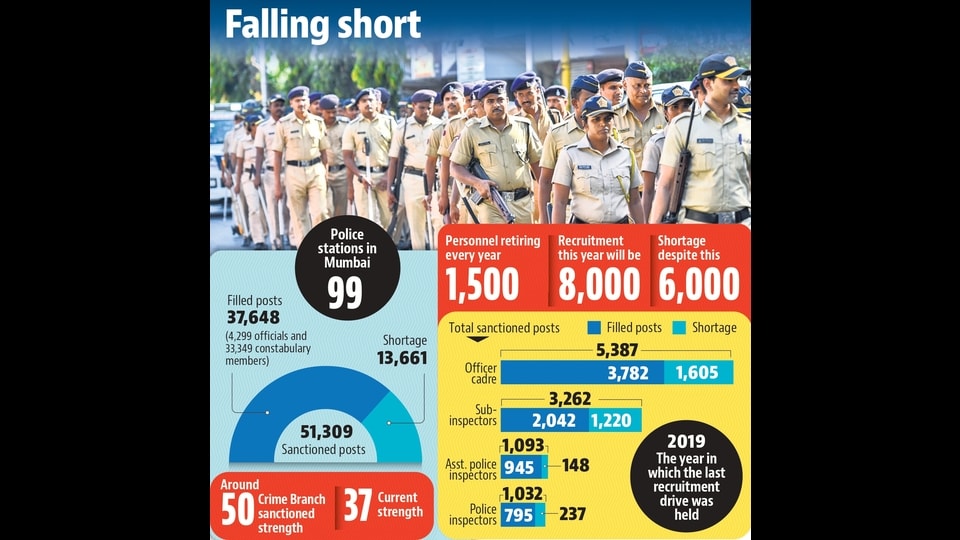
The police today are short of a humongous 13,661 personnel, a manpower shortage that has slowed down investigations, created a huge backlog of applications to be converted into FIRs and reduced the number of policemen on patrolling duty among other things. Two major reasons for this deficit are no recruitment since 2019—although a recruitment process has been initiated earlier this year—and several officers opting for postings outside Mumbai in pursuit of a work-life balance.
The Shortage
The total number of sanctioned posts for the city’s 99 police stations is 51,309. Of these, 37,648 posts are filled, 4,299 of them being officials and 33,349 constabulary members—leaving over 1,600 officer posts and 12,030 constabulary posts vacant.
For officer posts, the recruitment through the Maharashtra Public Service Commission has been slow while the takers for constabulary posts have reduced over time. “The last recruitment drive was in 2019. Every year, 1,500 personnel retire in the city,” said S Jaykumar, joint commissioner of police, (administration). This year, he added, the department will recruit 8,000 people.
Going by Jaykumar’s statement, at least 4,500 policemen have retired in the years since the last recruitment drive, and an additional 1,500 will retire this year. This would mean that even after the fresh round of recruitment, the Mumbai police force will still be short of 6,000 personnel.
The recruitment process itself is a long one. While written exams for constabulary candidates were conducted in May, the entire process, including physical examinations and academic training, for one batch of police personnel takes almost a year to be completed.
The most glaring shortfall is in the officer cadre, which is considered the backbone of the force—sub-inspectors, assistant inspectors, inspectors and senior inspectors. For instance, while the total sanctioned strength of sub-inspectors is 3,262, the actual number of sub-inspectors is 2,042, leaving more than one-third of the posts vacant.
Shortage affects routine work
The city is divided into 13 administrative divisions, with each having at least six police stations under it (except the port zone, which has three). The stations are headed by senior inspectors, with the number of people manning the other posts depending on the population of the area. One senior inspector acknowledged that with the severe staff crunch, the police had to prioritise work based on emergencies and their order of importance. His sanctioned staff consists of over 250 personnel.
“If any inspector goes on sick leave or long leave, I don’t have a replacement, and therefore the investigations assigned to them get delayed,” he said. “Usually, we need to file chargesheets within the stipulated period of 60 to 90 days, which then becomes difficult.”
Another senior inspector said he was used to working around the available number of staff. “Personally speaking, I just assign less staffers for each duty,” he said. “If five policemen are required on wireless duty, I assign two and instead of two patrolling marshals, I send one. In some cases, we utilise one person for two jobs that can be done from the police station, like, say, passport verification and the property registry. The orderly is also entrusted with multiple responsibilities as the need arises.”
Bandobast Woes
Another problem that slows down routine policing is extensive bandobast duty. Every few weeks, almost the entire force is on the streets during festivals, political rallies or protest marches. This impacts everyone but officials from the detection team suffer the most. “We have to stop pursuing leads and delay tracking accused who may have been located,” said a frustrated detection officer. “Often, that gives criminals enough time to escape our tracking.”
When most officers are out on bandobast duty, complainants who come to the police station are told to leave a written complaint. “Usually, these applications take less than a week to be converted into FIRs,” said an officer. During the festival season, which lasts the entire second half of the year, it could take a couple of months. But with the general elections slated for 2024, this will perhaps be the situation for the entire next year.”
Crime Branch Situation
A senior official, currently in the crime branch, said that the sanctioned strength of his unit was around 50 but it was being run by 37 personnel. “The existing staff also takes a variety of leaves as needed,” he said. “At any given time, the unit only has 50 percent of the sanctioned staff. Among them, three constables are assigned court duties in the different courts.”
The officer said that the branch needed clerical staff for the paperwork, thus freeing up the rest for investigations. “Once you interrogate an accused, you need to collect evidence from multiple places based on their confession,” he said. “Depending on the case, our staff needs to visit the crime scene, conduct a panchnama and gather evidence from the concerned department. What we also need is officers who can develop a local intelligence network and keep an eye on the notorious criminals of the locality.”
Work-Life Balance
The staff crunch forces policemen to do 12-hour workdays on an almost daily basis. During times of bandobast or vital investigations, many cops don’t go home for days—this, despite the state government declaring an eight-hour workday for policewomen and elderly members of the constabulary. No surprise, therefore, that the trend among inspector-cadre officers is to ask for postings outside Mumbai.
During his short stint as police commissioner, Sanjay Pande famously sanctioned more than 1,500 such applications. One of these officers, transferred to a Tier 2 city two years ago, said that not only had his relationship with his children undergone a transformation, he had also begun learning the tabla and guitar. “One of my batchmates, who moved to his hometown, started trekking and even went to the Everest base camp last year,” he said. Others have enrolled in law college and stock market courses to build on their skills.
Another officer said he had missed out on his 17-year-old daughter’s growing years but had been a more present father for his 14-year-old son over the last three years. “I can avail of more leave,” he said. “More importantly, I can actually dedicate more time to crime detection. This has improved my detection rate and pace.”
Work Culture Shock
Officers moving out are replaced by others from Tier 2 cities. “Working here is so different that it takes them time to understand the job requirements,” said the officer. “They are often the ones indulging in moral and social policing, especially when it comes to women complainants, until they understand the ethos of Mumbai.”
Another officer, many of whose team members had moved out, said that in other cities, documentation—which includes writing FIRs, taking complainants’ statements and subsequent court records—was taken care of by the constabulary. “Here, however, the documentation is also done by officers, which eats into their policing time,” he said.
2024: A Litmus Test
While the Mumbai police bosses are hoping to conclude the ongoing recruitment process at the soonest, 2024 will be a litmus test of their human resource management. Even as they provide better housing options, sponsor police kids’ education through welfare funds and give policemen more leave, the possibility of over-12-hour workdays for almost the whole of 2024 is a distinct possibility. Even if they hire new recruits and retain retirees for an extra year, a shortage of 5,000 personnel at this time will make for an unmanageable situation.


