
 E-Paper


Pune Metro Line 3 to be operational from November 4
Pune’s long-awaited Metro Line 3, connecting Maan and the Hinjewadi IT Park with Shivajinagar, will be inaugurated by Prime Minister Narendra Modi on November 3

 Prefer HTon Google


Pune’s long-awaited Metro Line 3, connecting Maan and the Hinjewadi IT Park with Shivajinagar, will be inaugurated by Prime Minister Narendra Modi on November 3. Passenger services on the 23.2-km elevated corridor, also known as the ‘Puneri Metro’ or Pink Line, will commence at 6 am on November 4.
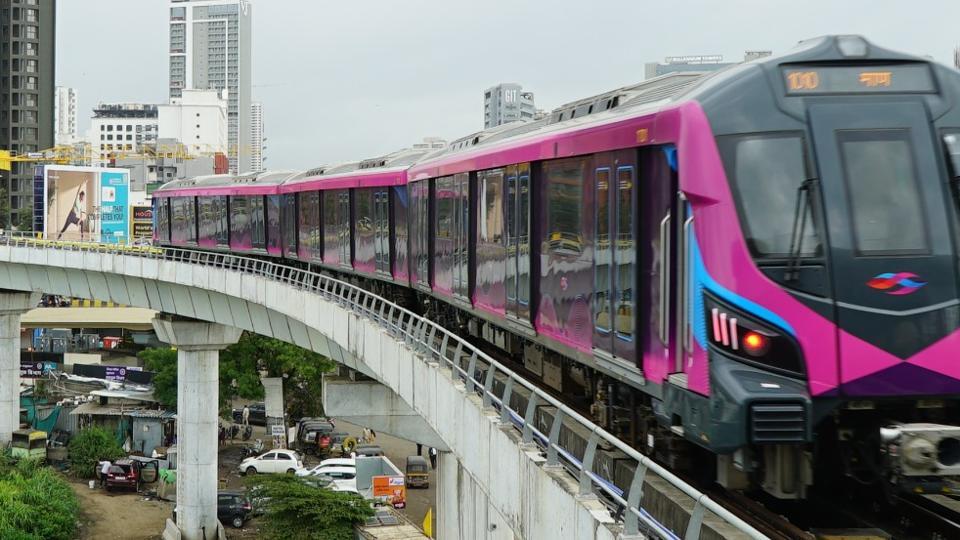
Chief minister Devendra Fadnavis and deputy chief ministers Eknath Shinde and Sunetra Ajit Pawar are expected to attend the inauguration ceremony. The event will be held at 10.30 am at the badminton hall of the Shri Shiv Chhatrapati Sports Complex in Mahalunge-Balewadi.
The announcement was made at a press conference held at the Pune Metropolitan Region Development Authority (PMRDA) headquarters in Akurdi on Saturday. PMRDA commissioner Abhijit Chaudhary, additional metropolitan commissioner K Manjulakshmi, Pune IT City Metro Rail Limited (PITCMRL) CEO Anilkumar Saini and PMRDA chief engineer (special projects) Rinaz Pathan were present.
Chaudhary said, “The 23.203-km elevated corridor would connect Maan with the Rajiv Gandhi Infotech Park in Hinjewadi and key administrative and commercial areas of Pune, including Shivajinagar.”
The project has an estimated cost of ₹ 8,313 crore, including land acquisition and the relocation of utilities and services.
First-of-its-kind PPP metro project
Implemented under the public-private partnership (PPP) model through the design, build, finance, operate and transfer (DBFOT) framework, the project is the first metro project in the country to be developed under this model in accordance with the National Metro Rail Policy, 2017.
The project is being implemented by Pune IT City Metro Rail Limited (PITCMRL), a special purpose vehicle established through the joint participation of TRIL Urban Transport Private Limited and Siemens Project Ventures GmbH, under a concession agreement with PMRDA.
17 of 23 stations to open initially
Of the total 23 stations on the corridor, 17 will be opened for passengers initially. At seven stations, only one staircase will be available, while the remaining ten stations will have both staircases operational.
The ten stations where both staircases will be operational are Hinjewadi Phase 2 Circle 2, Shri Chhatrapati Shivaji Maharaj Chowk in Hinjewadi, Hinjewadi Phase 1, Wakad Chowk, Shri Shiv Chhatrapati Sports Complex in Mahalunge, MITCON in Balewadi, RK Laxman Museum in Balewadi, Aundh, Sakalnagar and Savitribai Phule Pune University.
Work on stations 13 and 14 is in its final stage and is expected to be completed by the end of November 2026. The remaining four stations — 15, 16, 20 and 22 — along with their staircases, will be completed in phases by January 2027.
PMC develops parking facilities near metro stations
To encourage commuters to use the metro and reduce road congestion, the Pune Municipal Corporation (PMC) has developed parking facilities near select stations. A parking facility spread across approximately 30,000 square feet has been developed near Station PMR-11 in Balewadi, in the Amar Tech Park area.
Another parking facility covering around 21,000 square feet has been developed near Station PMR-14 in Baner, in the ABZ area.
Metro services every six minutes during peak hours
Anilkumar Saini, PITCMRL CEO , said, “The last train from Maan towards the District Court will depart at 10.30 pm, while the last service from the District Court towards Maan will leave at 11.40 pm.”
Trains will operate at six-minute intervals during peak hours, and every 12 minutes during non-peak hours, he said.
At the District Court Metro station in Shivajinagar, Line 3 will connect with MahaMetro’s Line 1 (Pimpri-Chinchwad to Swargate) and Line 2 (Vanaz to Ramwadi), enabling passengers to interchange between the three corridors.
A common mobile application has been developed to facilitate ticketing and travel across the existing MahaMetro network and the new Line 3 corridor.
Better last-mile connectivity and parking facilities
To improve last-mile connectivity, PMRDA is developing an integrated transport network around the metro stations.
Passengers will have access to PMPML buses, auto-rickshaws, app-based taxi services such as Ola and Uber, and e-bikes. Dedicated pick-up and drop-off zones are being developed outside stations.
Parking facilities for two-wheelers and four-wheelers are also being provided near selected stations.
The project includes dedicated cycle tracks, wider footpaths, pedestrian crossings and foot overbridges to improve safety and accessibility for pedestrians and cyclists.
These measures are expected to ease traffic congestion, particularly in the Hinjewadi IT Park area, and along the Aundh, Baner, Balewadi, Mahalunge, Ganeshkhind Road and Shivajinagar stretches.
Safety clearance, security arrangements complete
The entire corridor has undergone inspection by the Research Designs and Standards Organisation (RDSO).
The first 12.60-km section, from Man (PMR-1) to RK Laxman Museum in Balewadi (PMR-12), received final safety clearance from the Commissioner of Metro Railway Safety (CMRS) on July 23. The remaining section covering five stations received safety approval on September 23. Around 350 security personnel from the Maharashtra State Security Corporation (MSSC) have been deployed to ensure passenger safety at the stations.
Modern passenger information systems and ticketing facilities have also been developed to help commuters plan their journeys and navigate the stations.
30% of power requirements to be met through solar energy
The project has an installed solar power generation capacity of 7.60 MW, comprising 6.10 MW at metro stations and 1.50 MW at the car depot.
The solar installations are expected to meet around 30% of the project’s total electricity requirements.
Chaudhary said, “The corridor is expected to benefit around two to 2.5 lakh commuters daily and help reduce traffic congestion across several major parts of Pune.”
Around 100 women to operate trains
The new corridor will also have significant participation by women in its operations.
Around 100 women train pilots will operate the metro services. Women are also expected to account for approximately 50% of the station workforce, including station controllers, ticketing staff and station attendants.
Chaudhary said, “The initiative reflected the project’s commitment to women’s empowerment, gender equality and greater participation of women in the modern transport sector.”
Project incorporates green measures
PMRDA chief engineer Rinaz Pathan said the project had adopted several measures to reduce its environmental impact.
The use of Ground Granulated Blast Furnace Slag (GGBS) during construction has helped avoid approximately 28,000 tonnes of carbon dioxide emissions. The project has also saved around 2,000 tonnes of steel and 60 crore litres of water.
A total of 5,500 new trees have been planted to compensate for trees affected by the project. In addition, 750 trees have been successfully transplanted, with an 80% survival rate.
The project has also incorporated a double-decker integrated flyover at University Chowk on Ganeshkhind Road.
.


